
Key Words: Silicon Wafer Dicing PCB Depaneling Glass Cutting
Home > News > Industry News
【Description】:
How Fibre Laser Technology Enables Complex, High‑Precision Cutting of Neodymium Magnets for Modern Industrial Applications
NdFeB (Neodymium‑Iron‑Boron) permanent magnets—often referred to as "magnetic steel" or simply "permanent magnets"—are among the most powerful magnetic materials available today. They are indispensable in a wide range of modern applications:
| Industry | Typical Applications |
|---|---|
| Electric vehicles (EVs) | Traction motors, drive motors, sensors |
| Renewable energy | Wind turbine generators, hydroelectric systems |
| Consumer electronics | Smartphone speakers, vibration motors, hard disk drives |
| Medical devices | MRI machines, magnetic therapy equipment, surgical instruments |
| Industrial automation | Servo motors, linear actuators, magnetic couplings |
| Aerospace & defence | Radar systems, avionics, gyroscopes |
NdFeB magnets are manufactured from a mixture of neodymium, iron, boron, and other alloying elements. The material is brittle, hard, and highly magnetic—properties that make it extremely challenging to cut by conventional methods. Traditional multi‑wire cutting is the most common process on the market, but it has significant limitations: slow speed, high material waste, tool wear, and difficulty producing complex or irregular shapes.
Laser precision cutting has emerged as a transformative alternative. Using a high‑energy laser beam as the energy source, NdFeB precision laser cutting machines offer a non‑contact, highly flexible, and accurate method for cutting magnets into complex shapes—with minimal material waste and excellent edge quality.

NdFeB magnets are fundamentally different from common metals. Their unique properties create specific cutting challenges:
| Material Property | Challenge for Cutting |
|---|---|
| High hardness | NdFeB is brittle and hard—mechanical cutting tools wear rapidly. |
| Brittleness | Prone to chipping and cracking under mechanical stress. |
| Magnetic field | The strong magnetic field can attract cutting debris, complicating cleaning and affecting process stability. |
| Thin sections | Many applications require very thin magnet sections (<1 mm), which are fragile and difficult to handle. |
| Complex shapes | Modern applications demand complex geometries—arcs, holes, slots, and irregular profiles that traditional methods cannot achieve economically. |
| Method | Principle | Limitations |
|---|---|---|
| Multi‑wire cutting | A reciprocating wire (often diamond‑impregnated) slices through the material. | Slow cutting speed; high wire consumption; limited to straight cuts; difficulty with thin sections; material loss from wire kerf. |
| Mechanical sawing | Diamond or carbide blades grind through the material. | High tool wear; risk of chipping and cracking; limited to simple shapes; slow feed rates. |
| EDM (Electrical Discharge Machining) | Electrical sparks erode the material. | Slow; requires conductive workpiece; surface recast layer; complex setup; expensive for high‑volume production. |
Laser precision cutting uses a focused, high‑energy laser beam to melt and vaporise the material along a programmed path. The beam is delivered through a cutting head with assist gas (typically nitrogen or compressed air) that blows the molten material away, creating a clean cut.
| Advantage | How It Benefits NdFeB Cutting |
|---|---|
| Non‑contact cutting | No mechanical stress—eliminates chipping and cracking. |
| Complex shape capability | Any shape can be programmed—circles, slots, arcs, irregular contours. |
| High precision | Positioning accuracy <0.04 mm; repeat accuracy <0.02 mm for standard features. |
| Narrow kerf | Minimal material waste—critical for expensive NdFeB. |
| Smooth edge quality | Clean, burr‑free edges—no secondary processing required. |
| High speed | Faster than wire cutting—increases throughput. |
| No tool wear | No consumable cutting tools—reduces operating costs. |
| Automation ready | Fully software‑controlled; can integrate with automated loading/unloading systems. |
| Flexibility | Rapid design changes via software—no tooling changeover. |

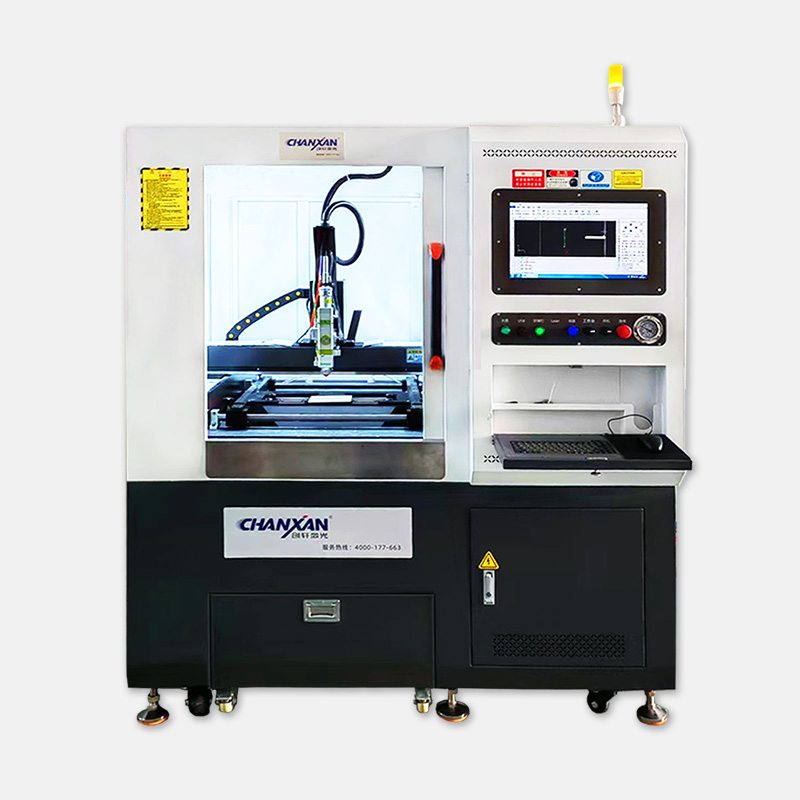
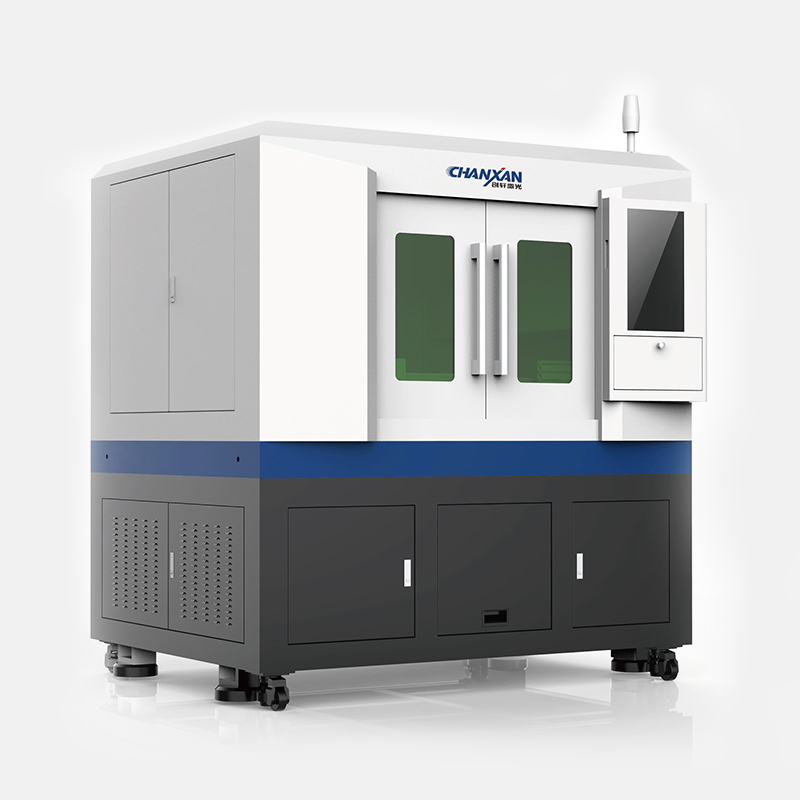
Chanxan Laser offers the 6060J QCW Fibre Laser Precision Metal Cutting Machine—a dedicated system for high‑precision cutting of NdFeB permanent magnets and other specialised metals.

QCW (Quasi‑Continuous Wave) fibre lasers are particularly well‑suited for NdFeB cutting because:
| Feature | Benefit for NdFeB |
|---|---|
| High peak power | Enables clean cutting of thick and thin sections. |
| Adjustable pulse parameters | Allows optimisation for different material thicknesses and complex shapes. |
| Excellent beam quality | Enables fine, precise cuts with minimal kerf width. |
| High efficiency | Low operating costs and reliable performance. |
| Small heat‑affected zone | Reduces risk of thermal damage to brittle NdFeB. |
| Application | Why the 6060J Excels |
|---|---|
| NdFeB magnet cutting | Precision, burr‑free cuts on hard, brittle magnetic materials. |
| Special‑shaped magnet production | Complex contours—arcs, slots, irregular shapes—programmed directly. |
| Thin magnet sections | Clean cutting without chipping or cracking. |
| Rapid prototyping | Quick design changes via software; no tooling costs. |
| High‑volume production | Fast cutting speed; automated options available. |
| Free solution
Previous: Laser Scribing for Photovoltaic Solar Cells – A Complete Guide to P1, P2, and P3 Processes
Next: Laser Slotting and Drilling Technology for Microfluidic Biochip