
Key Words: Silicon Wafer Dicing PCB Depaneling Glass Cutting
Home > News > Industry News
【Description】:
Laser marking for UDI in medical devices: achieve permanent, high-precision, FDA-compliant identification on surgical tools, implants, and medical components with advanced laser technology.
Traceability is a strict demand in today's regulated healthcare industry. The Unique Device Identification (UDI) system embodies the comprehensive lifecycle management of medical devices. Among the various identification technologies available, laser marking stands out. Currently, laser UDI marking is the most reliable solution for applying UDI identifiers to medical devices—and it best meets regulatory requirements.
Unique Device Identification (UDI) is a standardized system that assigns a unique code to every medical device. Regulatory bodies, such as the U.S. Food and Drug Administration (FDA) and the European Commission, are mandating the implementation of UDI. This initiative aims to enhance patient safety and supply chain transparency.
According to the U.S. Food and Drug Administration, the UDI system aims to:
Reduce medical errors
Improve post-market surveillance
Enable efficient product recalls
Enhance device identification across global markets
A compliant UDI typically includes the following:
Device Identifier (DI) – identifies the manufacturer and model
Production Identifier (PI) – includes lot number, serial number, or expiration date
Machine-readable code (e.g., Data Matrix)
Human-readable interpretation (HRI)
Laser marking has become the industry standard in the UDI marking field, primarily due to its unparalleled precision, durability, and compliance capabilities.
Laser marking creates marks that are resistant to:
Sterilization processes (autoclaving, gamma radiation)
Corrosion and wear
Chemical exposure
This ensures long-term traceability throughout the product lifecycle.
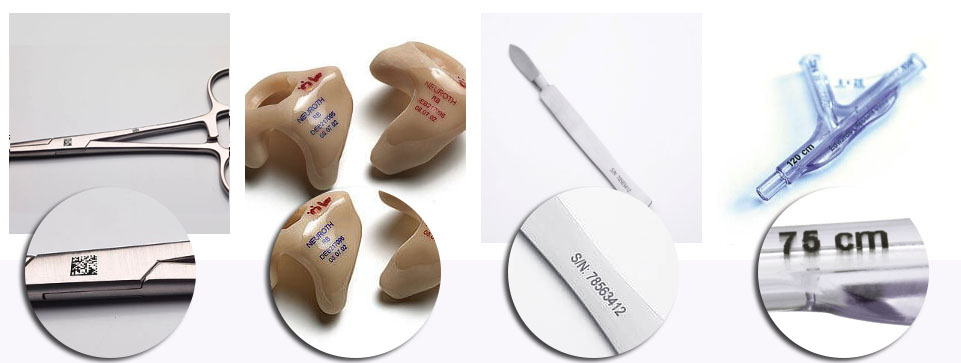
Medical devices—especially surgical instruments, implants, and micro-components—require ultra-fine marking. Laser systems can produce:
High-resolution Data Matrix codes
Micro-text and serial numbers
Complex geometries on small surfaces
This is critical for minimally invasive devices and micro instruments.
Unlike ink-based or mechanical marking methods, laser marking is:
Non-contact (no tool wear)
Contamination-free
Suitable for cleanroom environments
This aligns with strict medical manufacturing standards.
Different laser types are selected based on material and application requirements.
Ideal for metals (stainless steel, titanium, aluminum)
Common in surgical tools and implants
Produces high-contrast annealed or engraved marks
Suitable for plastics and sensitive materials
Minimal heat-affected zone
Ideal for polymer-based medical devices
Ultra-precise “cold processing”
No thermal damage
Used for high-end micro-machining and delicate implants
UDI marking must comply with strict global standards, including:
ISO 13485
ISO 15223-1
ISO/IEC 16022
Additionally, marking quality must meet verification standards such as:
ISO/IEC 15415 (print quality for 2D codes)
ISO/IEC 15416 (barcode quality)
Laser marking systems are capable of achieving high-grade Data Matrix codes (Grade A or B). Therefore, it ensures reliable scanning and compliance.
Laser UDI marking is widely used across multiple medical sectors:
Scalpels, forceps, clamps
Requires corrosion-resistant and sterilization-proof marks
Bone screws, plates, joint implants
Requires biocompatible, non-invasive marking
Stents and micro-tubes
Requires ultra-fine, high-precision marking
Syringes, catheters, plastic housings
Requires high-speed, non-damaging marking
To ensure optimal UDI marking results, manufacturers should follow these best practices:
Optimize Contrast Without Surface Damage
Use annealing (for metals) instead of deep engraving when surface integrity is critical.
Validate Marking Quality
Implement vision inspection systems to verify:
Code readability
Contrast and grading
Data accuracy
Ensure Traceability Integration
Integrate laser systems with MES/ERP systems for real-time data tracking and serialization.
Selecting the Appropriate Laser Source
Material compatibility is paramount. Therefore, the laser source and pulsed laser must precisely match the characteristics of the substrate and the required marking precision. With this in mind, when providing UDI laser marking solutions, Chanxan Laser pays close attention to the specific materials and requirements involved in each application. Also, it offers complimentary sample testing services to ensure the delivery of optimal UDI marking results.
As medical devices become smaller and more complex, UDI marking is evolving toward:
Micro and nano-scale marking
Automated inline marking systems
AI-based quality inspection
Integration with digital traceability platforms
Laser technology, especially ultrafast lasers, will play a crucial role in enabling next-generation medical manufacturing.
In the medical device industry, UDI marking serves as a critical pillar for ensuring compliance, safety, and traceability. Medical device manufacturers must adopt reliable and future-proof marking solutions to maintain regulatory compliance.
Distinguished by its precision, permanence, and compliance capabilities, laser marking stands out as the most effective solution for implementing UDI. Chanxan Laser, as a leading provider of advanced laser equipment, offers laser marking solutions that best meet the needs of manufacturers and compliance requirements, safeguarding market access for medical devices.
| Free solution