
Key Words: Silicon Wafer Dicing PCB Depaneling Glass Cutting
Home > News > Industry News
【Description】:
This guide provides a decision framework for choosing between nanosecond, picosecond, and femtosecond lasers. It explores the physics of "Cold Ablation," comparing systems based on precision, speed, and TCO to help manufacturers achieve near-zero HAZ in high-value industrial applications.
TL;DR Conclusion: Choosing the right ultrafast laser system involves balancing material sensitivity, precision, volume, and cost. Nanosecond lasers are cost-effective for robust materials. Picosecond lasers offer a sweet spot for precision electronics with micron-level accuracy. Femtosecond lasers provide ultimate sub-micron precision and zero thermal damage for high-value medical and semiconductor applications. A comprehensive ROI analysis should consider yield improvements and the elimination of post-processing steps.
In the precision manufacturing landscape of 2026, selecting between a femtosecond laser system, picosecond laser system, or nanosecond laser system is a high-stakes decision that impacts yield, throughput, and long-term ROI. To help manufacturers navigate this complex landscape, we have developed a structured evaluation framework focused on four critical dimensions: Material Sensitivity, Required Precision, Production Volume, and Total Cost of Ownership (TCO).
The first and most critical question is: Is your workpiece heat-sensitive?
The fundamental difference between these systems lies in their interaction with the material's lattice.
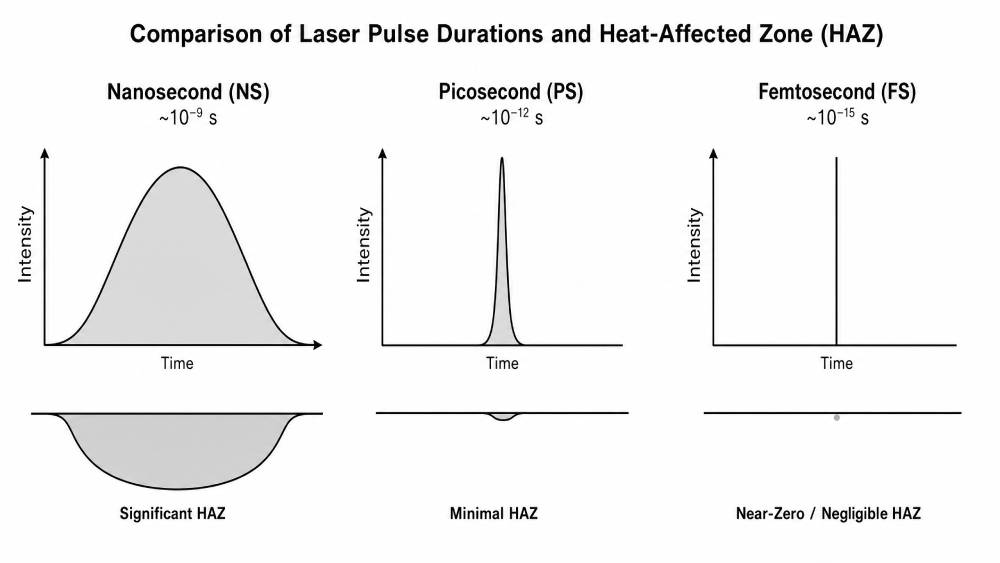
Thermal Processing: A nanosecond laser system or nanosecond laser machine relies on photothermal effects. The pulse duration is long enough for heat to conduct into the surrounding area, creating a Heat Affected Zone (HAZ). While suitable for thermally robust metals, it can cause melting or micro-cracks in sensitive substrates.
Cold Ablation: For materials such as polymer films, bio-tissues, thin-film coatings, and ultra-thin glass, the "Cold Processing" capabilities of a picosecond laser system or femtosecond laser system are mandatory.
The Femtosecond Advantage: A femtosecond laser machine operates at a timescale (10⁻¹⁵ s) shorter than the electron-phonon coupling time. This ensures that the material is vaporized before any heat can be transferred, making it the only choice for the most delicate semiconductor and medical applications.
Precision requirements often dictate the choice of the ultrafast laser machine.
Sub-Micron Precision: If your application requires sub-micron tolerances (±1 μm), a femtosecond laser machine or a femtosecond laser system is the industry standard. This is critical in fields like Micro LED fabrication and high-density semiconductor interconnects.
Micron-Level Balance: For applications tolerating ±3–5 μm, a picosecond laser machine offers an excellent cost-performance balance. It provides the edge quality needed for precision electronics without the premium cost of femtosecond technology.
General Industrial Precision: General industrial work at ±10 μm is well-served by a nanosecond laser machine or nanosecond laser system. For tasks like macro-marking or thick material welding, the nanosecond platform remains the most practical solution.
Throughput is the lifeblood of mass production, and each ultrafast laser system has its own performance profile.
The High-Volume Leader: The picosecond laser cutting machine leads in balanced high-volume production. It offers a higher repetition rate and faster feed speeds than many femtosecond systems while maintaining a much cleaner cut than nanosecond alternatives.
Precision vs. Speed: Femtosecond laser systems, while offering superior precision, often operate at lower repetition rates due to the complexity of managing ultra-short pulses. They are typically reserved for high-value, low-to-medium volume components where quality is paramount.
Bulk Material Removal: For tasks requiring rapid material removal on non-sensitive substrates, nanosecond laser systems or a nanosecond laser cutting machine offer the highest throughput.
The financial evaluation of a laser system must account for both initial capital expenditure (CAPEX) and long-term operational costs.
Low Entry Barrier: Nanosecond laser systems have the lowest initial capital cost and are widely supported by a mature global supply chain. They are ideal for standard industrial manufacturing where margins are tight.
The Mid-Tier Sweet Spot: Picosecond laser systems represent a mid-tier investment with a strong ROI in precision electronics manufacturing. A picosecond laser machine often pays for itself through reduced waste and the elimination of secondary finishing processes.
Premium for High-Value Yield: Femtosecond laser systems carry the highest acquisition cost. However, they are unmatched for applications where quality defects carry disproportionate downstream costs—such as in medical implants, aerospace components, and advanced semiconductor fabrication. In these sectors, the increased yield provided by a femtosecond laser machine far outweighs the initial investment.
| Feature | Nanosecond Laser | Picosecond Laser | Femtosecond Laser |
|---|---|---|---|
| Primary Processing Mechanism | Thermal Melting | Cold Ablation | Pure Cold Processing |
| Best Applications | Robust metals, industrial marking, standard precision processing | Electronics, OLED, FPC, precision micromachining | Semiconductors, medical devices, ultra-precision processing |
| Processing Precision | ±10 μm | ±3–5 μm | ±1 μm |
| Heat-Affected Zone (HAZ) | Moderate to High | Very Low | Nearly Zero |
| Material Compatibility | Metals, plastics, general industrial materials | Glass, ceramics, flexible electronics | SiC, GaN, ultra-thin wafers, fragile materials |
| Capital Investment | Lowest | Medium | Highest |
Selecting the right ultrafast laser machine requires a deep understanding of your material's physics and your production's economic goals. At Chanxan Laser, we provide the full spectrum of solutions—from the high-efficiency nanosecond laser machine to the ultra-precise femtosecond laser system.
Contact our application engineers today to request a process validation or to explore which ultrafast laser system is the right fit for your 2026 production roadmap.
Nanosecond: Large HAZ, visible melting.
Picosecond: Minimal HAZ, high-quality edges.
Femtosecond: Nearly zero HAZ, semiconductor-grade precision.
| Free solution
Previous: Best Ultrafast Laser System Manufacturers: How to Evaluate the Right Supplier
Next: Ultrafast Laser Technology: Principles, Comparison & Industrial Applications