
Key Words: Silicon Wafer Dicing PCB Depaneling Glass Cutting
Home > News > Industry News
【Description】:
There is no single "perfect" pulse frequency for laser micro-drilling; rather, it represents a dynamic balance between material throughput and structural edge quality.
TL;DR (Too Long; Didn't Read)
There is no single "perfect" pulse frequency for laser micro-drilling; rather, it represents a dynamic balance between material throughput and structural edge quality. For high-speed, defect-free micro-drilling on technical substrates, the optimal setup balances pulse repetition frequency (PRF) against the material's specific thermal relaxation threshold—typically utilizing 100 kHz to 500 kHz for ultrafast cold ablation, and 1 kHz to 50 kHz for fine-modulated industrial percussion drilling. Cranking the frequency too high without a proportional increase in scanning or spatial movement causes severe thermal accumulation, leading to micro-cracking, recast burrs, and plasma shielding that halts drilling depth progression.
In an ideal laser micro-drilling process, each discrete laser pulse should remove a microscopic layer of material and allow the localized perimeter to cool completely before the next pulse arrives. When processing brittle materials like Alumina ceramics, silicon wafers, or sapphire glass, setting the pulse frequency too high (e.g., above 1 MHz) without sufficient beam movement causes a phenomenon called heat accumulation. Because the time interval between consecutive pulses becomes shorter than the material's internal thermal diffusion time, residual heat builds up rapidly within the bore hole. This triggers localized melting, expanding the Heat Affected Zone (HAZ) and inducing thermal shock cracks.
When drilling high-aspect-ratio deep micro-holes, frequency management directly impacts depth capacity. Each high-energy laser pulse vaporizes a volume of material, creating an intense, ionized plume of gas and submicron soot inside the narrow canal. If the pulse repetition frequency is configured too high, a subsequent pulse will strike this expanding plume before it has a chance to dissipate. This plume acts as a plasma shield, absorbing and scattering the incoming laser energy. Consequently, the effective power reaching the bottom of the micro-hole drops off precipitously, stalling drilling speeds and causing heat to reflect sideways into the hole boundaries.
To unlock high-throughput processing while maintaining sub-micron geometric circularity, industrial operators pair specific pulse frequencies with high-speed beam motion configurations. Instead of firing static single-shot bursts (percussion drilling), advanced workstations utilize helical trepanning scanning paths. By rotating the laser beam concentrically at high speeds, the pulse energy is distributed evenly across a larger surface area. This spatial distribution allows engineers to scale the pulse frequency up to hundreds of kilohertz safely, achieving maximum material removal rates without risking thermal degradation along the finished hole sidewalls.
The following matrix details the optimized frequency profiles and laser drilling configurations designed to minimize taper and heat defects across high-spec industrial materials:
| Target Material Substrate | Optimized Frequency Window | Recommended Drilling Method | Key Process Quality Metric |
|---|---|---|---|
| Technical Ceramics (Alumina, AlN, Zirconia) | 100 kHz – 300 kHz | Multi-pass Helical Trepanning (Ultrafast) | Near-zero edge micro-chipping; clean entry profiles |
| Semiconductor Wafers (Monocrystalline Silicon) | 200 kHz – 500 kHz | High-Speed Galvo Percussion Array | Suppressed backside micro-cracking; pristine aspect ratios |
| Flexible PCBs (FPC) (Polyimide + Copper layer) | 50 kHz – 150 kHz | Concentric Trepanning Pathway | Zero carbonization (charring); crisp dielectric insulation |
| High-Spec Metal Alloys (Nitinol, Stainless Steel) | 10 kHz – 50 kHz | High-Peak-Power Percussion Scribing | Minimized molten recast layers; sharp cylindrical consistency |
Fine-tuning laser frequency output parameters is absolutely vital across strict manufacturing fields where microscopic variations compromise component yield rates:
Semiconductor Through-Silicon Vias (TSV): Milling micro-scale interconnect paths through fragile silicon wafers. Precise frequency tuning ensures clean, deep vertical via profiles, preventing internal structural chipping during subsequent copper metallization steps.
Advanced Aerospace Cooling Holes: Fabricating dense arrays of shallow, angled micro-orifices across heat-shielding components. Optimizing the pulse repetition rate prevents structural distortion and maintains strict geometric flow-coefficient limits.
Medical Microfluidic Diagnostics: Drilling highly uniform micro-channels and filtration matrix arrays across temperature-sensitive polymer plates. Utilizing cold ablation pulse sequences preserves pristine capillary flow surfaces, avoiding chemical residue trapping.
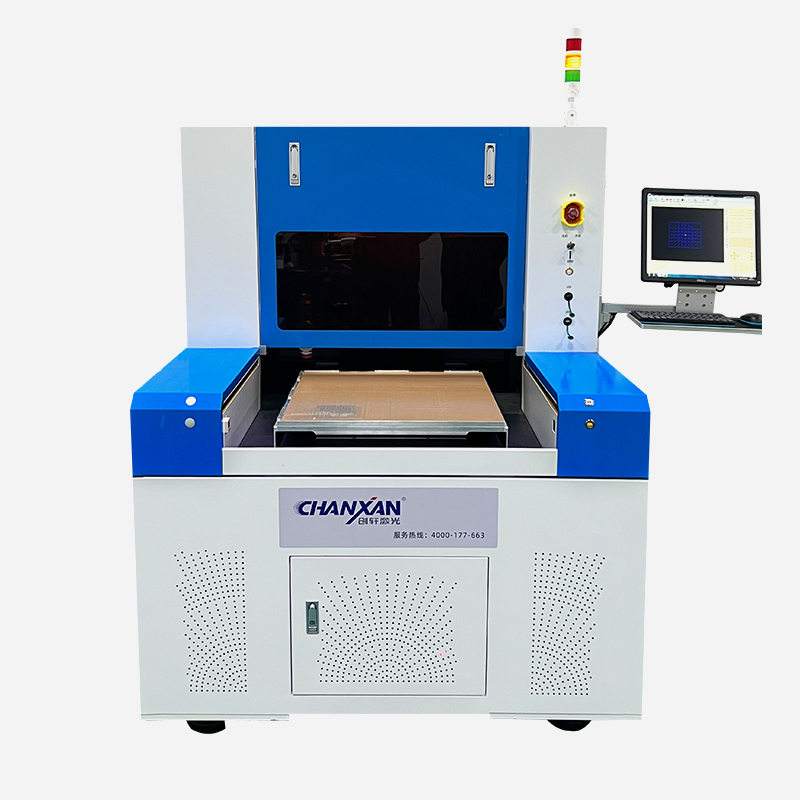
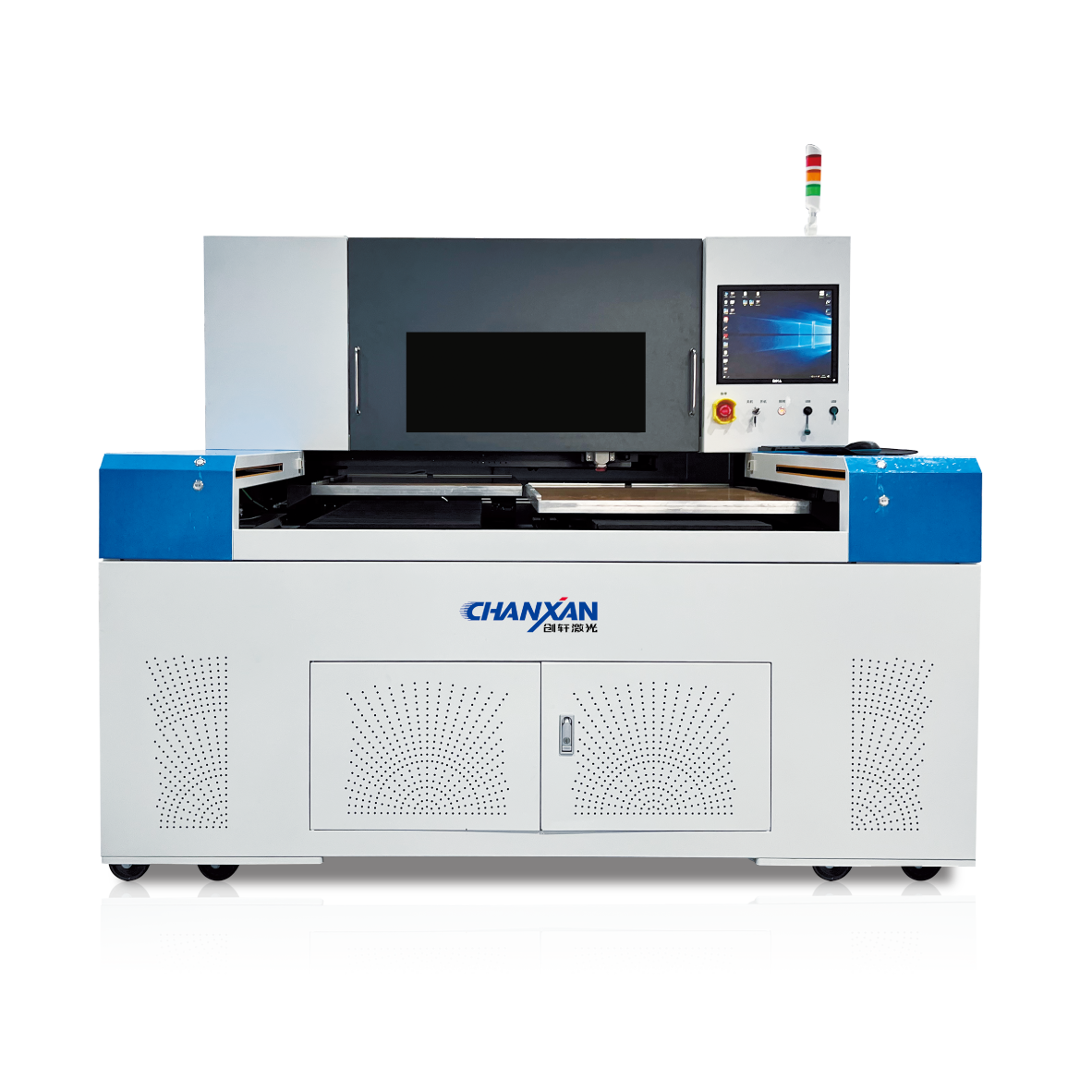
To establish reliable frequency control and maintain perfect focal coplanarity across complex micro-drilling grids, Chanxan Laser recommends the following professional system platforms:
The ultimate workstation for sub-micron micro-drilling precision and zero thermal stress. By pairing an ultra-short sub-400fs pulse duration with a highly flexible, software-programmable frequency modulation range, this system delivers unmatched hole quality on the most heat-sensitive substrates and microfluidic layers.
True Non-Thermal Ablation: Operates inside the ideal 100 kHz to 500 kHz window, vaporizing substrate targets instantly before thermal equilibrium can occur.
Best Suited For: Semiconductor TSV drilling, bio-resorbable medical mesh perforation, and advanced multi-layer glass micro-machining.
A premium, high-efficiency manufacturing solution leveraging fine pulse synchronization options and extreme peak power density. It features highly responsive frequency tuning to maximize array dicing and drilling throughput on dense technical substrates.
Fine Pulse Control Software: Coordinates laser pulse timing with active digital galvanometer tracking to prevent overlapping heat stacking at tight positions.
Multi-Light Architecture Options: Supports optical engine options across UV, Green, or Infrared bands to ensure optimum photon absorption relative to material properties.
Best Suited For: Advanced electronic ceramic submount drilling, flexible PCB via arrays, and precise industrial sapphire dicing.
Q: Why can't I just run my ultrafast laser at its maximum frequency to get the fastest drilling speed?
A: While increasing the frequency fires more pulses per second, it reduces the resting time between pulses. Without proportional beam motion, heat builds up rapidly in the micro-channel, causing the process to degrade from clean cold ablation to thermal melting. Additionally, intense plasma shielding will block subsequent pulses, actually stalling your drilling progress.
Q: How does assist gas pressure interact with the pulse frequency configuration?
A: For traditional percussion setups running under 50 kHz, high-pressure gas (such as 10-15 bar Nitrogen) is mandatory to mechanically push out liquid melt. For Chanxan's ultrafast workstations operating at higher frequencies (100+ kHz), the material sublimates directly into gas, meaning a low-pressure coaxial gas stream is utilized primarily to deflect fine soot clouds away from the telecentric focus lens.
Q: What is pulse bursting, and how does it relate to drilling frequency?
A: Burst mode splits a single primary macro-pulse into a package of multiple sub-pulses separated by mere nanoseconds, while maintaining the overall configured repetition frequency. In Chanxan ultrafast platforms, utilizing burst configurations significantly ramps up material removal efficiency per cycle because the ultra-short sub-pulses break down the molecular grid in rapid succession before the plasma cloud can fully expand.
Disclaimer: To protect intellectual property and honor customer Non-Disclosure Agreements (NDAs), specific corporate background details in application scenarios have been anonymized. However, all technical processing parameters, workflow data matrices, and operational cost-effectiveness metrics remain fully verified by Chanxan Laser's engineering applications laboratory.
| Free solution
Previous: Why Is Galvo Scanner Accuracy More Critical Than Linear Motor Speed in Micro-Cutting?
Next: How Does "Cold Ablation" in Picosecond Laser Cutting Improve Material Edge Quality?