
Key Words: Silicon Wafer Dicing PCB Depaneling Glass Cutting
Home > News > Industry News
【Description】:
High galvanometer positioning linearity and zero thermal drift are what prevent rounded corners, overlapping pulse errors, and part rejection.
TL;DR (Too Long; Didn't Read)
In ultra-precision laser micro-machining, relying solely on raw axis acceleration leads to severe geometric drift and structural deformities. While linear motors excel at transferring substrates rapidly across large processing layouts, the galvo scanner's dynamic mirror accuracy dictates the actual quality of sub-micron contours. Because micro-cutting operations occur within localized fields where vectors change direction in microseconds, high galvanometer positioning linearity and zero thermal drift are what prevent rounded corners, overlapping pulse errors, and part rejection. Speed without dynamic mirror feedback is useless when a geometric error of just two microns fails microelectronics or biomedical component inspection.
Industrial linear motors are exceptional pieces of hardware, capable of moving heavy granite-mounted cross-stages at velocities exceeding 2000 mm/s. However, in micro-cutting applications—such as fabricating complex flexible PCB via arrays, silicon die grids, or microscopic slots—the target geometries are often smaller than a few millimeters. For a heavy mechanical gantry stage to change direction along an intricate 50-micron radius curve, it faces the immutable laws of structural inertia. The stage simply cannot accelerate or decelerate fast enough within such a microscopic distance to hit its top speed. Attempting to force speed over these paths causes structural vibrations, resulting in distorted kerf tracks and microscopic edge jaggedness.
Galvanometer optical scanners bypass mass inertia barriers by moving microscopic, high-reflectivity mirrors attached to ultra-low-inertia rotary motors. Instead of shifting the entire bulk weight of a substrate or focal gantry, the galvo system deflects the focused laser beam across a fixed processing window. These mirrors can alter vector directions in mere microseconds with tracking accelerations that leave linear motors far behind. In micro-machining, where ultrafast picosecond or femtosecond pulses fire at hundreds of kilohertz, the galvo mirror's capability to maintain consistent position-to-pulse synchronization determines whether the energy vaporizes the material uniformly or stacks up to create localized melting hotspots.
The true enemy of sub-micron precision during continuous factory production runs is not raw velocity; it is thermal expansion within the scanning head. As galvo motors execute rapid oscillating trajectories over hours of operation, internal electrical coils generate heat. This temperature rise shifts the internal position detector signals, causing a phenomenon known as "thermal drift." If a scanner possesses poor feedback linearity or lacks thermal stabilization, the cutting path will slowly deform over time—turning perfect circles into ovals and throwing tight spatial nesting dimensions completely out of alignment. Advanced digital galvos feature temperature-controlled housings and high-resolution optical encoders to neutralize these drift errors entirely.
Securing premium galvanometer accuracy is critical across complex manufacturing setups where geometric tracking errors trigger immediate QA failure:
Semiconductor Advanced IC Substrates: Drilling micro-vias through multi-layer organic packaging panels. High-accuracy galvo tracking guarantees that the laser beam hits target copper landing pads perfectly down to the single-micron level, preventing electrical open-circuit defects.
Medical Grade Nitinol Stent Micro-Slitting: Cutting precise structural mesh interlocks on shape-memory alloy tubing. High optical linearity prevents pulse stacking at tight intersection corners, avoiding micro-cracks that cause intravascular component fatigue failure.
High-Frequency RF Dielectric Structuring: Machining dense ceramic antennas and micro-strip layouts. Perfect scanning trajectory control ensures geometric path uniformity, maintaining targeted impedance metrics without signal distortion.
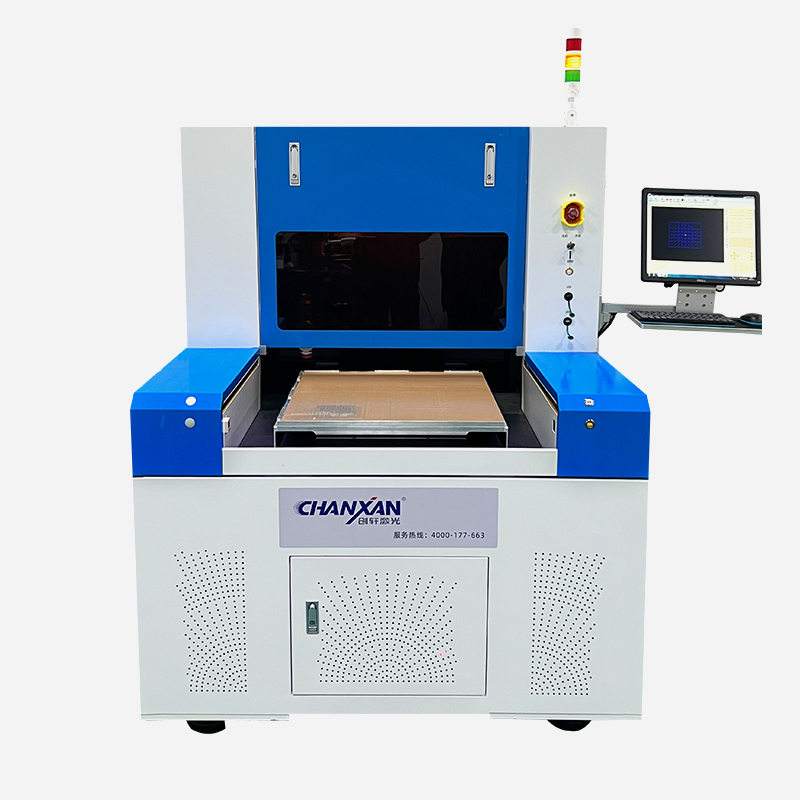
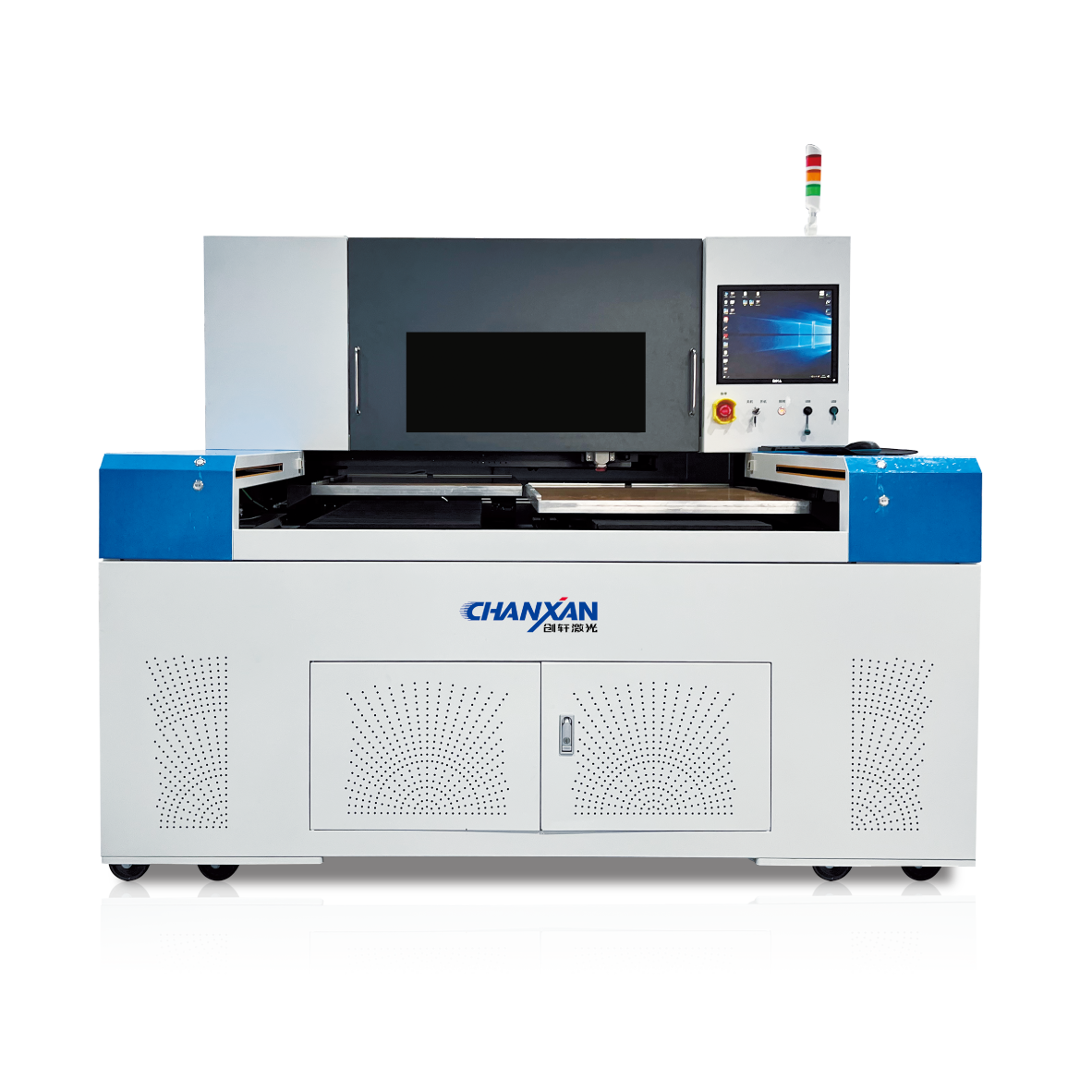
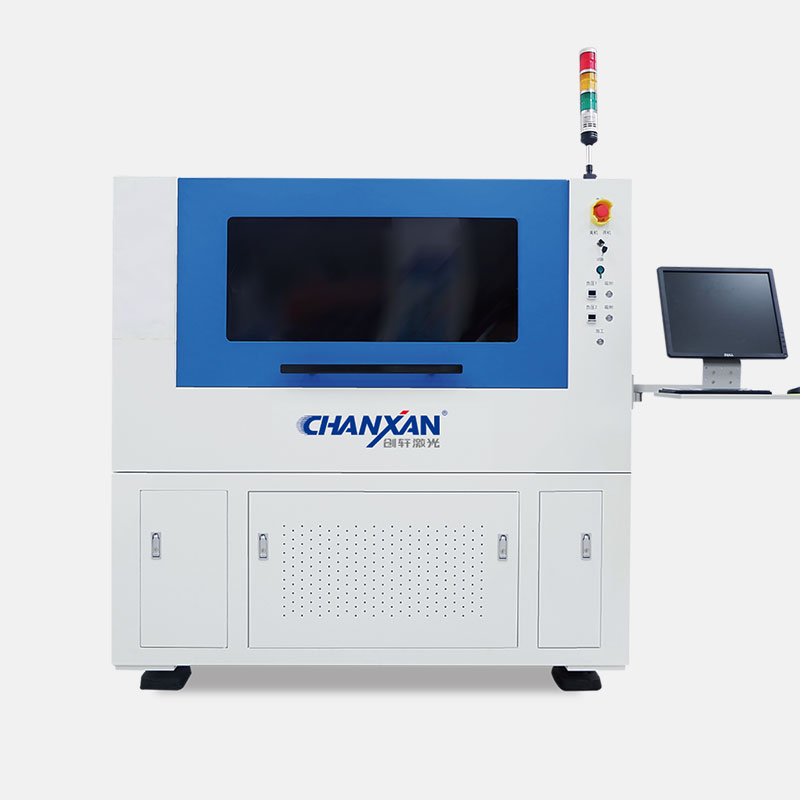
To achieve the ideal industrial balance between rapid wide-area stepping and ultra-precise localized cutting trajectories, Chanxan Laser integrates premium synchronized hardware:
A premium, high-efficiency production platform effortlessly links high-velocity linear gantry positioning with localized digital galvanometer paths.
Multi-Light Source Adaptability: Configurable with picosecond UV, Green, or Infrared engines to precisely match substrate material absorption curves.
Granite Core Isolation: Assembled on a vibration-dampening solid granite machine base to keep external factory floor vibrations away from the delicate optical path.
Best Suited For: Advanced technical ceramic dicing, large-scale flexible PCB drilling arrays, and precision sapphire panel scribing.
Q: Does focusing on galvo accuracy mean we sacrifice overall machine throughput?
A: No. Chanxan addresses this by deploying Synchronized Galvo-Gantry Technology (Processing On-The-Fly). While the linear motors keep moving the substrate at a smooth, constant speed across large areas, the fast galvo scanner executes the complex micro-details inside its field simultaneously. This approach delivers maximum throughput alongside sub-micron accuracy.
Disclaimer: To protect intellectual property and honor customer Non-Disclosure Agreements (NDAs), specific corporate background details in application scenarios have been anonymized. However, all technical processing parameters, workflow data matrices, and operational cost-effectiveness metrics remain fully verified by Chanxan Laser's engineering applications laboratory.
| Free solution
Previous: How Does Pulse Width Affect the Surface Roughness of Laser-Engraved Micro-Channels?
Next: What Is the Best Pulse Frequency Setup for High-Speed Laser Micro-Drilling?