
Key Words: Silicon Wafer Dicing PCB Depaneling Glass Cutting
Home > News > Industry News
【Description】:
Precision UV picosecond and nanosecond laser drilling solutions for solid-state battery separators, including oxide ceramics (LLZO, LATP), sulfide glasses, polymer-ceramic composites, and thin ceramic films.
Solid‑state batteries promise higher energy density, faster charging, and improved safety compared to conventional lithium‑ion cells. Yet bringing them from laboratory breakthroughs to mass production remains a formidable challenge. One of the most persistent bottlenecks lies in manufacturing the solid‑state separator—the solid electrolyte membrane that conducts lithium ions while blocking electrons and suppressing dendrite growth.
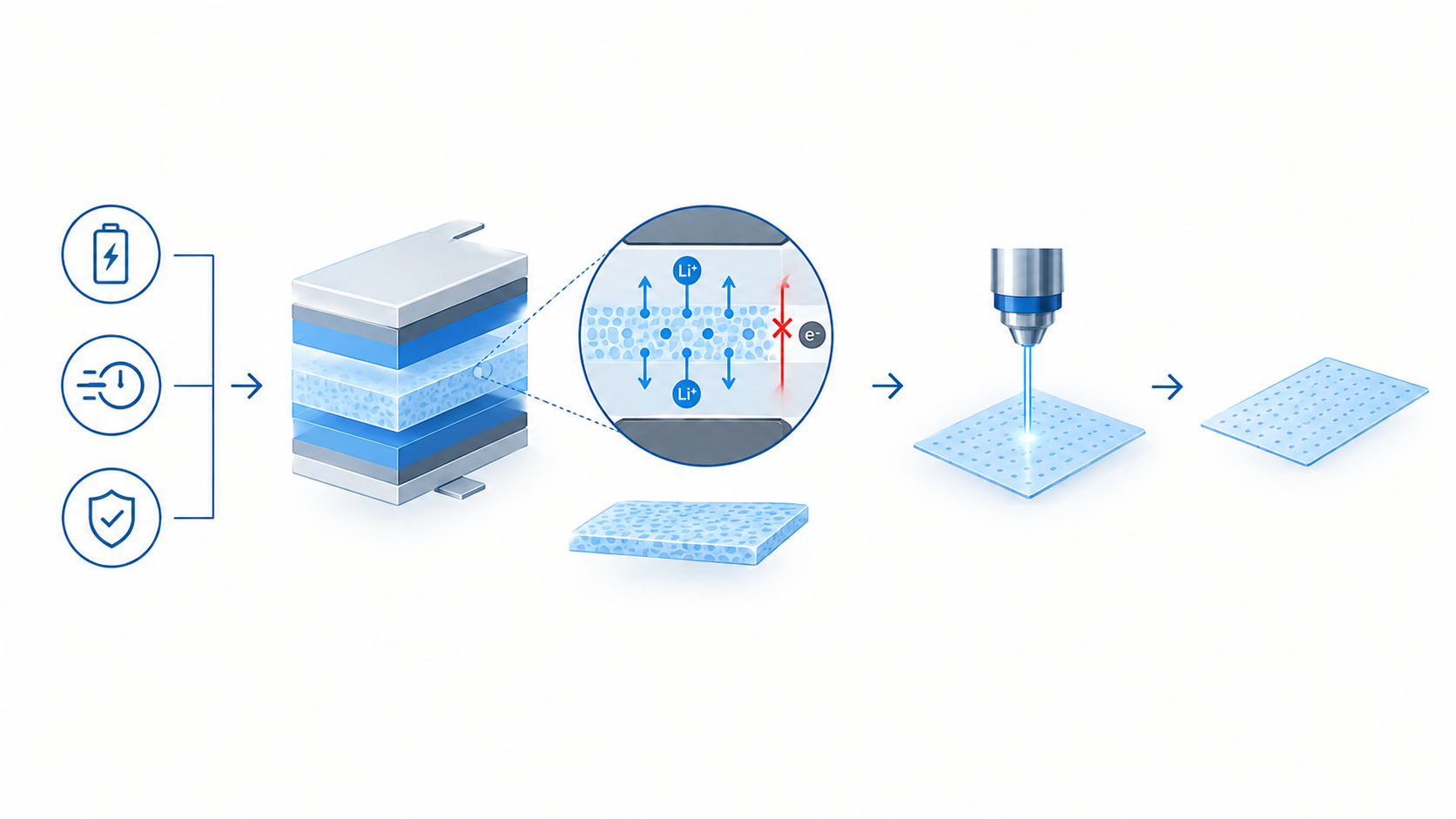
In a conventional lithium‑ion battery, the separator is a porous polymer film—typically polyethylene or polypropylene—that is cheap, flexible, and easy to manufacture. The pores are formed naturally during stretching, requiring no precision machining.
Laser drilling solves this problem. By creating micro‑hole arrays through the solid electrolyte, the effective ionic resistance drops dramatically, while the remaining solid material provides mechanical support and dendrite suppression. This is an essential production requirement for EV, consumer electronics, and grid storage applications.
High ionic conductivity and mechanical strength, but hard and brittle. Picosecond lasers reduce the heat-affected zone (HAZ) from >20 μm to under 5 μm, preventing micro-cracks.
Highest ionic conductivity, but moisture-sensitive with low melting points. Requires ultrashort pulse picosecond lasers in an inert gas atmosphere to prevent thermal melting and recast.
Combines polymer flexibility with ceramic fillers. Precise pulse energy control is essential to avoid selective ablation across multi-material interfaces.
Extremely fragile sputtered or ALD-deposited films. Femtosecond or picosecond lasers with low fluence are used to prevent substrate damage or delamination.
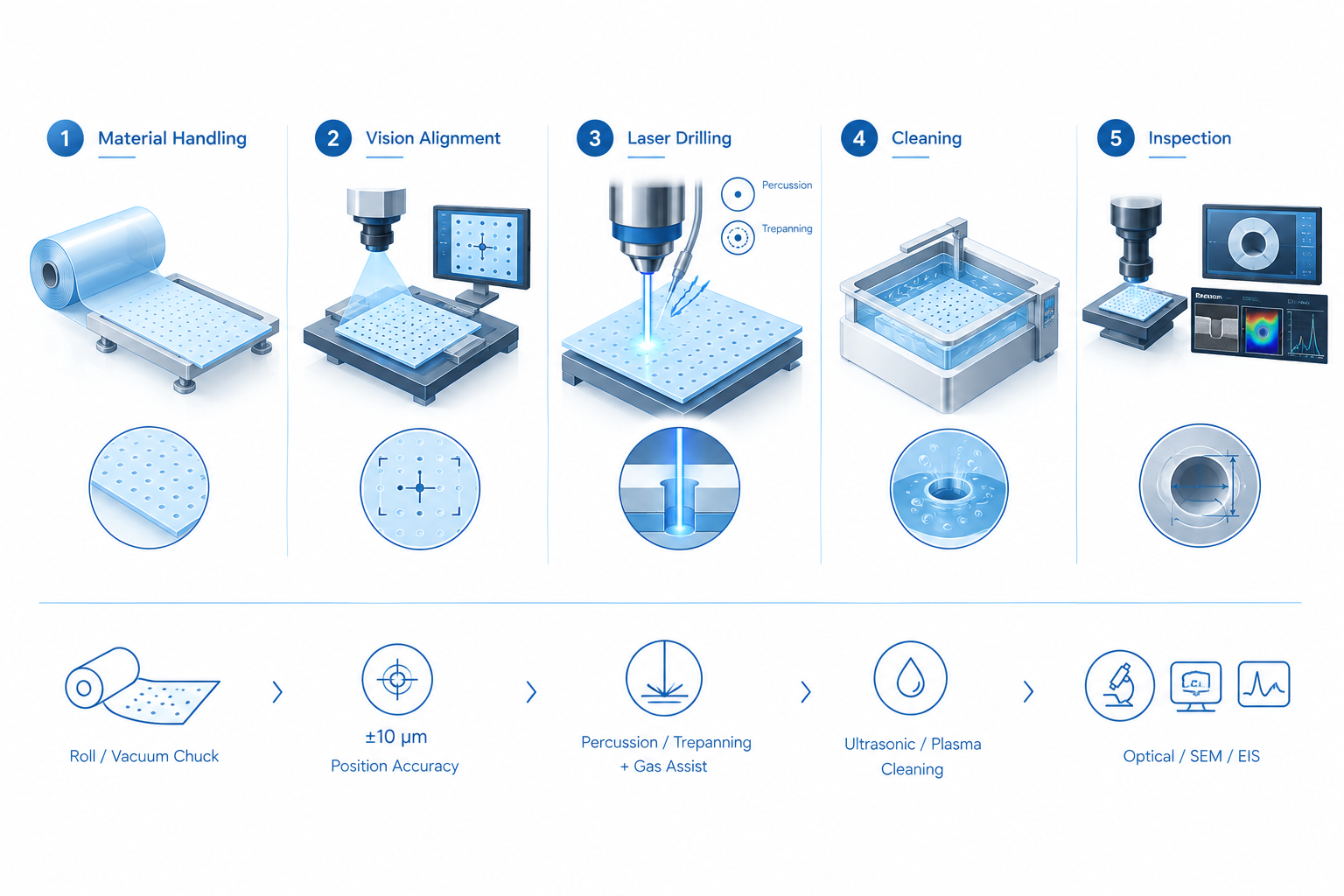
A typical production workflow for solid‑state separator micro-drilling follows a structured sequence:
Material Handling: Separator membranes are positioned via vacuum chucks or roll-to-roll (R2R) webs. Sulfide materials are processed inside dry rooms or gloveboxes (dew point < −40°C).
Vision Alignment: High-precision optical vision systems locate fiducial marks, achieving positional accuracy of ±10 μm with galvo scanners.
Laser Drilling: Focused UV/ultrashort beams utilize percussion drilling for holes under 75 μm or trepanning for larger holes with clean sidewalls. Coaxial gas assist removes debris dynamically.
Cleaning: Post-process ultrasonic solvent cleaning or plasma cleaning removes lingering particulate debris prior to cell stacking.
Inspection: Microscopic and SEM cross-section analysis verify hole diameter, taper, and HAZ. Electrochemical impedance spectroscopy measures final ionic resistance.
Hole Diameter and Tolerance: Direct impact on ionic transport. Standard target is ±5 μm to prevent current hot-spots.
Hole Position Accuracy: ±10 μm accuracy ensures exact alignment with electrode patterns and prevents localized degradation.
Taper Control: Hole sidewall taper must be kept below 5° for uniform ionic flux.
Heat‑Affected Zone (HAZ): Picosecond lasers restrict HAZ below 5 μm to preserve mechanical integrity and ionic conductivity.
Micro‑crack Prevention: Minimizing thermal shock prevents stress cracking and suppresses dendrite formation during cell cycling.
Debris Management: Gas assist and post-treatment ensure clear channels with low contact resistance.
Chanxan Laser offers specialized UV picosecond and nanosecond laser systems purpose‑built for solid‑state battery separator drilling. Our platforms are designed to address brittle ceramics, sulfide sensitivity, and ultra-thin composite challenges at mass production speeds.

Contact Chanxan Laser application engineers today to discuss your battery separator processing requirements or schedule a sample drilling trial.
Contact Chanxan Laser Today| Free solution
Previous: None
Next: Laser Processing for 5G/6G LTCC: RF Modules & Antenna‑in‑Package