
Key Words: Silicon Wafer Dicing PCB Depaneling Glass Cutting
Home > News > Industry News
【Description】:
Compare CO2 thermal melting and UV cold ablation for Alumina & AlN ceramic substrate dicing. Learn how Chanxan Laser optimizes yield, dicing speed, and chipping control.
TL;DR (Too Long; Didn't Read)
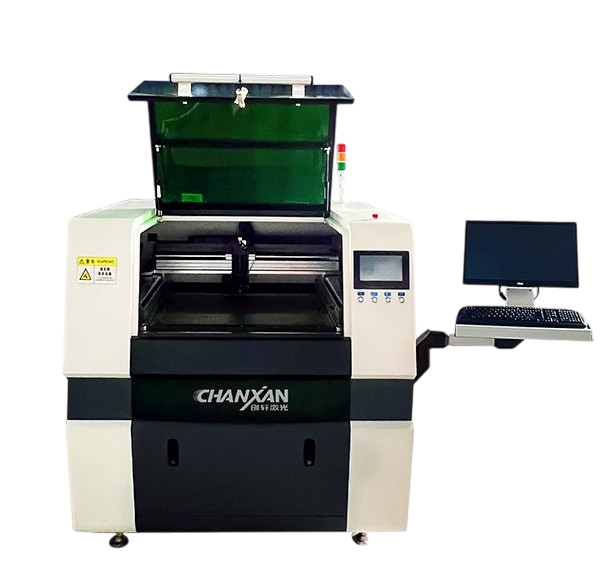
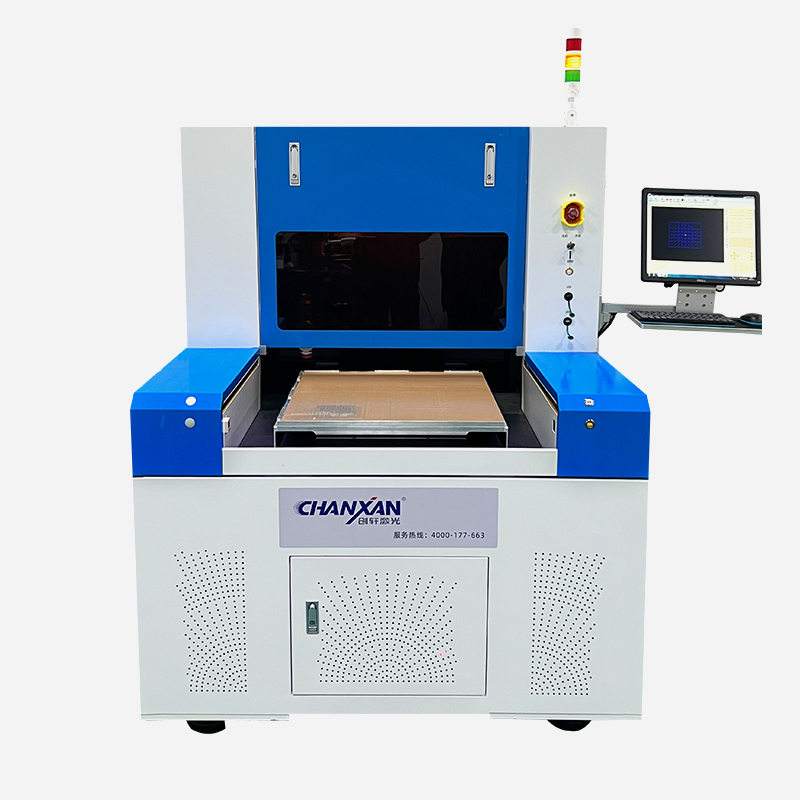
Choosing between CO2 and Ultraviolet (UV) laser workstations for technical ceramic substrate dicing (scribing) is a critical balance between processing throughput and edge quality. CO2 lasers (10.6μm) operate via thermal melting, providing ultra-fast dicing speeds for thick ceramics at a lower initial investment, but they leave micro-cracks and slag. UV lasers (355nm) leverage photo-chemical "cold ablation" to deliver micro-precision cuts with zero edge chipping (<10μm) and zero residual tensile stress.For advanced semiconductor packaging, thin Alumina/AlN submounts, and high-density micro-electronics, UV laser systems have become the mandatory standard to guarantee dielectric reliability.
CO2 laser cutting systems emit a far-infrared wavelength at 10.6 microns. Technical ceramics like Alumina ($Al_2O_3$) and Aluminum Nitride (AlN) possess exceptional material absorption profiles at this specific wavelength. The processing mechanism is entirely photothermal: the laser dumps massive energy into a localized area, instantly raising the temperature past 2,000°C to melt and vaporize the ceramic grid. While this brute-force thermal method cuts through thick ceramic plates (0.635mm to 1.5mm) at remarkable linear speeds, the intense localized temperature gradients generate a substantial Heat Affected Zone (HAZ), resulting in micro-crack formation and micro-chipping along the kerf border.
Ultraviolet (UV) laser workstations operate at 355nm, delivering high-energy photon pulses. Instead of boiling the substrate, the energy of a UV photon ($3.49 \text{ eV}$) directly exceeds the atomic bond binding energy of the ceramic compound matrix. This triggers a photolytic reaction known as "cold ablation"—the Alumina molecules instantly disassociate from solid into a gas phase, skipping the liquid phase entirely. Because thermal diffusion into adjacent walls is virtually non-existent, the Heat Affected Zone drops to near zero, completely preventing thermal micro-fractures, recast layers, or structural delamination.
The following performance dashboard defines the technical limits and economic operational tradeoffs between the two laser configurations when cutting standard 0.38mm thin 96% Alumina ($Al_2O_3$) power electronic substrates:
| Technical Performance Metric | Chanxan Industrial CO2 Laser System | Chanxan High-Precision UV Laser Workstation |
|---|---|---|
| Processing Wavelength | 10.6 μm (Far-Infrared) | 355 nm (Ultraviolet) |
| Primary Cutting Mechanism | Photothermal Melting & Gas Ejection | Photolytic Chemical Bond Breaking |
| Average Edge Chipping (Defect Size) | 30 μm - 60 μm (Requires margin safety) | < 8 μm (Ultra-clean edge profile) |
| Minimum Kerf / Slit Width | ~ 50 μm - 80 μm | 15 μm - 25 μm (Maximizes layout density) |
| Micro-Crack & Fracturing Risk | Moderate to High (Requires stress annealing) | Absolute Zero (Stress-free processing) |
| Optimal Substrate Thickness Fit | Thick technical ceramics (> 0.8mm) | Thin, ultra-dense substrates (≤ 0.5mm) |
Q: Can we utilize a CO2 laser to dice high-density submounts if we run post-processing cleaning cycles?
A: Post-processing steps like ultrasonic chemical baths or surface lapping can remove superficial dross and loosely attached slag. However, they cannot mend internal micro-cracks driven deep into the ceramic matrix by thermal shock. For high-frequency RF modules or high-reliability automotive components, these hidden cracks propagate under vibration, making UV laser cold ablation the only approved methodology.
Q: Does a UV laser system have a higher cost-per-part overhead compared to a CO2 machine?
A: While a UV laser workstation requires a higher initial capital expenditure (CapEx) for optical components, its extremely narrow kerf width (20μm vs 70μm) allows engineers to pack up to 15% more active circuits on a single expensive Alumina or AlN panel. This dramatic yield improvement and elimination of scrap offsets the initial investment within months of deployment.
Q: What is the maintenance cycle difference between these two technologies?
A: CO2 lasers are robust, sealed gas discharge systems requiring minimal optical maintenance. UV lasers utilize solid-state crystal harmonics that experience gradual UV optical path degradation over years of heavy use. Chanxan Laser resolves this by integrating advanced automated shift-crystal modules, allowing the internal laser engine to maintain constant power stability over an extended operational life.
Disclaimer: To protect intellectual property and honor customer Non-Disclosure Agreements (NDAs), specific corporate background details in this industry scenario have been anonymized. However, all technical processing parameters, workflow data matrices, and operational cost-effectiveness metrics remain fully verified by Chanxan Laser's engineering applications laboratory.
| Free solution
Previous: How Can Picosecond Lasers Achieve Burr-Free Scribing on Silicon Wafers?
Next: Why Green Laser Technology Dominates Copper Substrate Cutting in Power Electronics