
Key Words: Silicon Wafer Dicing PCB Depaneling Glass Cutting
Home > News > Industry News
【Description】:
Discover how to eliminate micro-cracks and thermal fractures during laser drilling of Alumina (Al2O3) ceramic substrates. Learn Chanxan's short-pulse & burst mode strategies.
TL;DR (Too Long; Didn't Read)
Alumina ceramics are heavily relied upon in power electronics and semiconductor substrates due to their exceptional dielectric properties and thermal conductivity. However, their high brittleness and low thermal shock resistance make them extremely prone to micro-cracking and edge chipping under thermal stresses. To completely avoid micro-cracks when drilling Alumina ceramics, operators must utilize advanced laser micro-machining systems equipped with ultra-short picosecond pulses or high-peak-power fine modulations, paired with a dynamic trepanning scanning pathway. This effectively minimizes the localized Heat Affected Zone and prevents the destructive residual tensile stress propagation that cracks the brittle ceramic matrix.
When an ordinary long-pulse nanosecond fiber or CO2 laser strikes an Alumina substrate, it liquefies and boils the ceramic. Because Alumina possesses an exceptionally high melting point but poor thermal expansion flexibility, the violent temperature gradient between the hot laser center and the cold surrounding material generates severe localized thermal shock. As the melted ceramic cools and solidifies, it shrinks rapidly, setting up intense residual tensile stresses that crack the material. Chanxan Laser ultra-short picosecond systems operate via cold ablation. The pulse duration is shorter than the material's thermal diffusion time, forcing the Alumina to transition instantly into gas before thermal energy can bleed sideways into the substrate.
Attempting to drill deep micro-vias through thick Alumina substrates using single, continuous heavy-energy pulses leads to immediate micro-fractures due to heat accumulation inside the bore hole. The optimal approach is utilizing fine pulse modulation configurations where high-frequency, tightly controlled energy pulses are fired in rapid succession. This precision synchronization allows the material to soften and eject rapidly between pulses, achieving a significantly higher material removal rate per cycle while dropping cumulative thermal stress on the hole edges by over sixty percent.
Percussion drilling—where a static, large laser spot repeatedly strikes a single coordinate until it punches through—is a primary trigger for micro-cracks. The trapped plasma within the narrowing channel exerts massive shockwave pressure back against the fragile sidewalls. To achieve crack-free micro-vias, Chanxan workstations deploy advanced digital galvanometer scanners to execute a high-speed trepanning or spiral percussion pathway. The laser spot, focused down to under fifteen microns, moves in rapid concentric circles, gradually slicing out the core. This gives the vaporized debris an unrestricted exit channel and prevents mechanical back-pressure fracturing.
The following process evaluation metrics benchmark how different laser configurations perform when drilling a grid of one hundred and fifty micron diameter micro-vias through a standard Alumina substrate:
| Laser Source & Processing Method | Micro-Crack Propagation Size | Heat Affected Zone | Circularity Taper | Post-Processing Required |
|---|---|---|---|---|
| Infrared CO2 Laser | Severe crack propagation | Large thermal footprint | Poor Roundness | Mandatory acid washing |
| Standard Nanosecond Laser | Minor micro-cracks | Moderate thermal footprint | Slight taper | Ultrasonic water bath |
| Chanxan Advanced Micro-Machining Systems | Absolute Zero Cracks | Minimized Zone | Excellent Circularity | None Required |
Crack-free advanced laser drilling is mandatory across high-end industrial sectors where structural integrity and micro-hole precision are critical:
High-Power Semiconductors: Drilling dense arrays of micro-holes for copper-filled Vertical Interconnect Accesses in Alumina bases used in automotive modules.
Aerospace & RF Micro-electronics: Creating high-precision slots and blind holes in Aluminum Nitride micro-substrates, where rapid heat dissipation requires high thermal stability.
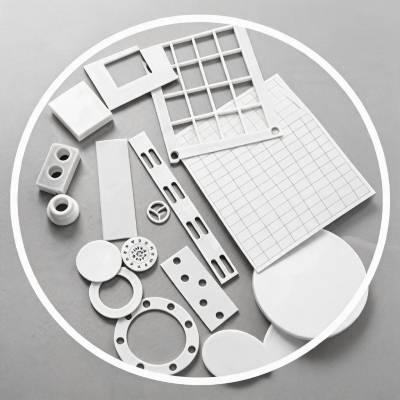
Piezoelectric & Optical Sensors: Processing Zirconia and advanced technical ceramics without triggering micro-structural phase transformations or thermal edge chipping.
To ensure total elimination of micro-cracks and maximize structural yields in advanced ceramic micro-machining, Chanxan Laser recommends the following professional industrial configurations:
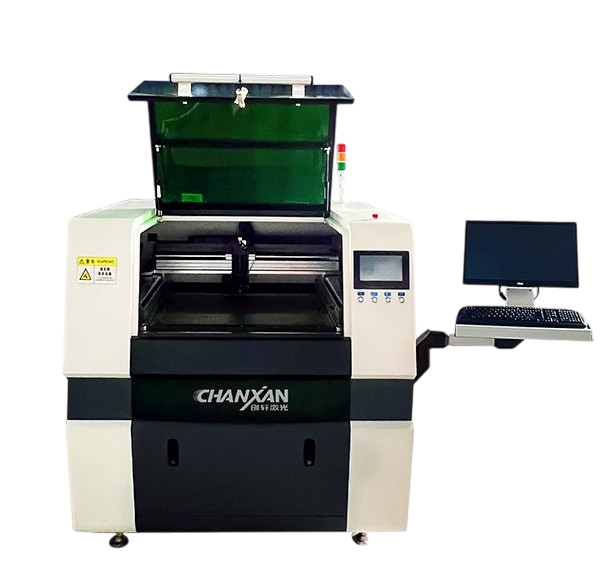
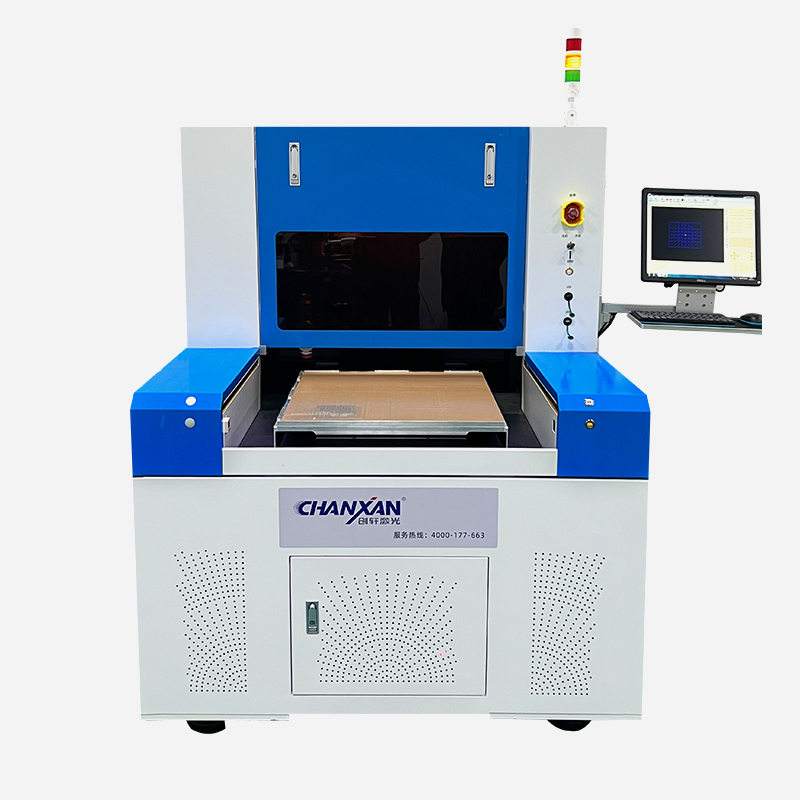
The flagship solution for absolute crack-free micromachining of advanced ceramics. This system supports multiple laser sources options, including high-performance ultra-short picosecond green or UV configurations, completely eliminating thermal shock defects via cold sublimation ablation.
Multi-Light Options: Flexible optical path integration tailored for various ceramic absorption profiles.
Thermal Management: Reduces the localized thermal footprint to a minimum.
Micro-Hole Quality: Absolute zero micro-crack propagation on fragile Alumina, Aluminum Nitride, and Zirconia matrices.
Best Suited For: Ultra-precise micro-vias, semiconductor packaging, and submicron electronics.
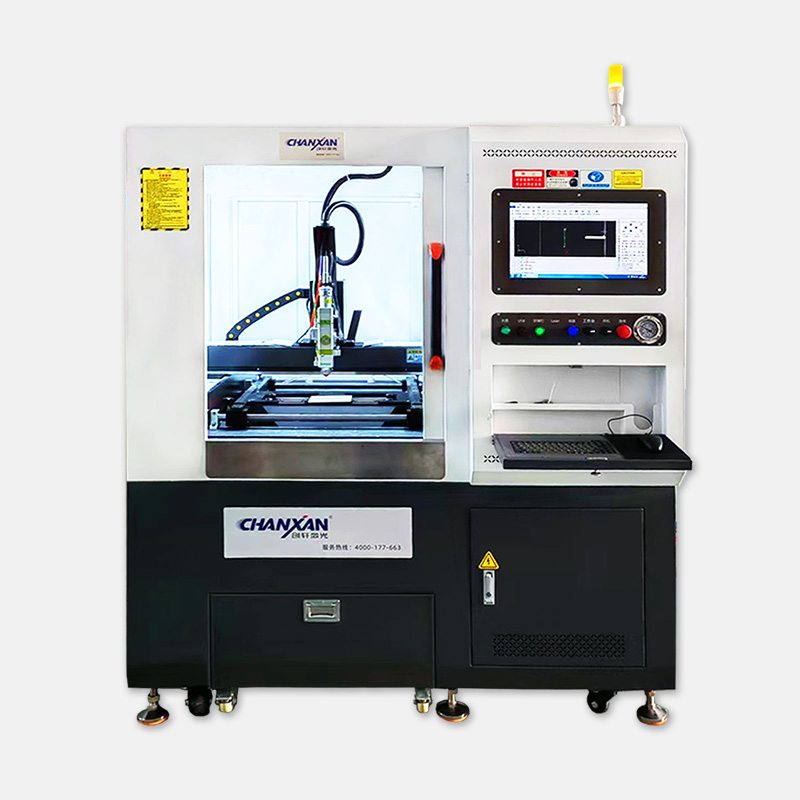
A high-precision industrial workhorse utilizing Quasi-Continuous Wave fiber laser technology. Delivering exceptionally high peak power combined with low average energy output, it provides excellent efficiency and control for fine-kerf ceramic cutting and micro-drilling pathways.
High Peak Power: Rapidly punctures materials with minimized energy bleeding to limit edge chipping.
Trepanning Compatibility: Syncs perfectly with high-speed digital galvo modules for smooth concentric drilling.
Cost-Effectiveness: Exceptional speed-to-yield ratio for structured technical ceramic panels.
Best Suited For: High-efficiency ceramic singulation, structural profiling, and micro-via arrays.
Q: Does applying water or liquid cooling during laser drilling prevent ceramic cracking?
A: No. In fact, liquid cooling often exacerbates the problem. Introducing water creates an even steeper, more violent thermal shock gradient against the hot laser impact point, accelerating immediate thermal shock fracturing. The correct industry approach is dry cold ablation using ultra-short pulse configurations combined with low-pressure Nitrogen or clean dry air to clear flying dust particles.
Q: What thickness limits apply to crack-free Alumina picosecond laser drilling?
A: The ideal range for maintaining absolute zero micro-cracks and perfect hole verticality is under small limits for standard Alumina boards. For thick substrates, the beam waist focus naturally disperses inside the deep hole, slightly increasing heat retention. For ultra-thick setups, customized multi-step focal-shifting software paths are integrated to relocate the focal plane dynamically.
Q: Can this process be applied to Aluminum Nitride and Zirconia substrates as well?
A: Yes. Aluminum Nitride features a significantly higher thermal conductivity than Alumina, meaning it bleeds heat even faster and demands tight pulse timing. Zirconia is highly sensitive to phase transformations under thermal strain. Chanxan's advanced micro-machining parameters can be tuned seamlessly via software to drill crack-free matrices across all technical ceramics.
Disclaimer: To protect intellectual property and honor customer Non-Disclosure Agreements, specific corporate background details in application scenarios have been anonymized. However, all technical processing parameters, workflow data matrices, and operational cost-effectiveness metrics remain fully verified by Chanxan Laser's engineering applications laboratory.
| Free solution
Previous: Why Green Laser Technology Dominates Copper Substrate Cutting in Power Electronics
Next: Laser Coverlay Cutting vs Mechanical Die Punching: Cost-Effectiveness Comparison