
Key Words: Silicon Wafer Dicing PCB Depaneling Glass Cutting
Home > News > Industry News
【Description】:
By restricting energy delivery to a window shorter than the material's internal thermal diffusion constant, ultrafast laser systems trigger pure non-thermal sublimation.
TL;DR (Too Long; Didn't Read)
In advanced micro-fluidics and semiconductor engraving, pulse width is the primary metric dictating channel floor morphology. Older photothermal regimes (nanosecond lasers) introduce high surface roughness due to hydrodynamic reflow, micro-waves, and re-solidified slag. Shifting to ultrafast regimes (picosecond and femtosecond) scales down surface roughness exponentially. By restricting energy delivery to a window shorter than the material's internal thermal diffusion constant, ultrafast systems trigger pure non-thermal sublimation ("cold ablation"). This suppresses molten recast development and delivers optical-grade micro-channel floors with sub-micron smoothness.
When configuring a standard nanosecond fiber or CO2 laser configuration, the pulse width sits broad enough (ranging from several nanoseconds to hundreds of nanoseconds) to allow continuous electron-to-lattice energy transfer. The primary removal mechanism here is photothermal. The laser heats the substrate matrix beyond its melting point, and an assist gas stream mechanically ejects the fluid core. However, surface tension and viscous forces within the liquid pool cause a percentage of the molten slag to cling to the micro-channel boundaries, cooling into irregular ripples, waves, and burrs. This hydrodynamic reflow cycle can cause surface roughness metrics (Ra) to spike into the multi-micron range.
Compressing the pulse width down to the picosecond window (10-12 seconds) radically disrupts the thermodynamic path. The pulse duration drops below the electron-phonon relaxation threshold of most industrial panels. Energy is deposited into target surface electrons with extreme peak power density, forcing direct solid-to-gas phase sublimation before broad thermal conduction fields develop. While localized shockwaves can still introduce minor mechanical perturbations along brittle ceramic or silicon channels, the absence of an active hydrodynamic melt pool drastically drops surface roughness, typically achieving a uniform semi-matte edge finish with an Ra below 1 µm.
The ultimate benchmark for achieving near-zero surface roughness belongs to the femtosecond regime (10-15 seconds). Because a femtosecond pulse delivers massive multi-photon excitation almost instantaneous relative to atomic lattice motion, the target matrix transitions directly into high-pressure plasma and expands outward via non-thermal ablation. The adjacent material boundaries experience virtually zero thermal load or structural relaxation stresses. This absolute confinement eliminates thermal stress micro-cracks, edge-rolling, and re-solidified dross, producing smooth vertical sidewalls and pristine, mirror-like channel floors measuring in the low nanometer roughness spectrum.
The following processing reference profile maps out expected roughness metrics, structural phase changes, and defect tendencies as the laser source scales from broad photothermal tracks down to ultrafast configurations:
| Laser Pulse Width Window | Primary Mass Removal Phase | Average Surface Roughness (Ra) | Dominant Channel Defect Profile |
|---|---|---|---|
| Nanosecond Fiber / CO2 (1 ns- 200 ns) | Photothermal Melting & Ejection | 3.5 μm – 12.0 μm | Heavy recast burrs, micro-waves, structural charring |
| Picosecond Ultrafast (5 ps - 15 ps) | Dominant Sublimation / Vaporization | 0.4 μm – 1.2 μm | Minor mechanical acoustic chipping, edge micro-fractures |
| Femtosecond Ultrafast (sub-400 fs) | Pure Non-Thermal Cold Ablation | Under 0.15 um | Absolute Zero (Prismatic mirror-like uniformity) |
Mitigating engraving surface roughness via ultra-short pulse manipulation is non-negotiable across high-spec processing fields where micro-scale imperfections cause catastrophic failures:
Lab-on-a-Chip Medical Diagnostics: Milling intricate capillary routing pathways into polymer or glass microfluidic chips. High surface roughness disrupts steady fluid flow, causing turbulent flow profiles, premature cell shear stress death, or air bubble trapping that ruins diagnostic accuracy.
Optoelectronic Waveguide Grating: Scribing reflective and transmissive optical tracks across sapphire, quartz, or technical glass panels. Keeping internal channel roughness within single-digit nanometer levels prevents stray optical scattering losses and preserves light signal fidelity.
Semiconductor MEMS Packaging: Patterning dense circuit insulation micro-channels and sensor slots into silicon or advanced technical ceramic submounts. Pristine, burr-free floor topologies ensure reliable component wire bonding and prevent localized electrical fields from arcing across uneven slag boundaries.
To resolve complex micro-channel geometry challenges and secure optical-grade roughness tolerances without expensive manual polishing steps, Chanxan Laser recommends the following specialized hardware solutions:
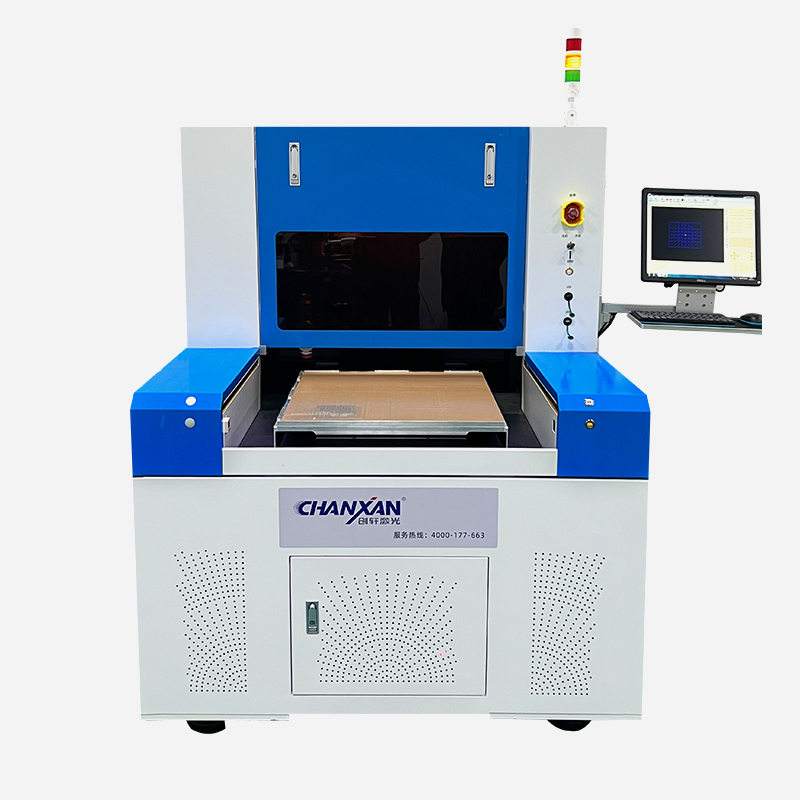
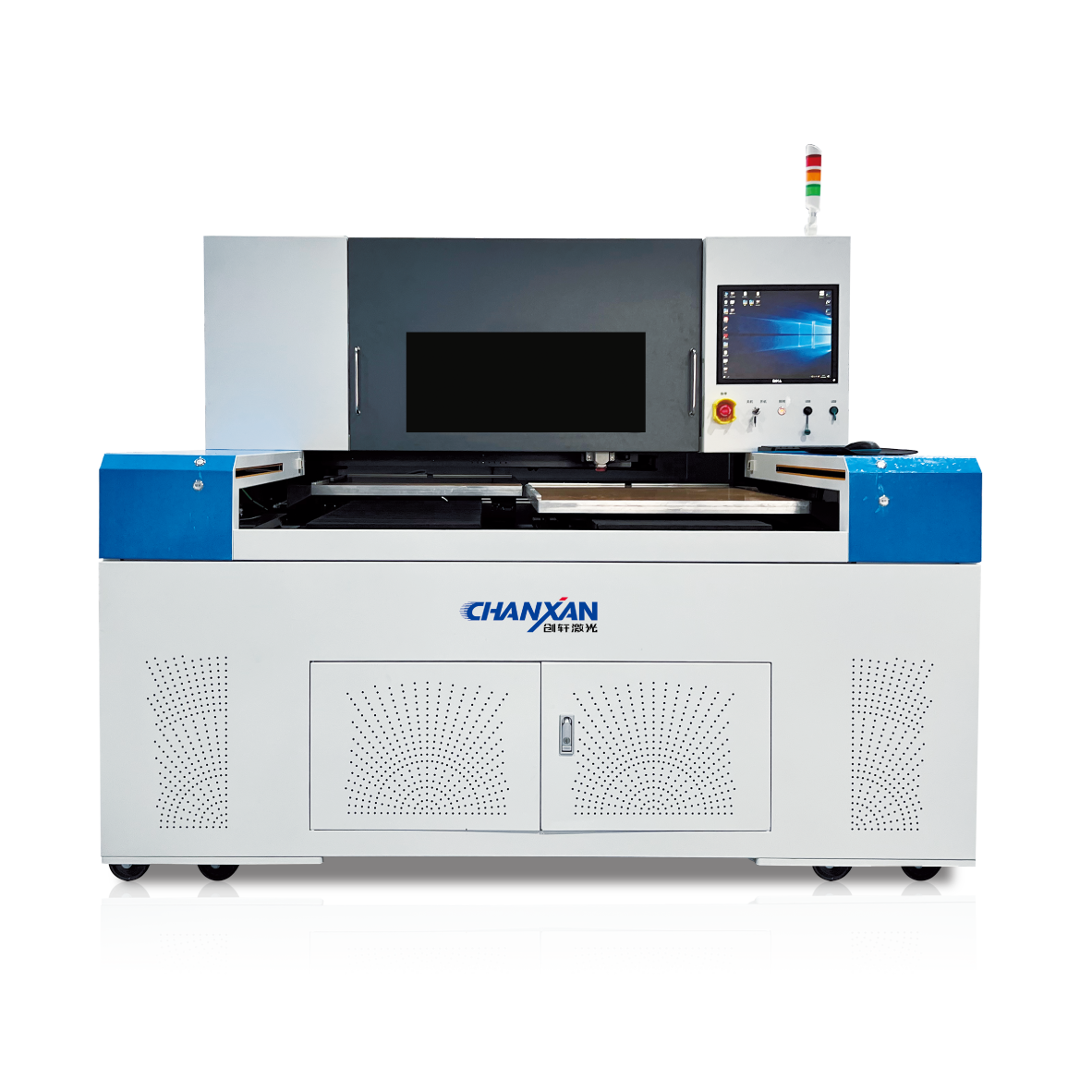
The absolute flagship platform designed for zero thermal stress and sub-micron engraving smoothness. By leveraging an ultra-short sub-400fs pulse width matrix, this platform completely isolates energy input from structural thermal diffusion, providing flawless non-thermal cold ablation.
Sub-400fs Pulse Width: Breaks molecular bounds instantly, bypassing liquid transformation cycles to eliminate recast burrs and heat-affected zones.
High-Stability Granite Bed: Fabricated on a premium granite foundation to eliminate ambient shop floor harmonic vibrations that can cause micro-waviness along deep channels.
Best Suited For: Transparent glass microfluidic diagnostic cells, sub-micron optoelectronic waveguides, and ultra-thin semiconductor die scribing.
A premium, high-throughput manufacturing system designed to optimize cost-to-performance metrics on dense industrial components. It features fine pulse synchronization options and extreme peak power delivery to deliver clean, flat trenches across tough technical substrates.
Software-Driven Burst Modulations: Allows operators to configure high-frequency pulse burst patterns that optimize material ablation rates while keeping accumulated edge roughness well within specification.
Multi-Light Engine Configuration Options: Supports seamless optical engine integration across UV, Green, or Infrared spectrums to align laser output with specific material absorption characteristics.
Best Suited For: Advanced technical ceramic submount engraving, flexible PCB layout via arrays, and industrial sapphire dicing cycles.
Q: Does lowering the pulse width mean the engraving material removal rate slows down?
A: Generally, yes. Because ultrafast pulses carry smaller fractional energy quantities per single pulse compared to heavy nanosecond bursts, total volumetric material removal is typically lower.
Q: How does the overlap ratio of the laser spot interact with pulse width regarding roughness?
A: They are tightly coupled. Even with a perfect femtosecond pulse width, if the galvo scanner's spot overlap ratio is configured incorrectly (e.g., too low), the channel floor will display a scallop-like trench tooth profile.
Q: Can assist gas selections alter the final roughness inside ultrafast engraved grooves?
A: In photothermal nanosecond configurations, gas type and pressure drastically alter roughness because high-pressure streams are needed to mechanically push liquid slag out of the kerf.
Disclaimer: To protect intellectual property and honor customer Non-Disclosure Agreements (NDAs), specific corporate background details in application scenarios have been anonymized. However, all technical processing parameters, workflow data matrices, and operational cost-effectiveness metrics remain fully verified by Chanxan Laser's engineering applications laboratory.
| Free solution
Previous: How to Choose Between a UV Laser and a Fiber Laser for Precision Plastics Cutting?
Next: Why Is Galvo Scanner Accuracy More Critical Than Linear Motor Speed in Micro-Cutting?