
Key Words: Silicon Wafer Dicing PCB Depaneling Glass Cutting
Home > News > Industry News
【Description】:
Choosing between UV and fiber wavelengths for high-precision plastic fabrication depends on material composition and acceptable thermal limits.
TL;DR (Too Long; Didn't Read)
Choosing between UV and fiber wavelengths for high-precision plastic fabrication depends on material composition and acceptable thermal limits. Fiber lasers (1064nm) rely on rapid photothermal heating, making them high-throughput tools for thick, robust engineering plastics like nylon, polycarbonates, and glass-filled polymers where minor edge discoloration is acceptable. Conversely, UV lasers (355nm) utilize high-energy photons to trigger non-thermal photo-chemical "cold ablation." This makes UV the definitive choice for sensitive, ultra-thin substrates like PI, PET, and Teflon, where preventing carbonization, melted burrs, and heat-affected zones (HAZ) is critical.
Industrial fiber lasers operate natively at a near-infrared wavelength of 1064nm. At this frequency, energy transmission relies heavily on thermal absorption. The laser rapidly heats the polymer matrix beyond its vaporization or degradation point. While highly efficient for fast processing speeds on thick sheets, many clear, white, or highly transmissive polymers exhibit very low intrinsic absorption at 1064nm. This causes the beam to pass straight through or disperse broadly, depositing sub-threshold thermal energy that produces structural melting, bubbling, and heavy yellow or black carbonization soot along the cut kerf.
Solid-state UV lasers utilize frequency-tripling crystals to deliver a short ultraviolet wavelength of 355nm. This short wavelength provides massive single-photon energy that alters the cutting mechanism completely. Instead of relying on heat to boil the plastic, UV photons possess enough energy to break the molecular covalent bonds holding the polymer chains together. This process, known as photo-chemical "cold ablation," transitions the solid plastic directly into volatile gas fragments. Because the energy is consumed instantly by breaking bonds rather than generating heat, thermal conduction to the adjacent plastic is virtually eliminated.
The chemical composition of the plastic dictates which laser source is viable. For instance, Polyimide (PI)—extensively used in flexible printed circuits—absorbs 355nm UV light exceptionally well, enabling clean cuts without charring. Similarly, thin materials like Polyethylene Terephthalate (PET) or Fluoropolymers (Teflon/PTFE) require the cold precision of UV to prevent severe edge curling and shrinking. On the other hand, robust engineering plastics like Polycarbonate (PC), Acrylonitrile Butadiene Styrene (ABS), and glass-reinforced nylons respond well to high-frequency fiber pulse arrays, provided minor melting can be controlled or post-processed.
The following matrix compares performance metrics, edge qualities, and typical material processing limits to guide your laser infrastructure investment:
| Processing Metric / Parameter | 355nm Ultraviolet (UV) Laser System | 1064nm Near-Infrared Fiber Laser System |
|---|---|---|
| Primary Removal Mechanism | Photo-Chemical Cold Ablation (Bond Breaking) | Photothermal Vaporization (Melting) |
| Heat Affected Zone (HAZ) | Near-Zero (No micro-melting or warping) | Moderate to High (Risk of edge recasting) |
| Optimal Substrate Thickness | Ultra-thin films (Under 0.5mm) | Thick panels and structures (1.0mm to 5.0mm+) |
| Focused Beam Spot Size | Ultra-Fine (Typically 10μm - 20μm) | Standard (Typically 30μm - 50μm) |
| Kerf Edge Carbonization | None (Prismatic, clean crisp edges) | Varies (Frequent soot/yellowing on light plastics) |
| Primary Material Fit | PI, PET, FPC Boards, Thin Teflon, Medical Polymers | Opaque ABS, Polycarbonate, Nylon, Carbon Fiber Composites |
Aligning laser wavelength with your industry specifications is essential for maximizing yield and avoiding part rejection:
Flexible Printed Circuits (FPC) and Microelectronics: Scribing, profile routing, and drilling coverlays on flexible copper-clad polyimide laminates. A UV laser is required here because fiber lasers generate excessive heat that causes the thin copper layers to delaminate and strips away structural insulation.
Medical Device Catheters and Inlays: Cutting complex micro-slots or multi-lumen profiles on biocompatible plastics like Pebax, Polyurethane, or PEEK. UV processing leaves zero carbonized soot or recast burrs, ensuring the components pass strict biocompatibility and surface cleanliness audits without manual scraping.
Automotive Structured Interior Plastics: Trimming molded ABS/PC instrument covers or texturing carbon-fiber-reinforced polymer (CFRP) panels. Fiber lasers excel in these workflows, utilizing raw average power and high travel speeds to slice through thick, rigid sections efficiently where sub-micron edge tolerances are less critical.
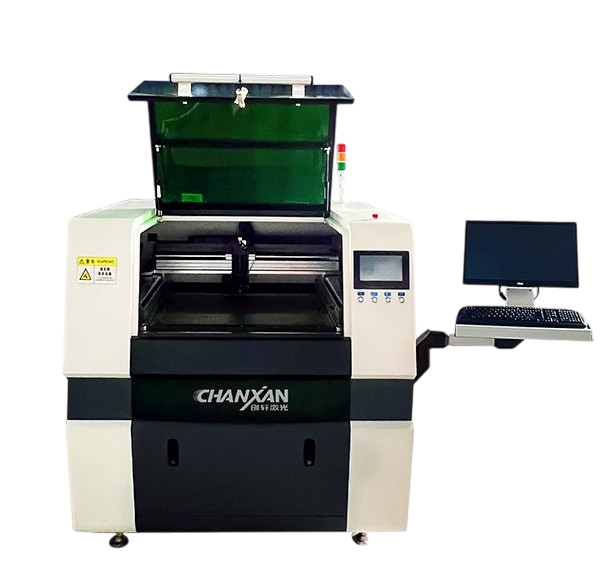
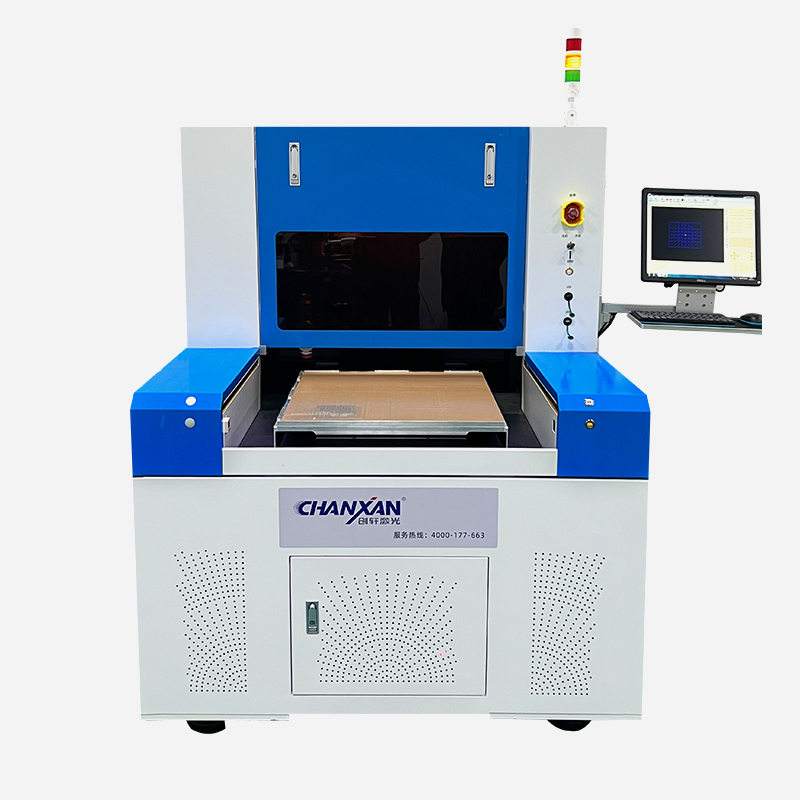
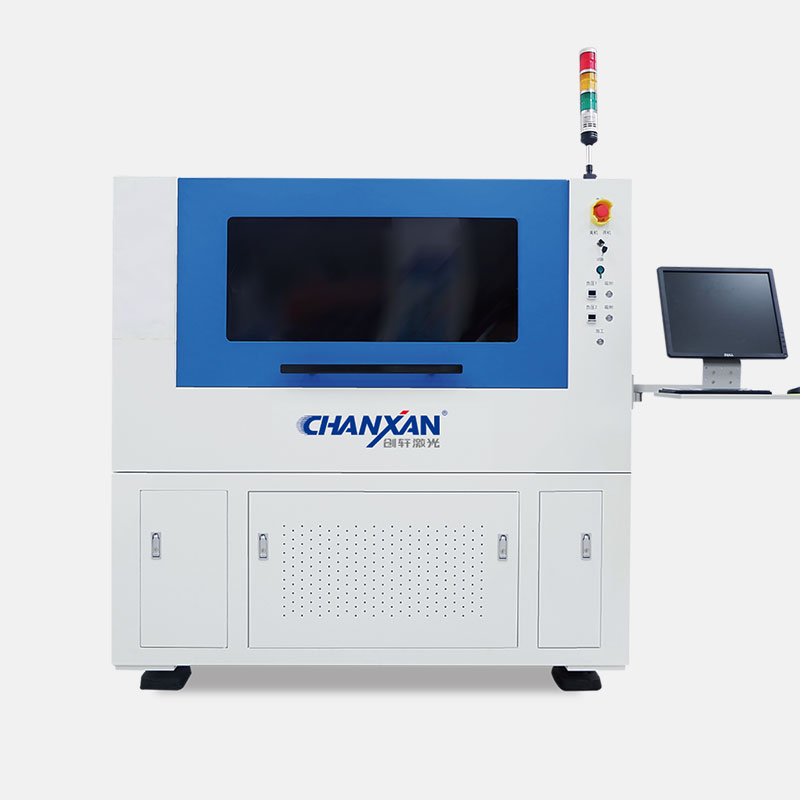
To implement high-yield industrial plastic cutting setups and ensure stable, long-term processing accuracy, Chanxan Laser offers specialized precision production platforms:
An ultra-precision platform configured with high-end Solid-State Ultraviolet (UV) or Green laser engines. Engineered with a short picosecond pulse duration, it is optimized for high-value micro-cutting tasks that demand zero thermal stress and zero edge carbonization.
Cold Photo-Chemical Processing: Operates at 355nm to break molecular bonds cleanly, ensuring zero melting or edge deformation on delicate films like PI and PET.
Vibration-Damped Granite Core: Assembled on a solid granite base to neutralize factory floor harmonics, keeping structural accuracy within sub-micron tolerances during 24/7 manufacturing.
Best Suited For: Advanced FPC routing, medical catheter hole drilling, thin polymer film stripping, and semiconductor wafer dicing.
Q: Why do some clear plastics like clear Acrylic cut beautifully with CO2 lasers but poorly with Fiber lasers?
A: This comes down to material absorption curves. Clear acrylic has high optical absorption at long infrared wavelengths, enabling smooth vaporization and flame-polished edges. However, it is nearly transparent at the 1064nm fiber wavelength, causing the beam to pass straight through without cutting, or scatter and melt the material. For thin, complex plastics, UV offers a versatile alternative.
Q: Can we use a Fiber laser to cut plastics if we add pigments or carbon black additives?
A: Yes. Adding carbon black or specialized infrared absorbers to a polymer increases its absorption at 1064nm, allowing a fiber laser to cut it efficiently. However, if your application requires pristine white, optical clarity, or medical-grade purity, adding pigments may not be an option, making a UV laser the ideal choice.
Disclaimer: To protect intellectual property and honor customer Non-Disclosure Agreements (NDAs), specific corporate background details in application scenarios have been anonymized. However, all technical processing parameters, workflow data matrices, and operational cost-effectiveness metrics remain fully verified by Chanxan Laser's engineering applications laboratory.
| Free solution
Previous: What Are the Hidden Maintenance Costs of Ultra-Fast (Picosecond/Femtosecond) Laser Systems?
Next: How Does Pulse Width Affect the Surface Roughness of Laser-Engraved Micro-Channels?