
Key Words: Silicon Wafer Dicing PCB Depaneling Glass Cutting
Home > News > Industry News
【Description】:
For electronics manufacturers migrating from mechanical dies or CNC routing to ultrafast laser technology, the timeline to achieve a complete Return on Investment (ROI) typically spans 8 to 14 months.
TL;DR (Too Long; Didn't Read)
For electronics manufacturers migrating from mechanical dies or CNC routing to ultrafast laser technology, the timeline to achieve a complete Return on Investment (ROI) typically spans 8 to 14 months. While high-precision laser equipment represents a significant upfront capital expenditure, it eliminates ongoing secondary costs. By completely removing expensive custom tooling dies, slashing substrate scrap rates through high-density nested panel designs, and delivering a zero-stress cutting pass that ends component reject rates, the system self-funds rapidly through increased daily manufacturing throughput and raw yield improvements.
Traditional mechanical routing, die-punching, and V-scoring methods demand a continuous stream of physical consumables. Punching dies require expensive custom-machined steel rules or carbide matrices for every unique circuit profile change, which can add thousands of dollars to production costs and create significant lead-time delays. Mechanical router bits degrade rapidly when cutting abrasive technical ceramics or glass-filled epoxies, requiring frequent replacement and operator interventions. High-precision laser systems utilize digital vector profiles instead of physical molds, allowing factory teams to switch production batches instantly without custom tooling bills or physical wear overheads.
Mechanical router bits require a wide channel (often 1.0mm to 2.0mm) to move through panel arrays without snapping, forcing engineers to design wide margins between adjacent circuit units. High-precision ultraviolet or ultrafast lasers focus light down to an ultra-fine kerf width measuring under 20µm. This narrow beam profile enables tight component nesting, cutting down individual unit spacing to fractional millimeter boundaries. Squeezing more operational circuits out of a single expensive multi-layer panel dramatically lowers material scrap rates and boosts daily revenue.
Mechanical routing applies stress to the edges of boards, which can lead to micro-cracking, trace delamination, or internal short circuits. Similarly, die punching often causes fiber fraying and structural burrs that require manual deburring steps before final assembly. Ultra-short pulse (USP) lasers rely on cold ablation to transition polymer substrates directly into volatile gas fragments without generating liquid slag or applying mechanical shear. This cleaner process protects sensitive SMD components from shock damage, lowering component reject rates and saving money on quality control reworks.
The following overview highlights the operational variables and savings areas that help determine how quickly high-precision laser automation pays for itself over standard production setups:
| Cost Center / Operational Variable | Traditional Mechanical Routing / Die Punching | High-Precision Vision-Guided Laser Systems |
|---|---|---|
| Initial Capital Outlay (CapEx) | Low to Moderate (Basic machinery costs) | High initial infrastructure investment |
| Consumable / Tooling Overhead | Continuous replacement of custom dies and router bits | Near-Zero (Software-driven digital vector profiles) |
| Batch Changeover Downtime | High (Manual tool alignment and calibration changes) | Instant (Digital profile selection in seconds) |
| Average Board Edge Yield | 92% – 96% (Losses due to stress fractures and burrs) | >99.8% (Pristine, non-thermal processing cuts) |
| Material Scrap Recovery Rate | Poor (Forced wide spacing for router clearance) | Excellent (Tight nesting minimizes wasted substrate material) |
To calculate your specific ROI window, your engineering and finance teams should monitor a few key operational variables:
Equipment Utilization Rates and Production Volume: Laser systems deliver their fastest payback periods in factories running multi-shift, high-volume production lines.
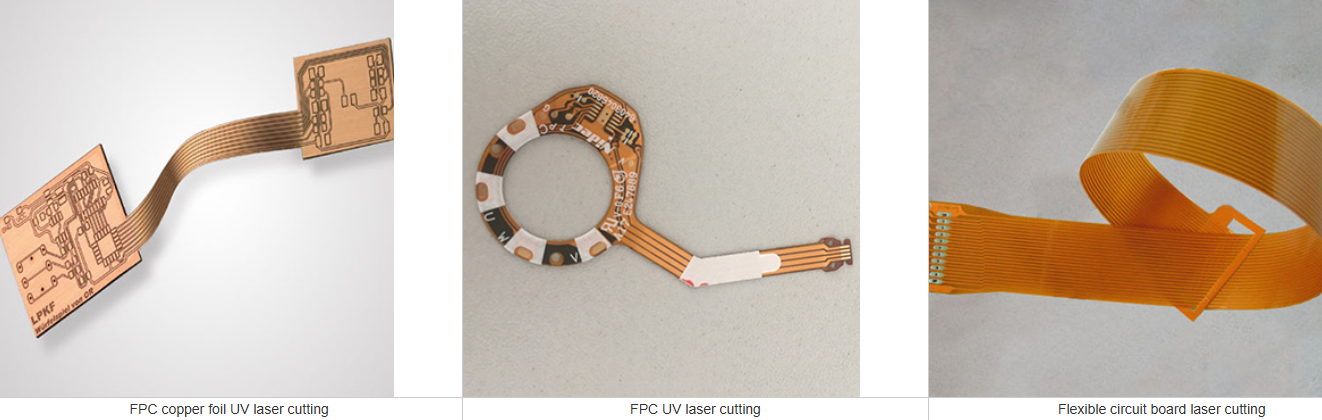
Material Complexity and Layer Densities: Processing complex substrates like polyimide (PI) flexible circuits, rigid-flex arrays, or thin technical ceramics yields an immediate return on investment. The high raw cost of these advanced materials means even small reductions in scrap or edge damage add up to significant financial savings.
Upstream Vision-Guided Integration: Using high-resolution machine vision registration helps safeguard production yields. By scanning custom fiducial markers on panels in real time, the system automatically detects and compensates for any non-linear shrinkage or etching distortions from earlier production steps, keeping cuts accurate and preventing expensive board tracking errors.
To lower long-term maintenance costs and keep your precision line running reliably, Chanxan Laser integrates protective sub-systems and operates specialized manufacturing infrastructures:
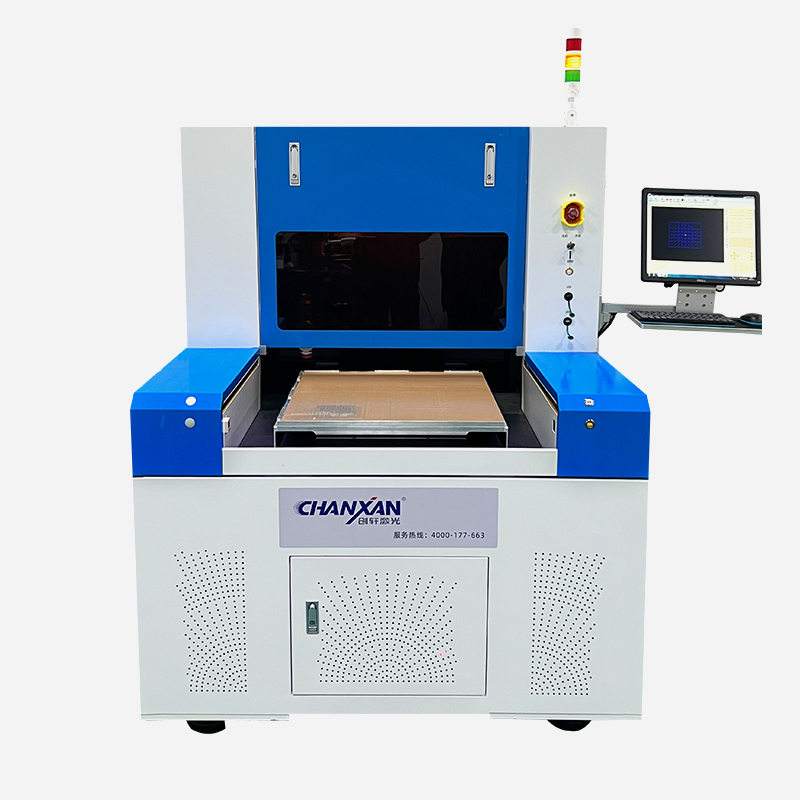
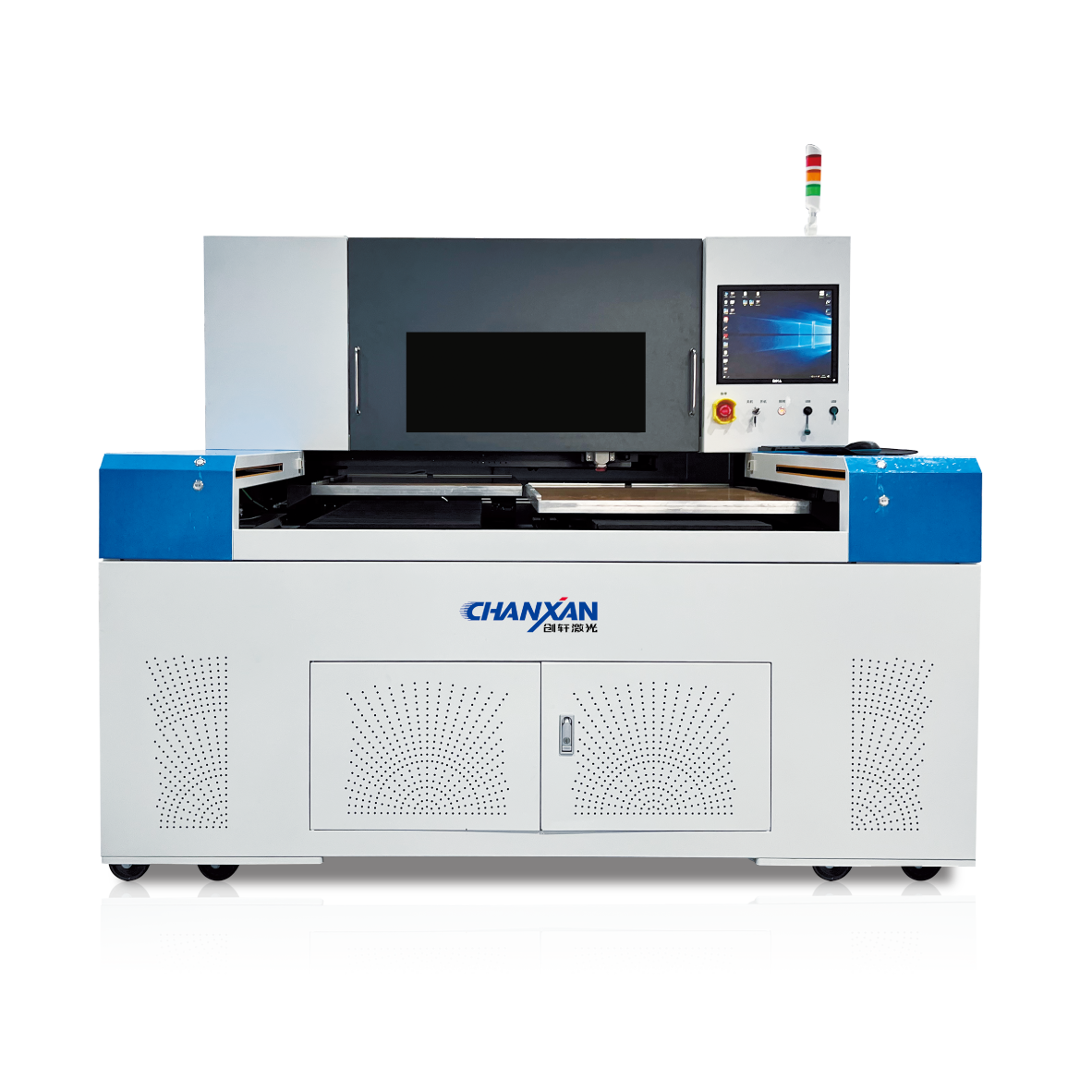
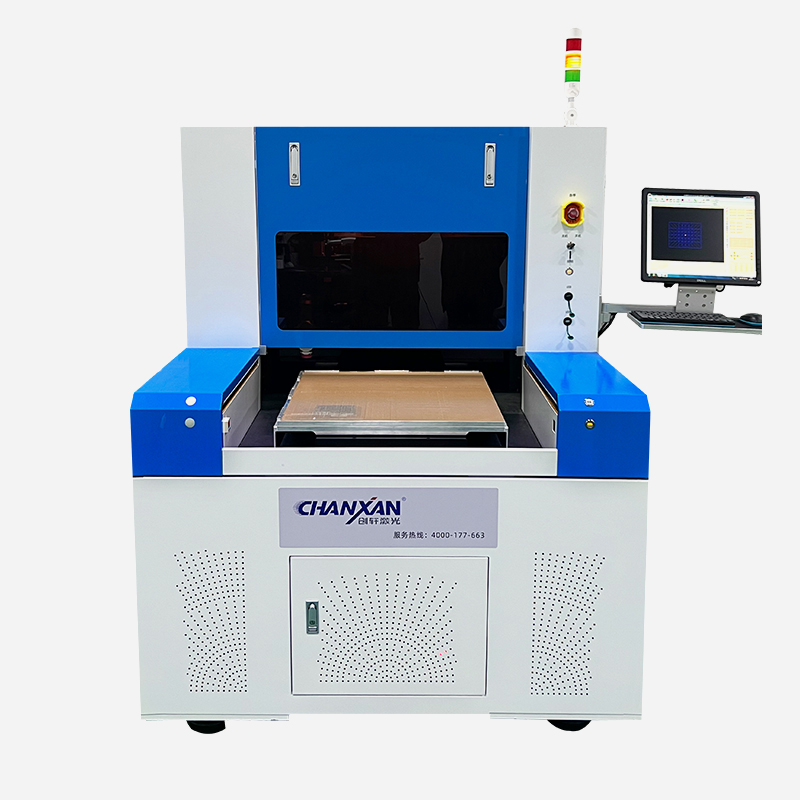
Housed in a heavy-duty, dual-tone fully enclosed safety cabin, this micro-machining workstation is optimized for high-yield operations that demand absolute power repeatability. The CW-6050PZ features an integrated high-visibility viewing window, a top-mounted tri-color LED status tower, and an articulated monitor arm for seamless real-time process management.
Coaxial Smart Vision Mapping: Integrates high-resolution machine vision registration to capture panel distortions in real time, pairing spatial tracking precision with stable pulse energy delivery.
Automated Intracavity Crystal Shifting: Features software-driven crystal shifting logic that automatically realigns the conversion path to fresh crystal coordinates, preserving stable UV output across thousands of operational hours.
Vibration-Isolated Granite Base: Built on a premium granite foundation to neutralize workshop floor harmonics, protecting sensitive intracavity mirrors from micro-misalignments.
Best Suited For: Multi-layer flexible printed circuit (FPC) routing, micro-scale coverlay laser skiving, and precision technical ceramic dicing.
Q: How does the higher initial cost of an ultrafast laser translate into better financial returns than a CO2 laser?
A: CO2 lasers rely on a thermal cutting mechanism that can cause edge charring and a wider heat-affected zone (HAZ) on delicate materials like polyimide. This often requires secondary manual washing or chemical cleaning steps to remove soot. Ultrafast systems use cold ablation to deliver a clean, burr-free cut, eliminating those extra manual processing steps and helping the equipment pay for itself faster.
Q: What are the main utility costs to consider when updating our facility budget for an ultrafast laser workstation?
A: The primary utility costs come from running the high-stability chiller and the multi-stage exhaust filtration unit. To ensure stable power delivery, the laser head must be paired with an active dual-loop PID chiller. Adding up the electricity costs for this thermal regulation and the compressed air supply gives a complete picture of your daily operational expenses.
Q: Can we use a single high-precision laser machine to process different types of PCBs on the same production line?
A: Yes. Because the cutting path is entirely software-controlled, you do not need to pause production for physical tool adjustments. Technicians can switch between rigid FR4 panels, flexible PI sheets, and rigid-flex arrays simply by loading different digital profiles in the software, helping to keep production moving efficiently and shortening your path to a full return on investment.
Disclaimer: To protect intellectual property and honor customer Non-Disclosure Agreements (NDAs), specific corporate background details in application scenarios have been anonymized. However, all technical processing parameters, workflow data matrices, and operational cost-effectiveness metrics remain fully verified by Chanxan Laser's engineering applications laboratory.
| Free solution
Previous: Why Is UV Laser Cutting Preferred Over Mechanical Die Punching for Flex PCB Laser Cutting?
Next: Why Is Vision Registration Vital for High-Yield FPC Laser Cutting Automation?