
Key Words: Silicon Wafer Dicing PCB Depaneling Glass Cutting
Home > News > Industry News
【Description】:
By utilizing high-resolution CCD cameras to capture microscopic fiducial markers in real time, the laser automation control system instantly calculates the exact offset, rotation, and scaling deviations.
TL;DR (Too Long; Didn't Read)
In high-volume Flexible Printed Circuit (FPC) manufacturing, traditional fixed-coordinate laser cutting inevitably triggers severe alignment rejects. Because polymer substrates like Polyimide (PI) contract and warp during wet chemical etching and plating cycles, the physical circuit layout never matches the original rigid CAD file. Machine vision registration resolves this structural variable. By utilizing high-resolution CCD cameras to capture microscopic fiducial markers in real time, the laser automation control system instantly calculates the exact offset, rotation, and scaling deviations. This micro-second computational alignment shrinks tracking errors to the single-digit micron spectrum, guaranteeing burr-free cuts, eliminating traces of copper delamination, and driving factory yield boundaries to maximum efficiency.
Flexible Printed Circuits rely on ultra-thin, highly flexible layers of Polyimide (PI) or Polyester base films laminated with conductive copper foils. While excellent for compact, dynamic electronic packaging, these base polymers possess high coefficients of thermal expansion (CTE) and hygroscopic expansion. During upstream fabrication phases—such as high-temperature baking, chemical etching, copper electroplating, and coverlay lamination—the FPC panel undergoes active structural stress relief. This leads to non-uniform sheet shrinkage, stretching, and localized material warping across the panel matrix, making blind, fixed-coordinate mechanical positioning obsolete.
To maximize throughput, FPCs are processed in large panelized arrays containing dozens of individual circuit units. Minor processing distortions might remain negligible on a single localized part, but across a wide-area panel, these structural variations accumulate exponentially. If an automated laser profile cutter relies solely on mechanical panel edge stops or basic indexing pins, a slight 0.05mm distortion at the panel center can scale into a catastrophic 0.25mm alignment error near the outer boundaries. This accumulation shifts the laser beam path directly onto active copper traces, causing expensive component destruction.
Modern multi-layer FPCs feature incredibly dense signal routing, where the isolation gap between an active copper trace and the dead-zone cutting line drops below 50µm. Without active position tracking, standard processing drifts can cause the laser spot to clip the copper perimeter. This contact leads to immediate trace exposure, localized insulation degradation, or fine copper burr creation that bridges adjacent layers, causing latent short circuits that fail quality control audits. Real-time vision registration ensures the beam remains precisely centered within designated cutting channels.
Industrial machine vision registration transforms laser hardware from a blind execution tool into an intelligent, adaptive processing system. The automated optimization routine executes across three distinct processing horizons:
| Alignment Phase | Hardware / Software Interaction Protocol | Target Correction Output |
|---|---|---|
| 1. Fiducial Capture | A coaxial CCD camera scans target optical markers (circles, crosses, or squares) utilizing specialized ring-light illumination profiles. | High-contrast digital pixel mapping of actual physical positioning coordinates. |
| 2. Deviation Mapping | Edge-detection algorithms compare captured pixel centers against theoretical CAD references, calculating offset, roll, and scale factors. | Instant generation of an individualized geometric error correction matrix. |
| 3. Dynamic Execution | The control architecture adjusts galvanometer mirror angles and linear motor stages to match the newly computed processing paths. | Taper-free vector profile tracking aligned with the distorted substrate geometry. |
Integrating high-precision vision registration into an automated FPC production line delivers immediate operational benefits, transforming processing yields and raw cost efficiency:
Elimination of Expensive Mechanical Tooling: Traditional die-punch cutting demands bespoke steel rule dies or hard carbide male/female matrix tools for every unique circuit profile. Machine vision allows operators to load a digital vector script instantly, adapting seamlessly to changing component layouts without tooling lead times or physical wear overheads.
Optimized Nesting Density and Material Utilization: Because vision-guided lasers scan exact component boundaries in real time, engineers can nest adjacent circuit profiles tightly together, reducing individual unit spacing down to fractional millimeter boundaries. This nesting layout drastically lowers sheet scrap rates on expensive polyimide base materials.
Traceable Quality Metrics for Automated Assembly Lines: Advanced vision controllers automatically log positional error histories and coordinate offset shifts for every processed unit. This database provides production engineers with complete statistical process control (SPC) data to isolate upstream printing or etching variations before they cause defects.
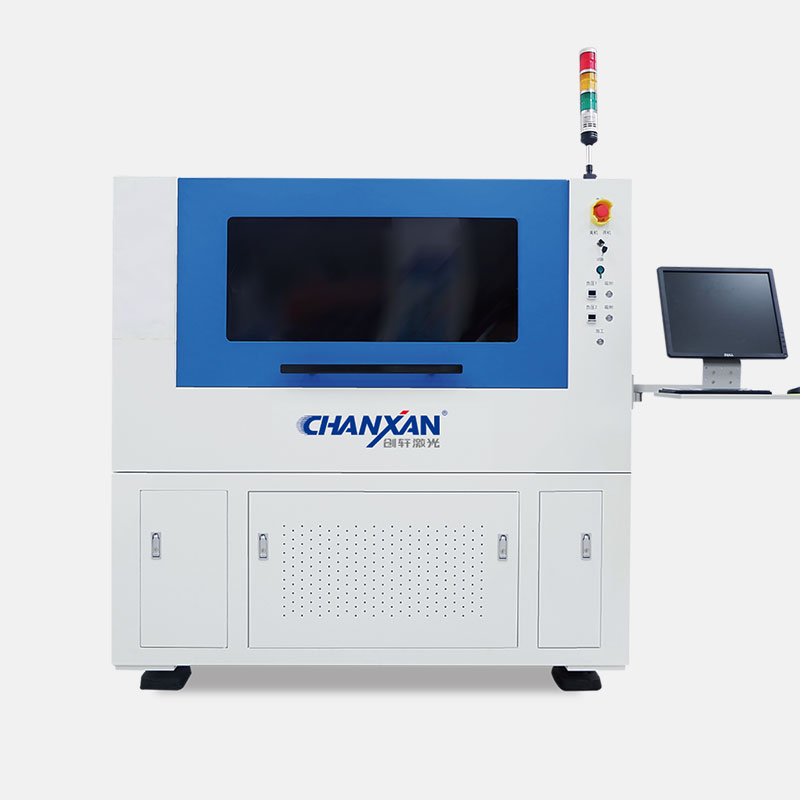
To satisfy the strict single-digit micron tolerances demanded by global consumer electronics and medical hardware assembly standards, Chanxan Laser integrates premium machine vision sub-systems into our advanced micro-machining workstations:
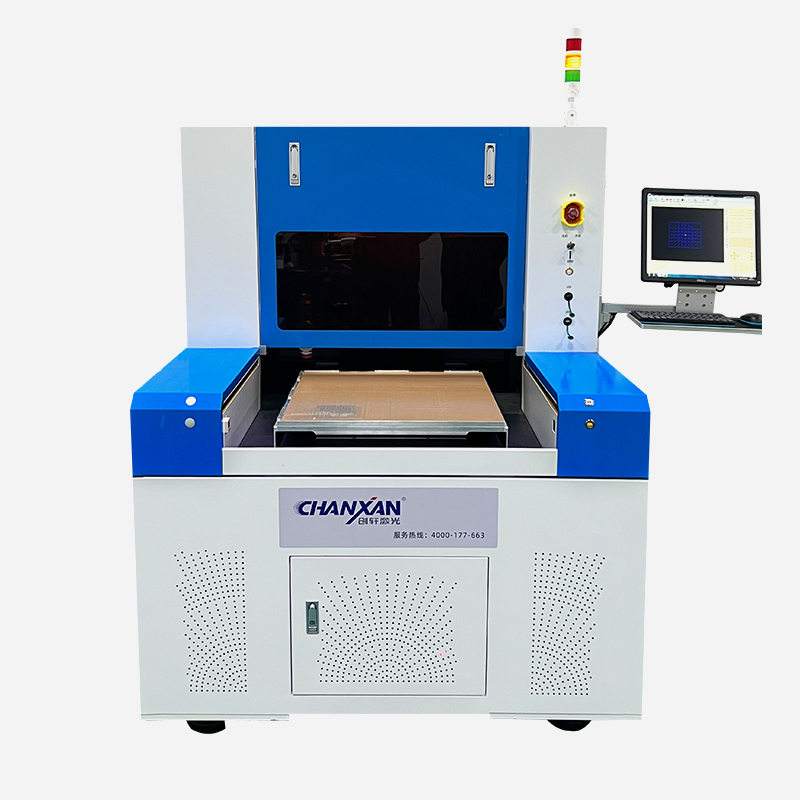
Housed in a heavy-duty, dual-tone fully enclosed safety cabin, this system is engineered to deliver high-yield FPC profile profiling and coverlay skiving. The CW-6050PZ pairs high-energy picosecond cold sublimation with a smart vision registration matrix to eliminate carbonization defects completely. Its ergonomic form factor includes an integrated high-visibility viewing window, a top-mounted tri-color LED status tower, and an articulated monitor arm for seamless operator interaction.
Coaxial Smart Vision Mapping: Utilizes high-resolution, through-the-lens (TTL) industrial cameras to eliminate parallax errors, capturing micro-fiducials reliably even through semi-transparent coverlay films.
Ultra-Short Picosecond Wavelength Delivery: Operates at 355nm (Ultraviolet) or 532nm (Green) to break polymer molecular chains cleanly, guaranteeing zero edge-melting or board warping.
Granite Isolation Bed: Built on a solid granite foundation to absorb workshop floor harmonic vibrations, keeping structural tracking accuracy stable across 24/7 manufacturing shifts.
Best Suited For: Multi-layer flexible printed circuit profiling, dense rigid-flex PCB border routing, and micro-scale coverlay laser skiving.
Our absolute flagship platform designed for zero-stress microfluidic and medical electronics processing. Assembled within Chanxan's state-of-the-art Class 1000 dust-free cleanroom facility, the CW-6050FZ features a low-center-of-mass cabinet architecture that guarantees absolute environmental stability. It integrates sub-400fs ultrafast engines with continuous vision alignment to achieve pristine, burr-free vector boundaries.
Advanced Sub-400fs Pulses: Bypasses the liquid phase change completely via pure non-thermal sublimation, preventing thermal stress micro-cracks and dross re-solidification.
Dynamic On-the-Fly Scanning Alignment: Continuously adjusts galvanometer tracking trajectories dynamically as the axis traverses, compensating for multi-directional warping across complex panels.
Fully Sealed Beam Path Enclosure: Protects high-end anti-reflective optics from airborne debris, lowering long-term maintenance costs and protecting beam consistency.
Best Suited For: High-density interconnect (HDI) circuit drilling, biocompatible medical micro-implants, and premium transparent optoelectronic cutting.
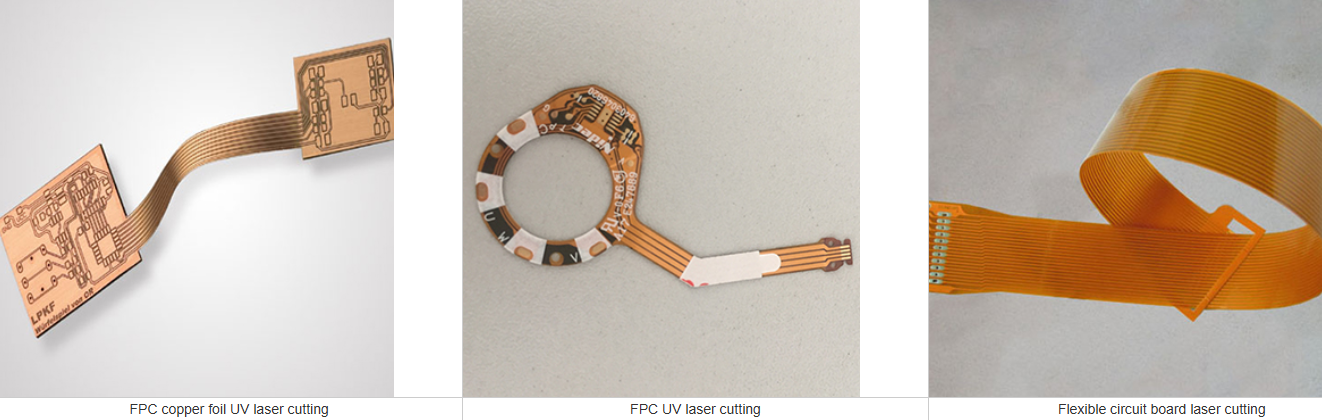
Disclaimer: To protect intellectual property and honor customer Non-Disclosure Agreements (NDAs), specific corporate background details in application scenarios have been anonymized. However, all technical processing parameters, workflow data matrices, and operational cost-effectiveness metrics remain fully verified by Chanxan Laser's engineering applications laboratory.
| Free solution
Previous: How Long Does It Take to Achieve ROI on a High-Precision PCB Laser Cutting Machine?
Next: What Are the Hidden Maintenance Costs of Ultra-Fast (Picosecond/Femtosecond) Laser Systems?