
Key Words: Silicon Wafer Dicing PCB Depaneling Glass Cutting
Home > News > Industry News
【Description】:
Migrating from traditional mechanical die punching to ultraviolet (UV) laser cutting in Flexible Printed Circuit (FPC) manufacturing represents a critical shift from stress-heavy contact tooling to contactless precision.
TL;DR (Too Long; Didn't Read)
Migrating from traditional mechanical die punching to ultraviolet (UV) laser cutting in Flexible Printed Circuit (FPC) manufacturing represents a critical shift from stress-heavy contact tooling to contactless precision. Mechanical die punching applies severe physical shear force to fragile substrates, causing micro-fractures, delamination of copper traces, and edge burrs that trigger immediate electrical failure. Conversely, UV solid-state lasers (355nm) utilize high-energy photons to break polymer covalent bonds via non-thermal photo-chemical "cold ablation." This contactless processing method completely eliminates mechanical deformation, scales kerf widths down to under 20um, enables ultra-high nesting density, and prevents localized carbonization or heat-affected zones (HAZ).
Mechanical die punching operates by accelerating a hard steel tool through a clamped polyimide (PI) panel into a matching female die cavity. This contact method concentrates significant downward mechanical shear force onto the edges of the FPC. Because the composite material consists of alternating elastic polymer layers and brittle conductive copper foils, this physical impact often causes micro-delamination along the circuit border. Over time, moisture and contaminants can seep into these microscopic separations, destroying the board's insulation and leading to latent field short circuits.
As mechanical punching dies inevitably wear down over thousands of continuous cycles, the clearance gap between the male punch and female die shifts out of calibration. Instead of slicing the polyimide film cleanly, the worn tool tears and crushes the edge fibers, producing prominent structural burrs and stringy polyimide fringe debris along the cut boundary. To pass strict quality control audits, factories are often forced to introduce manual or chemical deburring steps, which drastically slows down throughput and drives up direct labor costs.
Every unique FPC circuit layout requires a custom-engineered, precision-ground steel or hard carbide punching tool. These hard tools require weeks of machining lead time and represent a major upfront capital expenditure (CapEx). Furthermore, if an electronics designer makes a minor adjustment to a trace profile, the existing mold becomes obsolete immediately. This rigidity turns prototyping and low-volume, high-mix electronics assembly lines into an expensive logistical bottleneck.
Solid-state ultraviolet (UV) lasers bypass mechanical destruction completely by altering the physics of material removal. The technical transition to 355nm light delivers distinctive structural advantages across the production floor:
| Processing Metric / Driver | 355nm Solid-State UV Laser System | Traditional Mechanical Die Punching |
|---|---|---|
| Primary Removal Phase | Photo-Chemical Cold Ablation (Bond Breaking) | Mechanical Shear Force & Impact Compression |
| Induced Structural Stress | Absolute Zero (Contactless optical processing) | High (Risk of micro-cracking and board warping) |
| Average Kerf Line Width | Ultra-Fine (Typically 15um - 25um) | Wide (Dependent on rule die walls, >1.0mm) |
| Coverlay / Edge Finish Quality | Prismatic, crisp, completely burr-free edges | Prone to tearing, polyimide fraying, and copper burrs |
| Tooling Reconfiguration Speed | Instantaneous (Software-driven vector upload) | Slow (Weeks of hard tool machining and re-tooling) |
Upgrading to a vision-guided UV laser platform directly addresses the primary financial bottlenecks found in high-volume automated electronic assembly lines:
Optimized Nesting Density and Reduced Material Scrap: Because a focused UV laser beam tracks a narrow cutting path, engineers can nest adjacent circuit units extremely close together on a single panel. This tight spacing drastically reduces individual unit borders, lowering scrap rates on expensive multi-layer copper-clad polyimide sheets and increasing total panel revenue.
Smart Vision-Guided Shrinkage Compensation: Polymer sheets undergo unpredictable stretching and shrinkage during upstream chemical etching and thermal baking. Mechanical dies strike a rigid, fixed coordinate set, leading to severe alignment errors across distorted sheets. UV cutting workstations combine high-resolution machine vision with automated coordinate mapping to track fiducial markers in real time, adjusting vector profiles on the fly to eliminate alignment rejects.
Bypassing Secondary Thermal Defect Cleaning: While infrared CO2 lasers can also cut polyimide, their long wavelengths rely on extreme photothermal heating that leaves heavy carbonized soot and thick melted recasts. This debris requires secondary chemical washing. UV cold processing cleaves molecular bonds instantly, generating volatile gas fragments that leave edges clean and ready for immediate assembly without extra manual or chemical steps.
To satisfy the strict sub-micron tolerances and 24/7 manufacturing stability required by global smartphone, aerospace, and medical hardware assembly lines, Chanxan Laser integrates premium optical components and protective structural cabins:
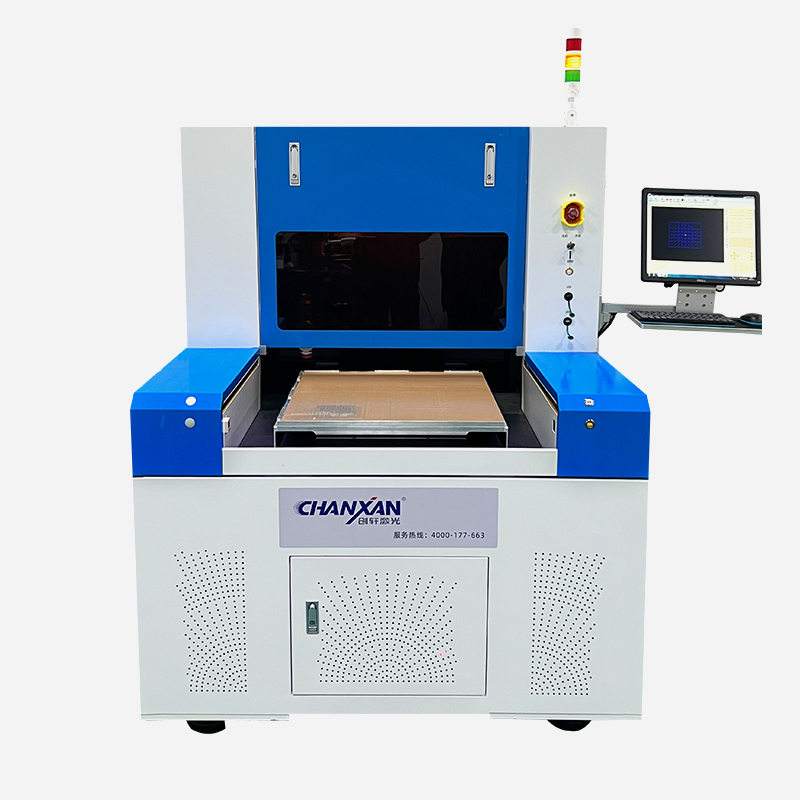
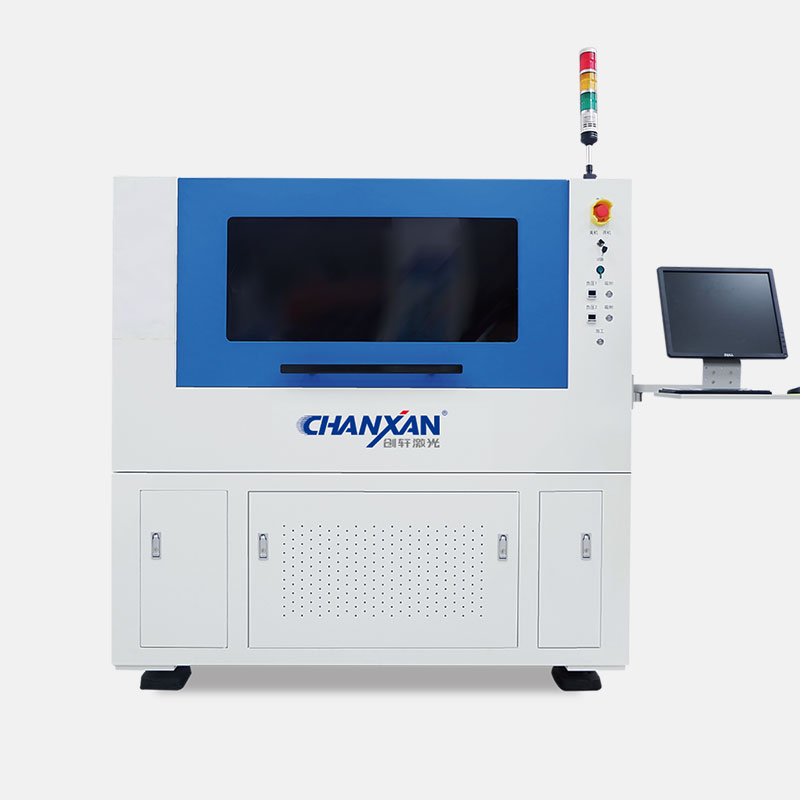
Housed in a rugged, heavy-duty dual-tone fully enclosed safety cabin, this flagship platform is engineered to deliver high-yield FPC profiling, coverlay skiving, and rigid-flex separation. The CW-6050PZ combines fine pulse synchronization with advanced automation controls. Its functional form factor features an integrated high-visibility viewing window, an articulated monitor arm for seamless real-time software management, and a top-mounted tri-color LED status tower for fast floor monitoring.
Coaxial Smart Vision Mapping: Employs high-resolution, through-the-lens (TTL) industrial cameras to eliminate parallax errors, capturing micro-fiducials accurately even through semi-transparent coverlays.
Vibration-Isolated Granite Foundation: Built on a massive, precision-ground granite base to neutralize ambient factory floor harmonic vibrations, ensuring long-term vector accuracy.
Best Suited For: Multi-layer flexible printed circuit profiling, precision rigid-flex border routing, and micro-scale copper-clad coverlay laser skiving.
Q: How long does it typically take to achieve full ROI when upgrading from mechanical punching dies to a UV laser workstation?
A: Most electronic contract manufacturers achieve full Return on Investment (ROI) within 8 to 14 months. This rapid payback is driven by the total elimination of custom tooling and mold design costs, significant substrate material savings from tight nesting layouts, and a dramatic drop in component rejection rates.
Q: Why is a picosecond UV laser source considered superior to a nanosecond UV laser source for thin FPC processing?
A: Although both operate at 355nm, a picosecond laser compresses individual pulses into an ultra-short window (10-12s), which is faster than the material's internal electron-phonon thermal relaxation threshold. This ultra-fast delivery ensures energy is entirely consumed by bond-breaking sublimation before heat can travel into adjacent copper traces, delivering completely melt-free edges.
Disclaimer: To protect intellectual property and honor customer Non-Disclosure Agreements (NDAs), specific corporate background details in application scenarios have been anonymized. However, all technical processing parameters, workflow data matrices, and operational cost-effectiveness metrics remain fully verified by Chanxan Laser's engineering applications laboratory.
| Free solution
Previous: Precision Laser Cutting & Micromachining for Flexible Films
Next: How Long Does It Take to Achieve ROI on a High-Precision PCB Laser Cutting Machine?