
Key Words: Silicon Wafer Dicing PCB Depaneling Glass Cutting
Home > News > Industry News
【Description】:
To compress the HAZ to absolute minimum layers, manufacturing engineers must transition from photothermal melting to photolytic cold ablation using ultrafast picosecond or UV laser systems
TL;DR (Too Long; Didn't Read)
Controlling the Heat Affected Zone (HAZ) in technical ceramic laser machining is vital to prevent catastrophic micro-cracking and material degradation. To compress the HAZ to absolute minimum layers, manufacturing engineers must transition from photothermal melting to photolytic cold ablation using ultrafast picosecond or UV laser systems, manage precise cumulative pulse overlap tolerances, and deploy specialized dynamic high-speed galvanometer scanning routines. By keeping the pulse duration shorter than the ceramic's internal thermal diffusion time, the substrate transitions instantly from a solid matrix to vapor, bypassing liquid phases and preserving the structural and dielectric integrity of the ceramic edge.
Advanced industrial ceramics like Alumina, Aluminum Nitride, and Zirconia are widely favored in power electronics for their outstanding dielectric properties and thermal conductivity. However, these same materials possess extremely low fracture toughness and poor thermal shock flexibility. When traditional continuous-wave CO2 or long-pulse nanosecond lasers strike the surface, the material absorbs energy via thermal conduction. The energy diffuses outward into the surrounding crystal lattice, establishing a large thermal gradient. This thermal footprint results in an extended Heat Affected Zone where severe residual tensile stresses accumulate, leading to microscopic edge chipping and late-stage structural fractures under operational stress.
To effectively control and eliminate HAZ propagation, the laser interaction time must be strictly compressed. Chanxan Laser advanced ultrafast picosecond workstations deliver energy pulses measured in trillionths of a second. This pulse duration is significantly shorter than the electron-phonon relaxation time of technical ceramics. Through intense localized peak power density, the material undergoes a non-thermal process known as cold ablation. The ceramic compound matrix ionizes instantly via multi-photon absorption, vaporizing into a plasma phase before thermal energy has an open time window to conduct sideways into the substrate. This direct solid-to-gas transition yields a pristine edge profile with an unmeasurable HAZ footprint.
Even when utilizing an ultrafast laser source, running slow cutting vectors with high pulse repetition rates causes localized heat accumulation inside the scribing track, which re-introduces a severe HAZ boundary. Controlling the thermal footprint requires precise management of the pulse overlap ratio, which is governed by scanning speed and laser frequency configurations. Implementing high-speed multi-pass scanning patterns allows the material to cool fractionally between consecutive pulses. This method reduces spatial energy stacking by over fifty percent, achieving clean material removal per pass without rising boundary temperatures.
The following performance matrix benchmarks the resulting HAZ dimensions and structural defect sizes when processing a standard 0.38mm thin Alumina power electronic board:
| Laser Platform Parameter | Heat Affected Zone (HAZ) Size | Micro-Crack Propagation Risk | Recast Layer Slag Formation | Edge Profile Taper Control |
|---|---|---|---|---|
| Standard Infrared CO2 Laser | 50 microns to over 100 microns | High (Requires margin safety boundaries) | Severe (Heavy re-solidified slag) | Poor (Visible melting taper) |
| Industrial Nanosecond Fiber Laser | 15 microns to 30 microns | Moderate (Minor edge micro-chipping) | Slight (Requires ultrasonic cleaning) | Moderate (1 to 3 degree variance) |
| Advanced Picosecond System | under 3 microns (Near-Zero) | Absolute Zero (Stress-Free Edge) | None (Prismatic Ablation) | Excellent (under 0.5 degrees) |
Strict structural stabilization and HAZ minimization are mandatory across high-spec industrial manufacturing streams where component reliability is non-negotiable:
Semiconductor SiP Packaging Submounts: Singulating high-density Aluminum Nitride panels where copper circuitry tracks flank the cutting pathway. Restricting HAZ protects the delicate metal-to-ceramic interfaces from thermal delamination, passing stringent automotive power module qualification standards.
Bio-Medical Piezoelectric Sensors: Precision micro-drilling and profiling sensitive Zirconia structures for medical instrumentation. Eliminating thermal melting ensures the material avoids localized phase transformations or micro-structural alterations, preserving long-term resonant performance.
Aerospace RF Interconnect Components: Processing high-frequency micro-strip ceramic submounts with strict geometric tolerances. Mitigating the recast layer and thermal footprint ensures the dielectric constant remains uniform across the processed perimeter, avoiding signal attenuation.
To satisfy demanding quality requirements and secure perfect thermal control over advanced technical ceramics, Chanxan Laser recommends the following professional hardware configurations:
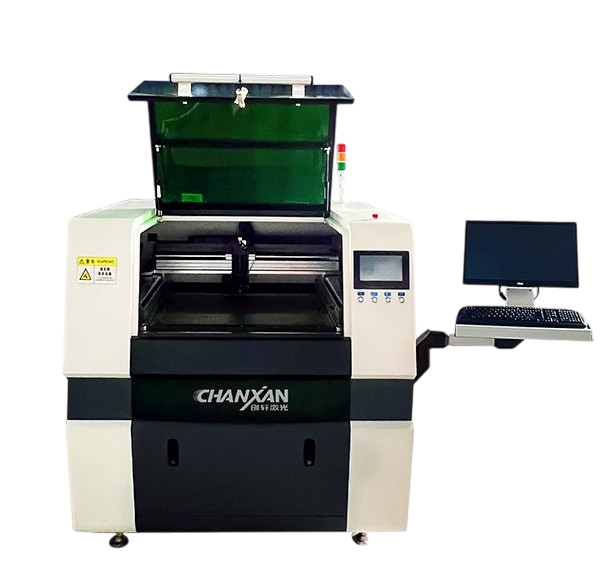
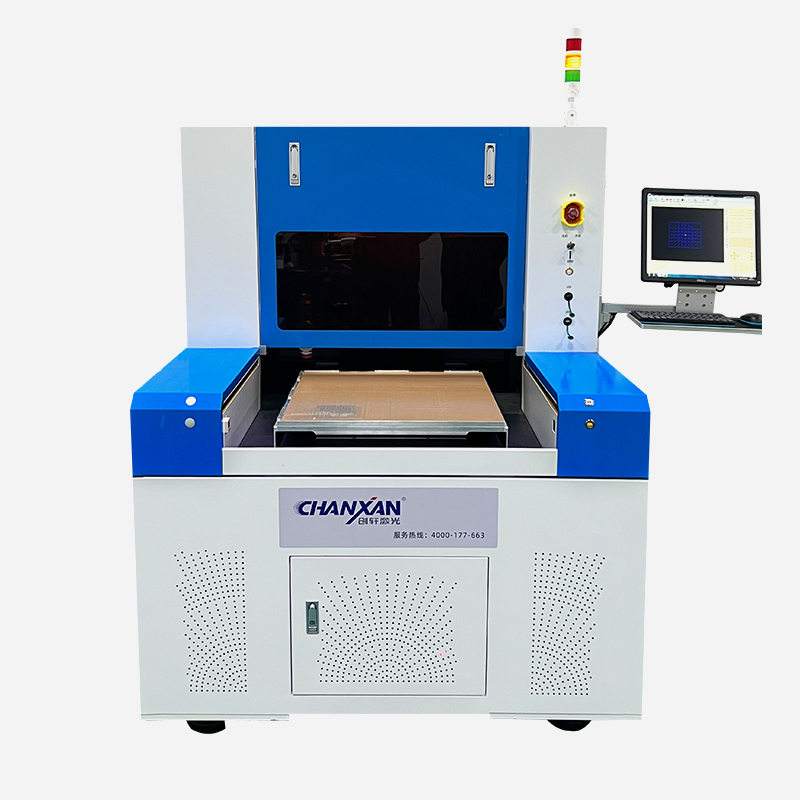
The flagship cleanroom solution engineered for absolute crack-free micromachining, dicing, and drilling of technical ceramics. This platform natively supports multiple laser sources options, including ultra-short picosecond green or UV configurations, completely removing thermal stress risks via true cold ablation.
Multi-Light Options: Supports seamless optical switching to optimize absorption metrics across diverse ceramic compounds.
Ultra-Short Pulse Timings: Delivers high peak power metrics that finalize material sublimation before thermal conduction can occur.
Porous Matrix Vacuum Chucking: Integrates segmented micro-porous vacuum tables to maintain flat coplanarity tolerances, eliminating focal depth drift along thin panels.
Best Suited For: Advanced semiconductor packaging singulation, TGV microfluidic routing, and multi-layer ceramic submount processing.
Q: Can assist gas selection help reduce the size of the Heat Affected Zone?
A: Yes, but its function changes based on pulse duration. For traditional thermal lasers, high-pressure Nitrogen or Argon assist gas is mandatory to blow out molten slag before it re-solidifies, which partially reduces HAZ. For ultrafast picosecond systems, the gas primarily serves to protect the telecentric lens from submicron vaporized soot particles, as the material sublimates directly into gas without forming a liquid melt phase.
Q: How does material thickness affect HAZ development during laser drilling?
A: As technical ceramic thickness increases, deep hole pathways introduce beam clipping along the internal walls. The vaporized material faces an obstructed escape path, trapping plasma and expanding heat inside the bore hole. This is resolved by integrating Chanxan's multi-step software focal shifting routines, which move the focal plane deeper into the substrate across incremental pass repetitions.
Q: Is post-process thermal annealing necessary if a picosecond laser is deployed?
A: No. Traditional CO2 laser scribing requires post-process thermal annealing to relax the deep residual tensile stresses locked inside the material. Because Chanxan's picosecond cold ablation process completes energy transfer faster than the lattice relaxation threshold, it leaves a stress-free edge, completely removing the need for costly post-processing annealing steps.
Disclaimer: To protect intellectual property and honor customer Non-Disclosure Agreements (NDAs), specific corporate background details in application scenarios have been anonymized. However, all technical processing parameters, workflow data matrices, and operational cost-effectiveness metrics remain fully verified by Chanxan Laser's engineering applications laboratory.
| Free solution
Previous: Why Choose a Femtosecond Laser Over a Picosecond Laser for Medical Stent Cutting?
Next: What Is the Maximum Aspect Ratio for High-Precision Laser Hole Drilling in Quartz?