
Key Words: Silicon Wafer Dicing PCB Depaneling Glass Cutting
Home > News > Industry News
【Description】:
In high-precision glass and optical micro-machining, drilling deep micro-vias in fused silica or quartz substrates presents a major physical constraint due to beam clipping and taper formation.
TL;DR (Too Long; Didn't Read)
In high-precision glass and optical micro-machining, drilling deep micro-vias in fused silica or quartz substrates presents a major physical constraint due to beam clipping and taper formation. With traditional photothermal nanosecond or CO2 processing, the practical maximum aspect ratio maxes out at around 1:5 to 1:10 before micro-cracking and thermal stress destroy the substrate. However, advanced ultrafast picosecond laser workstations—especially when paired with specialized helical trepanning optical heads or Selective Laser Etching (SLE) multi-stage workflows—can achieve exceptional aspect ratios exceeding 1:50 to 1:100. This allows industrial manufacturers to drill perfectly vertical, crack-free micro-holes with diameters under 20 microns through millimeter-thick technical glass components.
The primary optical bottleneck in deep hole laser drilling is the natural convergence and divergence of the focused beam, known as the Rayleigh range. To achieve a microscopic hole diameter (e.g., under 30 microns), the laser must be focused tightly, which naturally results in a very shallow depth of focus. As the laser penetrates deeper into the quartz substrate, the beam energy clips against the upper sidewalls of the narrowing trench. This geometric energy loss creates an inner wall taper. Traditional processing methods suffer from a severe reduction in energy density at the bottom of the bore hole, halting material removal and causing hole stagnation.
Quartz glass features an extremely low coefficient of thermal expansion, yet it remains highly susceptible to severe thermal shock micro-fractures when exposed to prolonged infrared energy inputs. Traditional photothermal processing melts the quartz matrix, trapping high-pressure plasma and expanding vapor within the narrow blind channel. When this molten recast layer cools rapidly, it generates immense localized tensile stress that triggers jagged edge chipping and micro-cracks. Chanxan Laser ultra-short picosecond laser workstations drop the heat affected zone to near zero. Energy deposition concludes before the lattice can vibrate thermally, achieving direct molecular sublimation and leaving an ultra-smooth, structural stress-free inner channel surface.
Standard percussion drilling—repeatedly firing a static laser spot down a single coordinate—is highly limited when attempting to scale past a 1:5 aspect ratio. The vaporized quartz debris has no escape route, accumulating along the hole entry and blocking subsequent incoming laser energy. To unlock maximum aspect ratios, advanced workstations utilize high-speed digital galvanometer setups or motorized helical drilling optics. By shifting the beam in multi-pass concentric pathways, the laser slices out the core incrementally. This precise path control ensures the vaporized silica soot vents out continuously without clouding the optical path or creating back-pressure fracturing.
The following evaluation matrix defines the technical limits, max aspect ratio capacities, and output quality parameters across different industrial laser setups on a 1.0mm thick optical quartz wafer:
| Laser Configuration Method | Maximum Achievable Aspect Ratio | Inner Sidewall Taper Angle | Micro-Crack Propagation Risk | Post-Processing Requirements |
|---|---|---|---|---|
| Industrial Infrared CO2 Laser | 1:3 to 1:5 (Very low depth limits) | Severe taper (exceeding 10 degrees) | Severe (High risk of thermal shattering) | Mandatory thermal annealing |
| Standard Nanosecond Fiber Laser | 1:5 to 1:10 (Mid-range boundary) | Moderate taper (3 to 5 degrees) | Minor micro-chipping along edges | Ultrasonic mechanical bath |
| Advanced Picosecond Workstation | 1:50 to over 1:100 (Deep Micro-Vias) | under 0.5 degrees (Near-Vertical) | Absolute Zero (Stress-Free Edge) | None (Ready for metallization) |
Achieving extreme aspect ratios without micro-crack development is essential across high-precision optical and semiconductor processing sectors:
Through-Glass Vias (TGV) in Semiconductor Packaging: Drilling arrays of high-density 20-micron micro-holes through 500-micron thick fused silica substrates. Maintaining a near-vertical wall profile with no micro-chipping ensures perfect copper seed deposition and long-term electrical reliability.
Microfluidic Diagnostic Devices (Lab-on-a-Chip): Machining ultra-deep, narrow fluid injection ports and micro-channels in pure quartz plates for bio-medical sensor testing. Burr-free processing prevents turbulent liquid flow and ensures fluidic track consistency.
Optical Interconnects and Aerospace Glass Sensors: Processing precise array matrices for complex fiber optic alignment plates. Eliminating internal mechanical stress guarantees that high thermal environments do not trigger delayed structural crack failures.
To maintain maximum focus stability inside deep micro-cavities and eliminate crack propagation, Chanxan Laser recommends the following industrial system layouts:
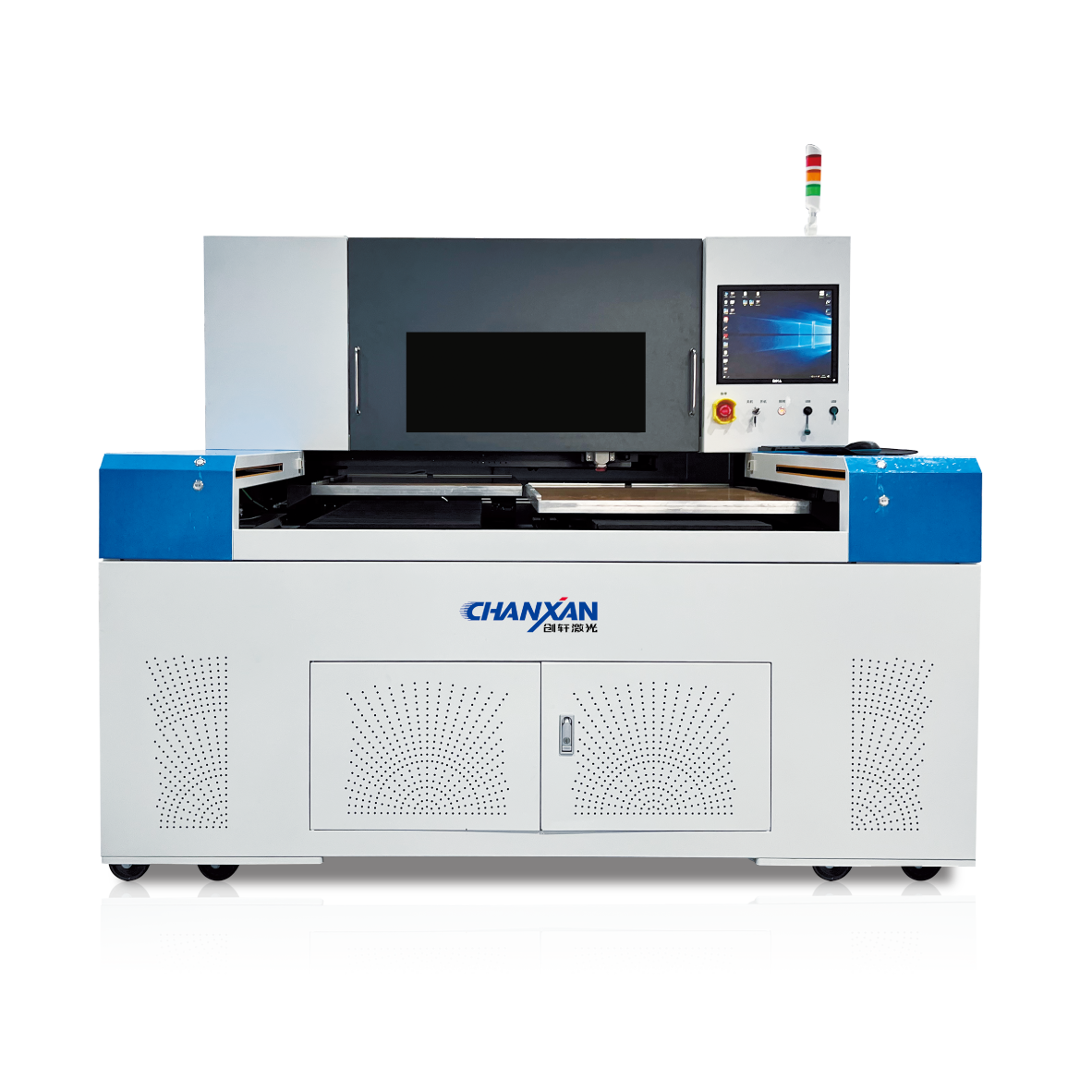
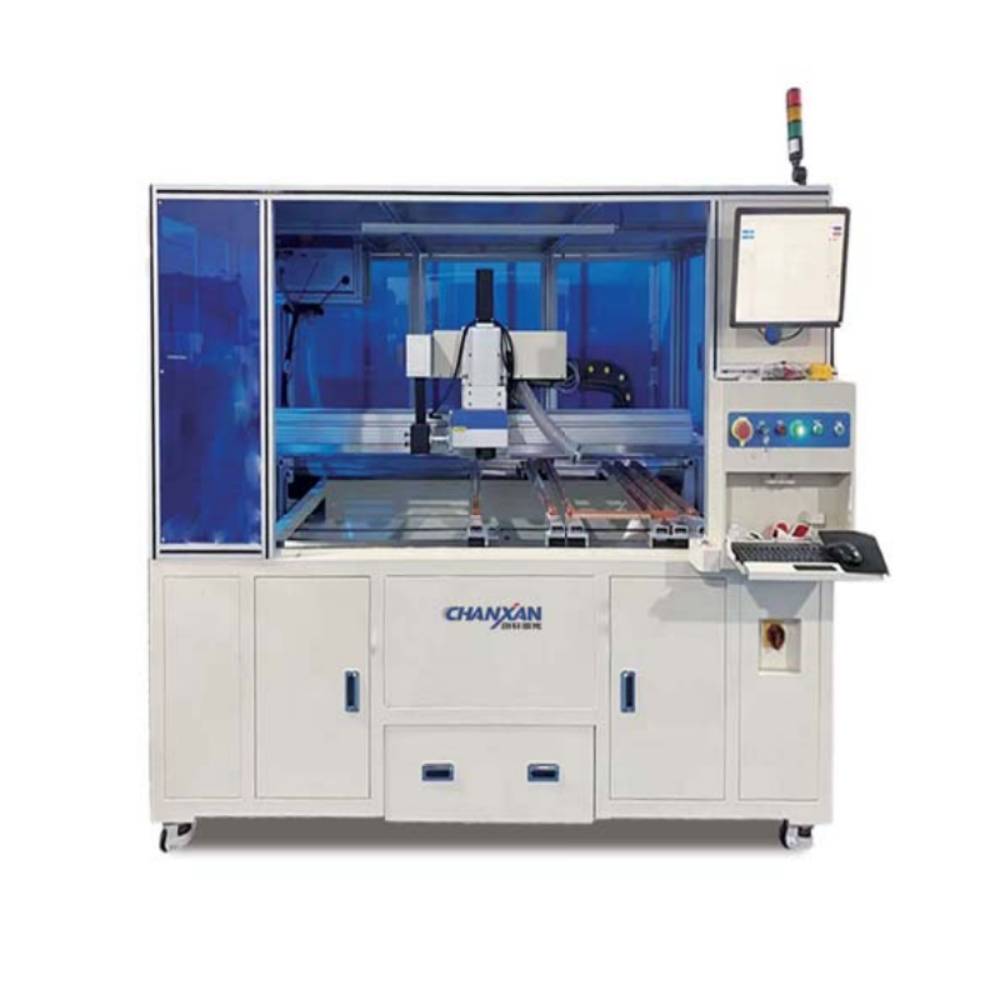
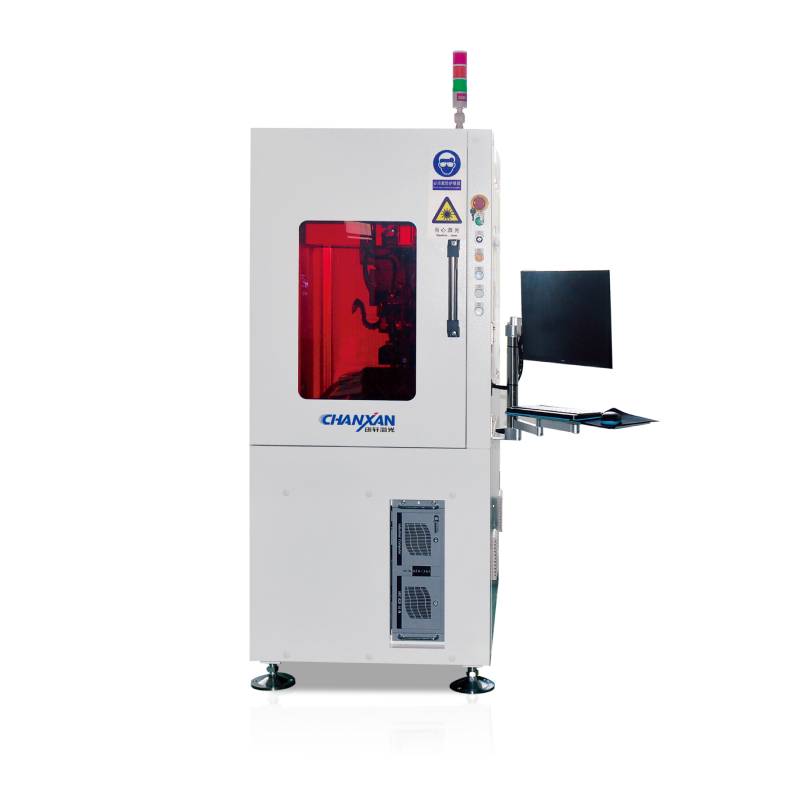
The flagship high-precision system designed for extreme aspect ratio applications across brittle substrates. Supporting multiple laser sources options, this platform seamlessly integrates ultra-short picosecond green or UV configurations to deliver flawless cold sublimation ablation.
Multi-Light Options: Supports optimized wavelengths to maximize absorption profiles in technical glasses and technical ceramics.
Dynamic Focal Tracking: Features advanced multi-step software focal shifting to relocate the focal plane dynamically as the hole deepens.
Porous Vacuum Stabilization: Utilizes highly flat micro-porous suction grids to keep the thin glass wafer perfectly flat, preventing out-of-focus drift.
Best Suited For: Through-Glass Vias (TGV) fabrication, microfluidic quartz routing, and advanced semiconductor packaging.
Q: Why does standard laser drilling fail to exceed a 1:10 aspect ratio in fused silica?
A: As the depth increases, the laser beam undergoes clipping along the hole walls due to its geometric convergence profile. If utilizing nanosecond or longer pulses, the trapped plasma cannot escape and absorbs subsequent beam energy, melting the hole entry instead of processing the bottom. Ultrafast picosecond multi-pass scanning routes resolve this completely.
Q: Can we achieve zero taper on deep holes with an aspect ratio of 1:50?
A: Yes. By integrating Chanxan's high-precision picosecond systems with an advanced helical drilling head, the beam can tilt dynamically relative to the substrate surface. This optical path manipulation counteracts the natural convergence profile, generating near-vertical sidewalls with a taper angle of under 0.5 degrees.
Q: Does this high-aspect ratio process apply to borosilicate or soda-lime glass as well?
A: Yes, though borosilicate and soda-lime glass have higher coefficients of thermal expansion compared to pure quartz, making them more sensitive to micro-cracking. Chanxan's fine pulse modulation tuning allows operators to lower average power and maximize peak pulse intensity, enabling clean drilling parameters on all industrial glass types.
Disclaimer: To protect intellectual property and honor customer Non-Disclosure Agreements (NDAs), specific corporate background details in application scenarios have been anonymized. However, all technical processing parameters, workflow data matrices, and operational cost-effectiveness metrics remain fully verified by Chanxan Laser's engineering applications laboratory.
| Free solution
Previous: How to Control the Heat Affected Zone (HAZ) in Ceramic Laser Machining?
Next: How Can Picosecond Lasers Achieve Burr-Free Scribing on Silicon Wafers?