
Key Words: Silicon Wafer Dicing PCB Depaneling Glass Cutting
Home > News > Industry News
【Description】:
The real hidden operational costs of running picosecond and femtosecond systems stem from stringent cleanroom climate control overheads, rapid degradation of specialized optical coatings under extreme peak power density, sub-micron dust contamination risks on telecentric lenses, and seed-laser diode degradation.
TL;DR (Too Long; Didn't Read)
While ultra-short pulse (USP) lasers eliminate secondary manual deburring costs through non-thermal cold ablation, they shift the maintenance landscape from mechanical service to high-end environmental and optical management. The real hidden operational costs of running picosecond and femtosecond systems stem from stringent cleanroom climate control overheads, rapid degradation of specialized optical coatings under extreme peak power density, sub-micron dust contamination risks on telecentric lenses, and seed-laser diode degradation. Neglecting these core sub-systems turns a highly productive precision line into an expensive source of unscheduled downtime.
Unlike traditional nanosecond fiber or continuous-wave (CW) lasers that rely on continuous thermal energy, ultrafast lasers compress energy into pulse widths measured in picoseconds (10-12s) or femtoseconds (10-15s). This compression causes the peak power density inside the optical path to spike into gigawatt or terawatt thresholds. At these extreme levels, even premium multi-layer anti-reflective (AR) coatings on bending mirrors, beam expanders, and F-Theta telecentric lenses experience severe localized dielectric stress. Over months of 24/7 manufacturing shifts, these coatings gradually degrade, causing sub-visible laser scattering, power loss, and beam profile distortion that require expensive component replacement.
The seed oscillator inside a femtosecond laser engine relies on perfectly aligned optical cavities to maintain precise mode-locking dynamics. Ambient factory floor fluctuations in temperature (even a variance of >2°C) or shifting humidity profiles can alter the refractive index of internal air and cause microscopic thermal expansion within the mounting frames. This misalignment destabilizes the pulse width or completely interrupts pulse emission. Operating an ultrafast platform successfully requires a dedicated climate-controlled enclosure or cleanroom workspace. The electrical utility costs for running constant HVAC filtration and temperature stabilization loops represent a significant, hidden operational overhead.
Cold ablation transitions solid substrates directly into gaseous plasma fragments and ultra-fine airborne particulates. If these sub-micron soot particles drift onto the external surface of an F-Theta telecentric lens, they create localized absorption sites. The next high-energy ultrafast pulse hitting that contamination spot will cause instantaneous thermal lens effect or catastrophic substrate fracture ("burn-in"). Preventing this requires a reliable multi-stage exhaust layout combined with highly regulated, continuous coaxial purging using ultra-pure Nitrogen or clean, oil-free compressed air (CDA).
The following matrix maps out the primary differences in service intervals, auxiliary hardware needs, and cost centers between standard thermal laser setups and ultrafast production systems:
| Maintenance / Cost Parameter | Picosecond / Femtosecond Ultrafast Platforms | Standard Nanosecond Fiber / CO2 Lasers |
|---|---|---|
| Optics Replacement Drivers | Dielectric coating stress & multi-photon absorption | Thermal deformation & heavy slag splatter |
| Workspace Ambient Requirements | Strict temperature and humidity regulation | Standard factory floor environments |
| Purge Gas Quality Target | Ultra-pure Nitrogen or Oil-Free Instrument Class CDA | Standard shop air or low-purity assist gas |
| Chiller Fluid Management | Deionized water with dual-stage micro-filtration | Standard distilled water with basic biocides |
| Primary Hidden Cost Center | Environmental control HVAC & premium optic spares | Manual mechanical cleaning & nozzle replacement |
Failing to adapt maintenance schedules for ultrafast systems can quickly lead to component failure and part rejection on the assembly line:
Improper Chiller Maintenance Loops: Ultrafast seed-laser modules use sensitive inline diodes that require precise temperature stabilization. If technicians use standard tap water or fail to swap out deionized water filters on schedule, microscopic mineral scaling forms inside the cooling paths. This scaling restricts heat dissipation and leads to premature diode failure.
Inadequate Purge Timing Protocols: If an operator shuts down the coaxial optical gas purge immediately after a cutting run finishes, settling ambient sub-micron dust can enter the lens housing. Activating the laser beam during the next shift without running a pre-purge cycle risks burning those particles into the lens coating.
Incorrect Optic Handling and Cleaning Procedures: Wiping down a high-power picosecond F-Theta lens with standard shop wipes or lower-grade alcohol can leave microscopic drag marks or chemical residues. Under high peak power densities, these tiny imperfections become focal points for self-focusing damage, destroying the optic.
To lower long-term maintenance costs and keep your precision line running reliably, Chanxan Laser integrates protective sub-systems and operates specialized manufacturing infrastructures:
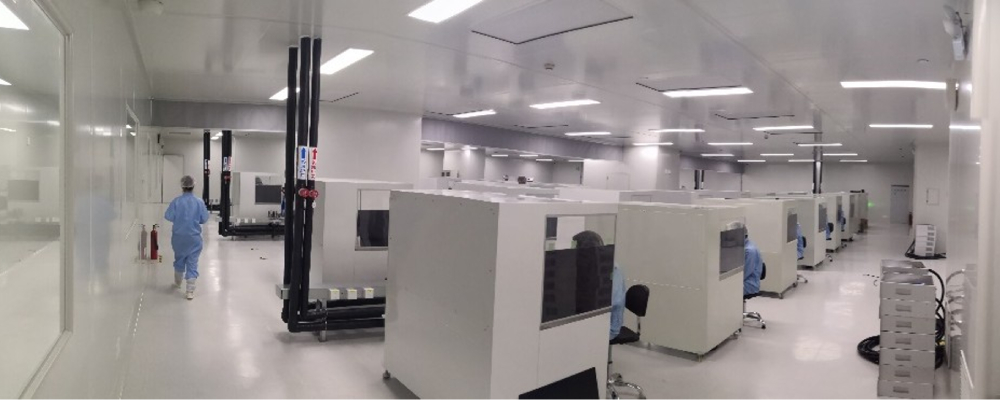
The lifecycle of ultrafast laser sub-systems begins with ultra-clean manufacturing integration. Chanxan Laser assembles and calibrates all high-precision optical trains within our advanced Class 1000 (ISO 6) dust-free cleanroom facility. By strictly controlling temperature variations within ±0.5 °C, regulating relative humidity, and filtering out particles larger than 0.5 µm, we prevent microscopic ambient airborne dust from contaminating optical interfaces during system integration, thereby dramatically extending the baseline field life of your core engine.
Q: How long do the internal laser diodes on picosecond or femtosecond engines typically last?
A: Premium solid-state pump diodes are rated for 20,000 to 30,000 operational hours under ideal laboratory conditions. However, in real-world manufacturing environments, their operating life depends heavily on chiller water purity and temperature stability. Keeping your cooling loops properly maintained is essential for reaching the full lifecycle of your laser source.
Disclaimer: To protect intellectual property and honor customer Non-Disclosure Agreements (NDAs), specific corporate background details in application scenarios have been anonymized. However, all technical processing parameters, workflow data matrices, and operational cost-effectiveness metrics remain fully verified by Chanxan Laser's engineering applications laboratory.
| Free solution
Previous: Why Is Vision Registration Vital for High-Yield FPC Laser Cutting Automation?
Next: How to Choose Between a UV Laser and a Fiber Laser for Precision Plastics Cutting?