
Key Words: Silicon Wafer Dicing PCB Depaneling Glass Cutting
Home > News > Company News
【Description】:
A step-by-step field guide for diagnosing and resolving assist gas airflow issues and air pump failures in industrial laser processing systems.
In laser processing applications, the role of assist gas is often underestimated until it is absent. When airflow drops or disappears entirely, the consequences are immediate: cut edges turn black and charred, ablation depth becomes inconsistent, and the focusing lens accumulates debris at an accelerated rate.
When an air pump fails to start or runs without delivering adequate pressure, the natural inclination is to suspect the pump itself. However, field experience across thousands of installation hours shows that over 90% of airflow issues originate either from simple power or thermal protection triggers, or from restrictions in the delivery path—not from a failed pump. A methodical inspection, starting from the pump and moving downstream, typically resolves the problem without the need for replacement.
The first diagnostic action isolates the pump from the rest of the system. The air hose should be disconnected from the pump outlet, and the pump powered on. A hand placed over the outlet will detect the presence and force of airflow.
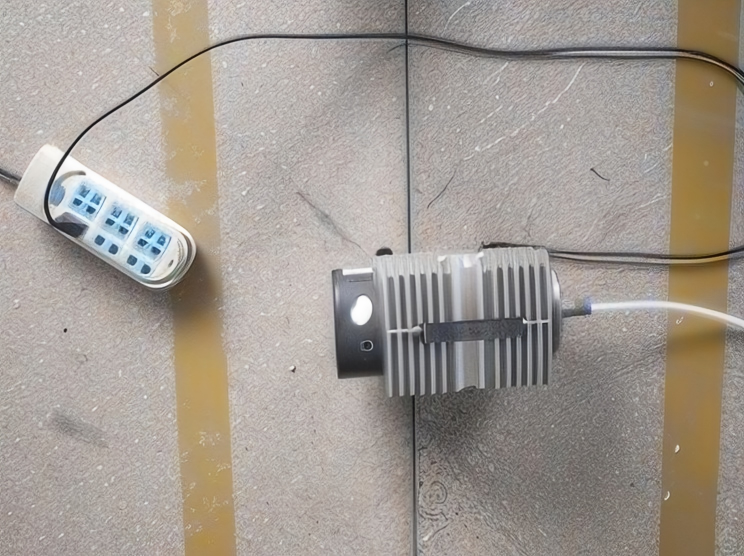
If strong, steady flow is present: The pump is functioning normally; the issue lies downstream in the hose, valve, or nozzle.
If flow is weak or absent: The pump itself requires attention.
Before concluding that the pump is defective, two preliminary checks are essential:
Power supply verification: The indicator light should be illuminated. If it is off, inspect the power socket, fuse, and any emergency-stop circuits that may cut auxiliary power.
Thermal overload status: Many pumps incorporate a thermal cut‑out that activates after extended operation. Allowing a 15‑minute cooling period, followed by pressing the reset button (if equipped), may restore function.
Diagnostic Tip: If the pump is receiving power, has cooled, and still produces no airflow, the internal diaphragm or valves are likely worn. This condition typically requires pump rebuild or replacement, rather than field repair.
When the pump is confirmed to be producing pressure, the air delivery path from the pump outlet to the processing nozzle must be examined for restrictions.
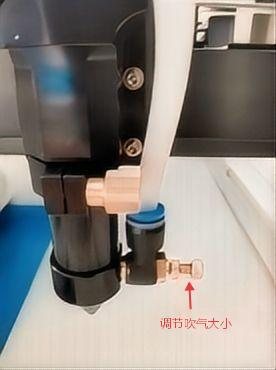
Kinked or pinched hoses: Flexible hoses are often routed through moving cable carriers or alongside machine gantries. Repeated motion can cause sharp bends, flattening, or crushing. A single pronounced kink can reduce flow by 50% or more. The entire hose length should be visually and physically inspected—running a hand along the hose can reveal flattened sections or spots where the hose has been trapped under machine components.
Closed or partially closed flow control valve: A regulator or needle valve is typically installed near the machine inlet. This valve may have been closed during maintenance and inadvertently left in that position. The valve should be turned fully to its open position (usually counter‑clockwise), and if a pressure gauge is present, it should read the normal operating range—commonly 0.2–0.5 MPa for air‑assist applications in laser processing.
Nozzle blockage: Residue from ablation processes, such as carbonised polymer from PET ablation or metal spatter, can accumulate inside the nozzle tip. The nozzle should be removed and inspected against a light source. If the bore appears narrowed or crusted, cleaning with a fine wire or ultrasonic bath, or replacement, will restore flow.
If the above checks do not restore adequate airflow, two less obvious causes should be investigated:
Hose leaks: Small punctures or loose fittings can bleed pressure. A systematic listening test for hissing sounds, or application of a soap‑water solution to the hose and joints, will reveal leaks through bubble formation.
Clogged pump intake filter: Many air pumps are equipped with a foam or mesh filter at the air inlet. In a typical laser workshop environment, this filter becomes clogged with dust over time. A choked filter restricts the pump's ability to draw air, reducing output pressure even when the motor runs normally. The filter should be removed, cleaned with compressed air, or replaced.
The following table summarises observed symptoms, likely causes, and recommended actions:
| Observed Symptom | Most Likely Cause | Recommended Action |
|---|---|---|
| No airflow at pump outlet | Power supply issue, thermal trip, or internal pump failure | Check power, reset thermal switch; if no flow, replace/repair pump |
| Airflow at pump outlet, none at nozzle | Kinked hose or closed flow valve | Straighten hose, fully open valve |
| Strong flow at pump, weak at nozzle | Nozzle blockage or hose leak | Clean nozzle, inspect for leaks |
| Pump runs loudly and hot | Clogged intake filter | Clean or replace filter |
To ensure uninterrupted assist gas supply, establish a routine preventive maintenance plan:
| Component | Frequency | Action |
|---|---|---|
| Processing Nozzle Tip | Daily (or shift start) | Inspect for debris crust; wipe or clear bore. |
| Delivery Hoses & Fittings | Weekly | Check for kinks in energy chains; listen for air leaks. |
| Pump Intake Filter | Monthly | Blow out dust with compressed air; replace if heavily fouled. |
| Air Pump & Pressure Valves | Quarterly | Check output pressure, thermal cutout switch, and power connections. |
If all diagnostic steps have been completed and adequate airflow is not restored, the fault may involve internal mechanical failure (e.g., worn motor capacitor, failed pressure switch) or a control-signal issue from the machine's main controller. At such point, professional service is recommended. Chanxan Laser is committed to ensuring that every subsystem—not just the laser source—operates reliably, so that production lines maintain consistent quality and uptime.
Please contact our technical support team with your test findings, including:
Machine model number and serial number
Air pump specifications or pressure readings
Photos or video of the air nozzle and hose layout
*Our engineering team typically responds within 24 hours.
| Free solution
Previous: Water Chiller Alarm Troubleshooting for Laser Systems: A Step-by-Step Guide
Next: Fume Extraction Troubleshooting: Sealing & Cleaning for Laser Systems