
Key Words: Silicon Wafer Dicing PCB Depaneling Glass Cutting
Home > News > Industry News
【Description】:
What is a femtosecond laser system, and why is it critical for ultra-precision manufacturing? This guide explains how femtosecond lasers enable cold ablation, near-zero thermal damage, and true 3D processing, while exploring key applications in medical devices, semiconductors, glass, and advanced micromachining.
TL;DR Conclusion: Femtosecond laser systems represent the pinnacle of precision, utilizing ultra-short pulses (10-999 fs) to achieve true "cold ablation" via multiphoton ionization. This allows for zero-thermal-damage processing and internal material modification. They are indispensable for high-stakes applications like medical device UDI marking, cardiovascular stent manufacturing, and semiconductor wafer dicing. While carrying a higher investment cost, they deliver immense value through regulatory compliance, yield improvement on high-value parts, and unique decorative capabilities like structural color.
There is a category of manufacturing problem that neither nanosecond nor picosecond lasers can fully solve: applications where the margin for thermal error is effectively zero, where the material interaction must be controlled at the atomic scale, or where the functional quality of a mark or cut directly determines patient safety or device reliability.
Femtosecond lasers occupy the top of the precision laser hierarchy. They are not the right tool for every application — their cost and complexity mean they should be deployed where their unique capabilities are truly required. But in those applications, no other technology delivers equivalent results.
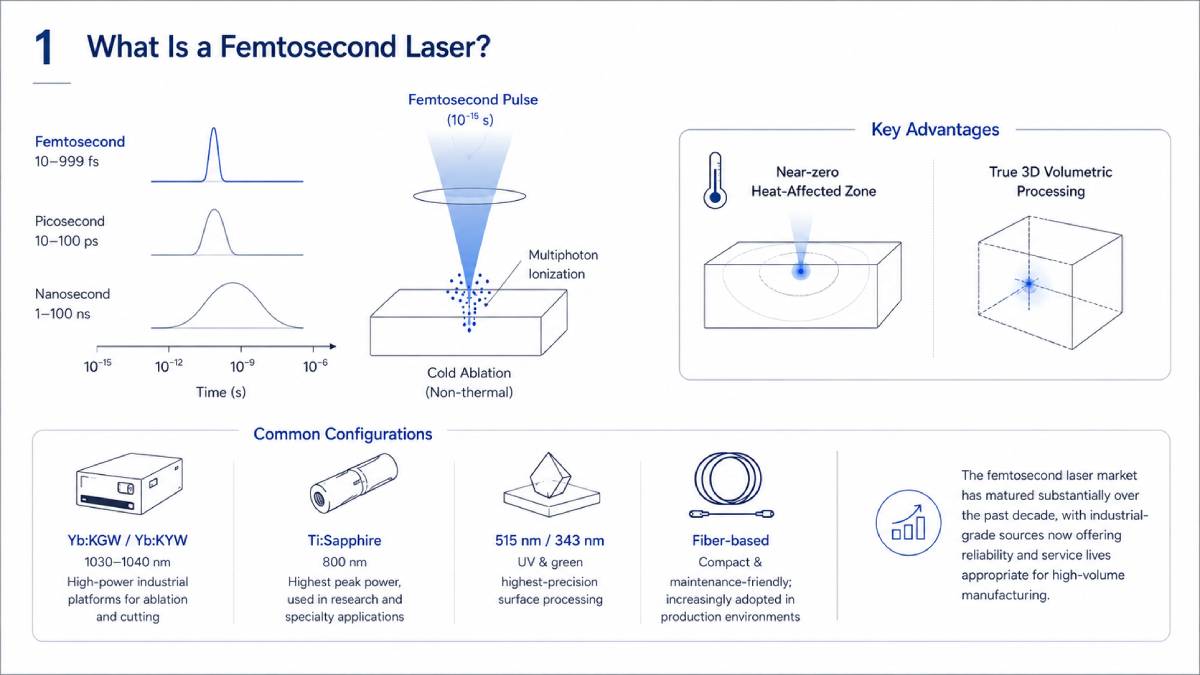
A femtosecond laser emits pulses with durations of 10 to 999 femtoseconds (10⁻¹⁵ seconds) — millions of times shorter than a nanosecond pulse, and roughly 10 to 100 times shorter than picosecond pulses. The physical consequences of this extreme pulse brevity are profound.
At femtosecond timescales, the laser pulse is deposited before any significant lattice heating can occur. The energy density reached in the focal volume is sufficient to directly ionize the material — a process called multiphoton ionization — without the intermediate thermal stages of melting and vaporization that dominate in longer-pulse regimes. Material removal is essentially instantaneous and non-thermal: the ablated volume is precisely defined by the focal geometry, and the surrounding material sees almost no temperature rise.
This mechanism, often described as "cold ablation" in the strictest sense, has two consequences that define femtosecond laser applications:
Near-zero heat-affected zone — the surrounding material, however thermally sensitive, remains undamaged
True 3D volumetric processing — because the interaction occurs only where intensity exceeds the ionization threshold, femtosecond lasers can modify material inside transparent solids without surface disruption
Yb:KGW / Yb:KYW systems (1030–1040 nm) — high-power industrial platforms for ablation and cutting
Ti:Sapphire systems (800 nm) — highest peak power, used in research and specialty applications
Frequency-doubled (515 nm) and tripled (343 nm) — UV and green femtosecond for highest-precision surface processing
Fiber-based femtosecond lasers — more compact and maintenance-friendly; increasingly adopted in production environments
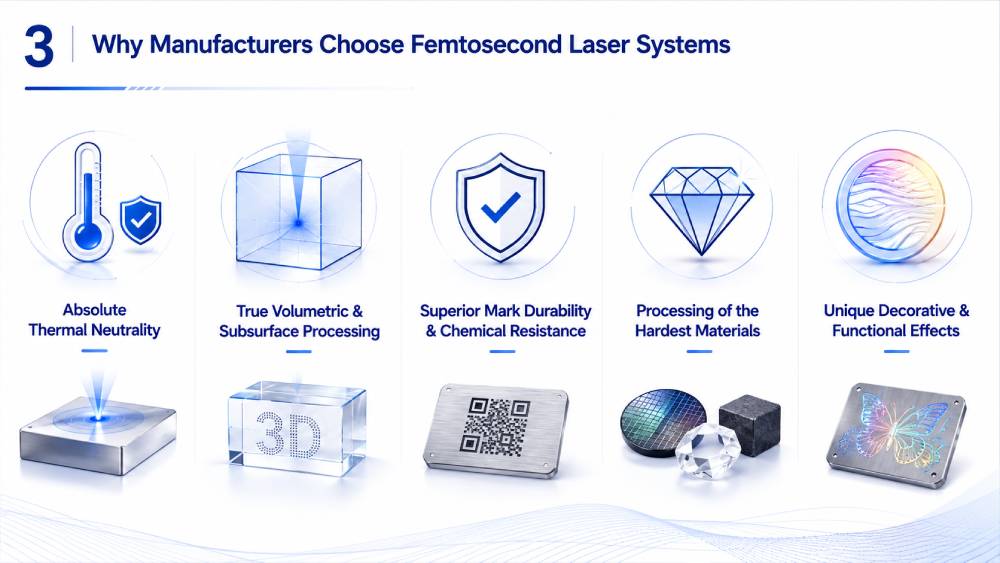
The decision to invest in femtosecond laser equipment is driven by specific application requirements that other laser types cannot meet — not by a general preference for higher precision.
Absolute thermal neutrality: In medical device manufacturing, implantable component processing, and semiconductor work, thermal damage is not just a quality issue — it can be a functional or regulatory issue. Femtosecond processing provides the guarantee that surrounding material has not been altered.
True volumetric and subsurface processing: The ability to focus femtosecond pulses inside transparent materials and modify only the focal volume enables applications like internal marking of glass and wafer internal modification.
Superior mark durability and chemical resistance: Femtosecond laser marks change the surface at a crystallographic level, producing marks with corrosion resistance and contrast critical for medical device UDI compliance.
Processing of the hardest materials: SiC, diamond, sapphire, and hardened glass are processed with clean, controlled ablation.
Exclusive decorative and functional effects: Mirror-finish marking, ink-free black marking, and structural color (iridescent) effects are unique femtosecond capabilities.
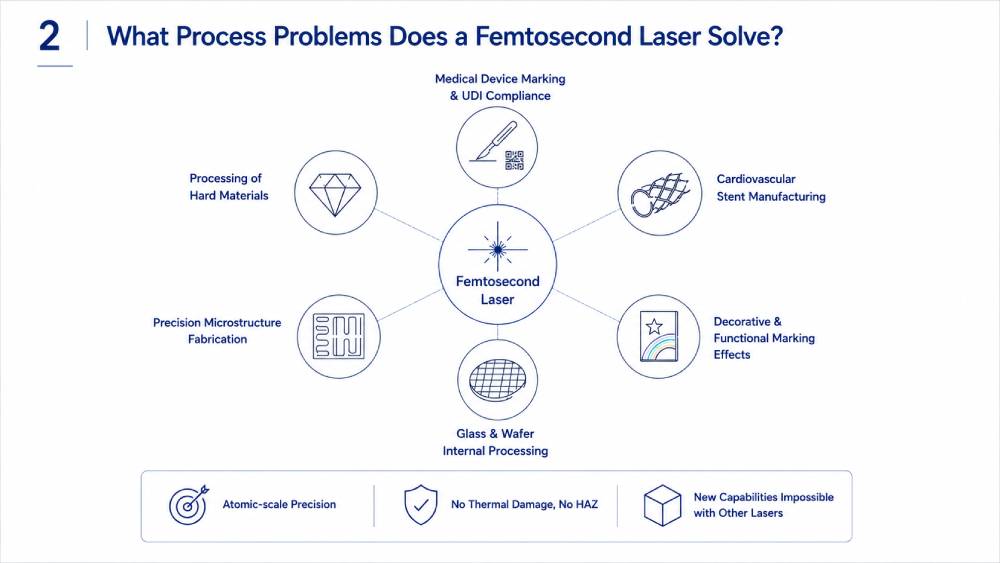
UDI marking on surgical instruments and implants must survive sterilization and clinical use.
Corrosion-resistant UDI marking — femtosecond marks on implant-grade alloys create surface modifications that do not initiate pitting corrosion under repeated sterilization cycles.
Marking on cobalt-chrome, nitinol, and PEEK — implant materials benefit from the low-thermal approach.
Direct part marking without consumables — no inks or chemicals, ensuring biocompatibility.
Stents are cut from thin-wall metal tubes with strut widths below 100 µm and zero HAZ tolerance.
Stent cutting from metal tube stock — reduces or eliminates electropolishing and cleaning steps required after thermal cutting.
Nitinol processing — preserves the alloy's temperature-sensitive shape-memory characteristics.
Sub-100-µm strut geometry — enables feature definition for next-generation thin-strut designs.
Mirror-finish marking — marking on polished surfaces without disturbing the reflective finish.
Ink-free black marking — deep, high-contrast marks produced by surface nanostructuring rather than thermal discoloration.
Structural color / iridescent marking — laser-induced periodic surface structures (LIPSS) produce diffractive color effects without pigments.
Glass internal marking and 3D engraving — marks formed inside the bulk without surface contact.
Wafer internal stealth modification — used for stealth dicing and internal anti-counterfeiting features in semiconductor wafers.
Semiconductor wafer internal security features — embedded features within the wafer bulk for IP protection.
Microfluidic channel fabrication — writing microchannels inside glass and polymer for lab-on-chip devices.
Fiber Bragg grating inscription — writing refractive index gratings directly in optical fiber.
MEMS and optical component micromachining — complex 3D microstructures in glass, quartz, and silicon.
Medical device manufacturing — the highest-value sector, driven by UDI marking compliance and stent cutting.
Semiconductor and display — wafer internal modification and IP protection applications.
Luxury goods and premium consumer electronics — branding and anti-counterfeiting via unique surface effects.
Optics and photonics — precision micromachining and fiber grating inscription.
Research and advanced manufacturing — standard equipment in high-end research and development environments.
Regulatory compliance value: Eliminates the risk of corrosion-related mark failure and associated recall costs in medical devices.
Post-process elimination: Compresses cycle time by reducing electropolishing and cleaning steps.
Yield on high-value components: Even minor yield improvements on expensive parts like stents can justify the investment.
Premium product capability: Enables revenue-generating features like iridescent marking impossible with other lasers.
Competitive differentiation: Accesses customer segments that require zero-HAZ or subsurface processing.
Pulse duration: Shorter pulses (< 200 fs) for the most demanding work; longer (500-999 fs) for glass cutting at lower cost.
Average power and repetition rate: Match power to cycle time; high repetition rates (> 1 MHz) enable efficient burst processing.
Wavelength: IR is most common; UV (343 nm) for finest spots; Green for reflective metals.
Beam delivery: Galvo scanners for speed; fixed-beam stage-scanning for absolute positioning accuracy.
Environmental requirements: Requires stringent temperature and vibration control (±1°C).
Service and support: Evaluate supplier's regional service capability due to system complexity.
Femtosecond laser systems represent the frontier of industrial laser processing capability — tools reserved for applications where precision, surface quality, or regulatory compliance demands leave no room for compromise.
Chanxan Laser provides femtosecond laser processing solutions for medical device marking, precision micromachining, decorative surface processing, and semiconductor applications.
| Free solution
Previous: What Is a Picosecond Laser System? Applications, Advantages, and Manufacturing Value
Next: Best Ultrafast Laser System Manufacturers: How to Evaluate the Right Supplier