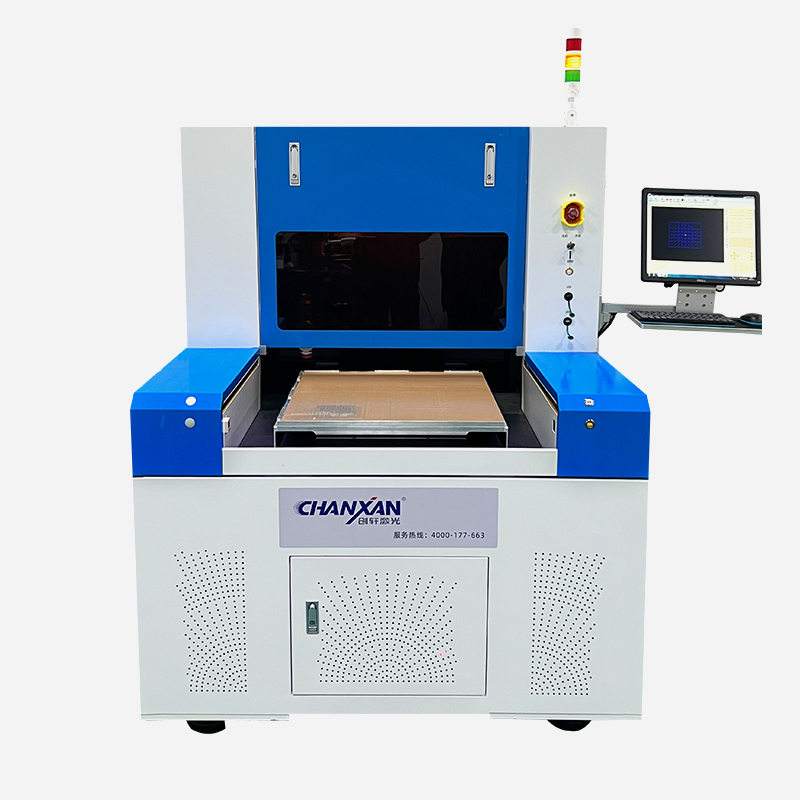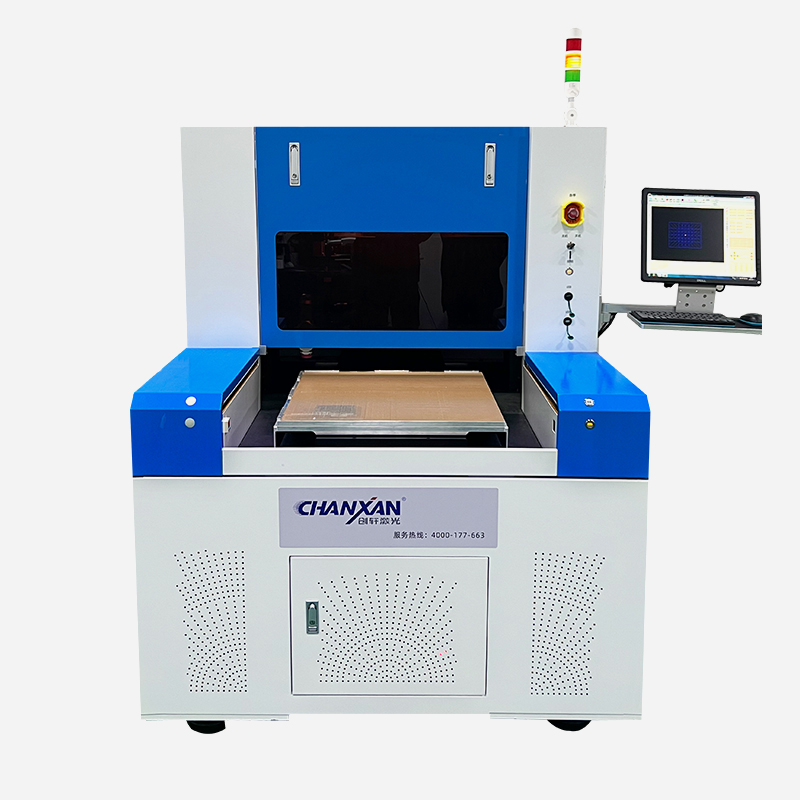




What Is a Nanosecond Laser System? Applications, Benefits, and Manufacturing Value
TL;DR — Key Takeaways
Nanosecond lasers emit pulses of 1–100 ns, creating a manageable heat-affected zone (HAZ) that is acceptable for most industrial applications — metals, ceramics, PCBs, polymers, and packaging films.
UV nanosecond (355 nm) is the production standard for PCB drilling — clean through FR4, multi-layer copper stacks, and specialty laminates with well-controlled thermal spread.
Capital cost is 30–60% lower than picosecond systems, with payback periods of 12–24 months on PCB lines replacing mechanical drilling.
Key ROI levers: consumable elimination (drill bits), improved first-pass yield, line flexibility without retooling, and high average power throughput.
Broad material compatibility — metals, ceramics, CFRP, diamond blanks, copper, packaging films — makes a single nanosecond system serviceable across multiple production lines.
Not the right choice for sub-10-µm features, ultra-thin wafers (<100 µm), SiC/sapphire cutting, or TSV drilling — evaluate picosecond or femtosecond for those applications.
Nanosecond lasers have been refined over decades of industrial deployment. They are cost-effective, robust, and capable of processing a broad range of materials across a wide set of industries. Understanding where they excel — and where their limits begin — is the foundation of any sound laser procurement decision.
What Is a Nanosecond Laser?
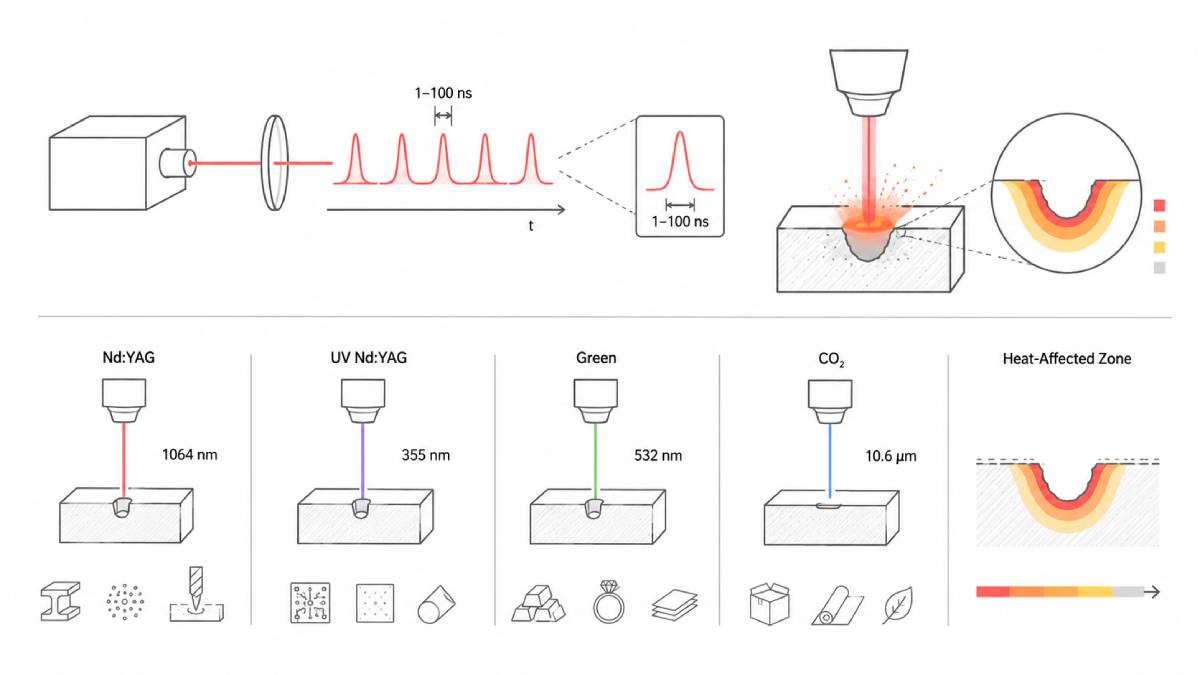
A nanosecond laser emits optical pulses with durations between 1 and 100 nanoseconds (10⁻⁹ seconds). This places them in the "short-pulse" category relative to CW (continuous wave) or millisecond-pulsed lasers, but they are distinctly different from ultrafast picosecond and femtosecond systems.
During a nanosecond pulse, the laser delivers a high-energy burst that heats, melts, and vaporizes the target material. Because the pulse duration is relatively long compared to ultrafast alternatives, some thermal energy diffuses into the surrounding material before the interaction completes. This creates a heat-affected zone (HAZ) — a region adjacent to the processing area that experiences elevated temperature without direct ablation.
Common nanosecond laser configurations include:
Nd:YAG nanosecond lasers — 1064 nm fundamental wavelength, widely used for metal marking, drilling, and cutting
UV nanosecond lasers (355 nm) — third-harmonic Nd:YAG; preferred for PCB processing, ceramics, and polymer materials where reduced thermal impact is needed
Green nanosecond lasers (532 nm) — used for copper, gold, and certain coatings where UV absorption characteristics are optimal
CO₂ nanosecond lasers — suited to organic materials, packaging films, and non-metallic substrates
The HAZ produced by nanosecond lasers is manageable — often acceptable in production — and is substantially outweighed by the advantages in throughput and cost for many applications. The key is matching the laser wavelength and pulse energy to the material and quality specification.
Why Manufacturers Choose Nanosecond Laser Systems
Nanosecond laser systems dominate industrial laser installations for several reasons that matter directly to production decision-makers.
Lower capital cost. A production-grade nanosecond laser system typically costs 30–60% less than an equivalent picosecond system and a fraction of femtosecond system pricing. For multi-station production lines or high-channel-count deployments, this cost difference has a substantial impact on total line investment.
Proven reliability and long service life. Nanosecond laser sources — particularly fiber-based and Nd:YAG configurations — have accumulated decades of industrial operating hours. Maintenance intervals are well-established, spare parts are widely available, and service networks are mature across major manufacturing regions.
High average power and throughput. Nanosecond systems can deliver high average output power, which translates to fast material processing at production speeds. For applications like PCB drilling, batch marking, or ceramic scoring, this throughput advantage is significant.
Broad material compatibility. Nanosecond lasers process metals, ceramics, polymers, composites, glass, and organic materials with reliable results. A single nanosecond system can often handle multiple material types across a production facility.
Process simplicity. Nanosecond laser processes are well-characterized and documented. Process engineers have extensive reference data, and integration with standard motion systems, galvo scanners, and machine vision is straightforward.
What Process Problems Does a Nanosecond Laser Solve?
The nanosecond laser addresses a specific category of manufacturing problem: the need for precise material removal or marking at production speed, where moderate thermal effects are acceptable and cost efficiency is critical.
PCB and Electronic Substrate Processing
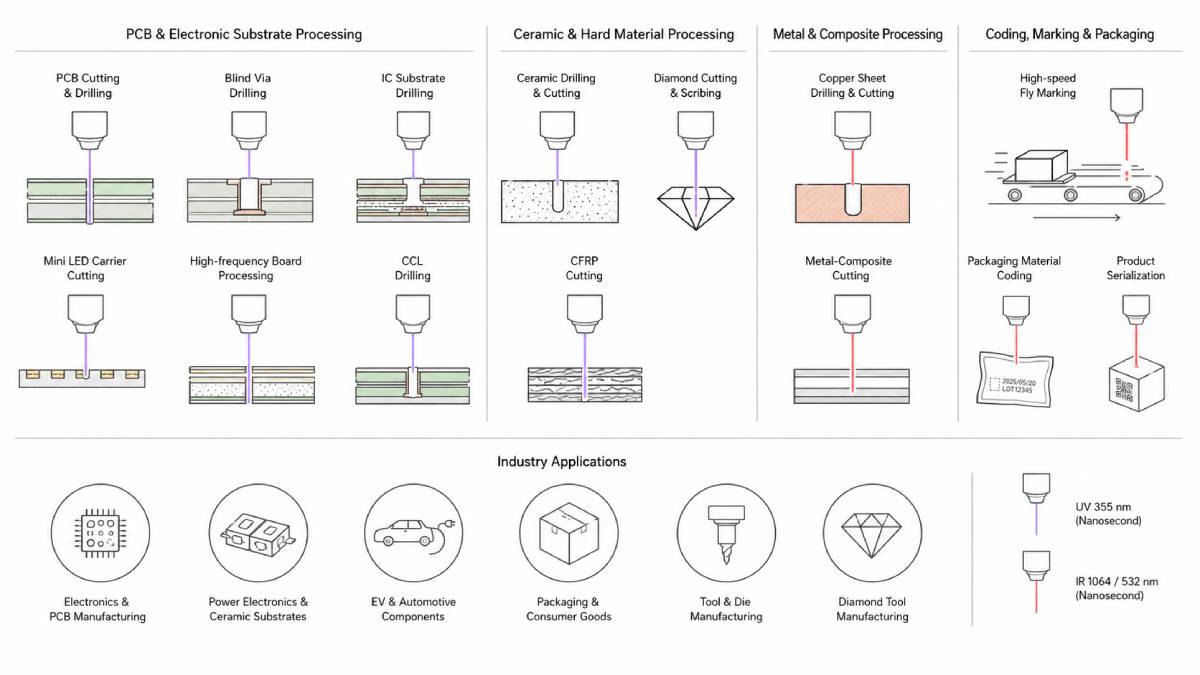
Nanosecond UV lasers are extensively used in PCB manufacturing for:
Thick and multi-layer PCB cutting and drilling — UV nanosecond sources (355 nm) deliver clean cuts through FR4, high-frequency laminates, and multi-layer copper stacks with manageable HAZ
Blind via drilling — precise depth-controlled drilling through dielectric layers to expose buried copper pads
Automotive-grade PCB processing — cutting and drilling of automotive PCBs where process stability and throughput are primary requirements
IC substrate processing — fine-pitch drilling on IC carrier boards, where UV wavelength reduces thermal spread compared to IR sources
Mini LED carrier board cutting — scoring and singulation of LED substrates used in backlighting and display applications
High-frequency communication board processing — drilling and cutting of PTFE-based and other specialty high-frequency laminates
Copper-clad laminate (CCL) drilling — hole formation in copper-clad sheets before plating processes
Ceramic and Hard Material Processing
Nanosecond lasers are effective for brittle, hard materials that are difficult to process mechanically:
Thick ceramic drilling and cutting — alumina, zirconia, and AlN ceramic substrates used in power electronics and RF modules
Diamond blank cutting and scribing — scoring and dicing of CVD diamond and natural diamond substrates used in cutting tools and high-power electronics
Carbon fiber reinforced polymer (CFRP) cutting — nanosecond lasers cut CFRP sheets without the delamination risk associated with mechanical routing
Metal and Composite Processing
Copper sheet drilling and cutting — controlled processing of pure copper and copper alloys for connector manufacturing and thermal management components
Multi-layer metal-composite cutting — separation of bonded metal-dielectric stacks used in RF shielding and EMI management
Coding, Marking, and Packaging
High-speed flight marking (fly-marking) — on-the-fly coding and serialization on products moving at line speed; nanosecond sources deliver sufficient power for clear marks at conveyor speeds up to 1,000+ meters per minute
Packaging material coding — date codes, batch numbers, and QR codes on flexible films, labels, paper, and rigid packaging
Product serialization — permanent marks on metal, plastic, and coated components for traceability compliance
Industry Applications
Electronics and PCB manufacturing is the single largest application sector for industrial nanosecond lasers. Automotive PCB, high-frequency communication board, mini LED carrier, and IC substrate processing all rely on UV nanosecond systems as the primary production laser tool.
Power electronics and ceramic substrates — ceramic drilling for power module substrates (DBC, AMB) uses nanosecond lasers for both hole formation and edge cutting.
EV and automotive components — battery tab cutting, copper busbar drilling, and power electronics substrate processing increasingly incorporate nanosecond laser stations.
Packaging and consumer goods — nanosecond fiber laser coders are standard equipment on packaging lines for food, pharmaceutical, and consumer products.
Tool and die manufacturing — nanosecond Nd:YAG systems mark cutting tools, drill bits, and mold components with permanent identifiers for tool tracking.
Diamond tool manufacturing — nanosecond lasers cut and shape CVD diamond blanks and polycrystalline diamond (PCD) inserts, replacing slow EDM processes in some configurations.
ROI and Production Value
Nanosecond laser systems deliver production ROI through three primary mechanisms.
Throughput at cost. The combination of high average power and low capital cost gives nanosecond systems the best cost-per-processed-part at volume for most applications. A UV nanosecond drilling system on a PCB line typically achieves payback in 12–24 months depending on utilization rate and the mechanical process it replaces.
Elimination of consumables. Compared to mechanical drilling (drill bits, router bits), nanosecond laser processing eliminates consumable tooling costs entirely. For high-density PCB drilling operations running multiple shifts, this saving is substantial.
Process yield improvement. Transitioning from mechanical to laser processing typically reduces edge chipping, delamination, and contamination defects — particularly on thin PCBs and ceramic substrates — improving first-pass yield without requiring additional inspection steps.
Line flexibility. A single nanosecond laser system can be reconfigured between material types and job formats by changing software parameters rather than retooling, reducing changeover time and enabling smaller batch sizes without cost penalty.
How to Choose a Nanosecond Laser System
Selecting the right nanosecond laser configuration requires matching several parameters to the target application.
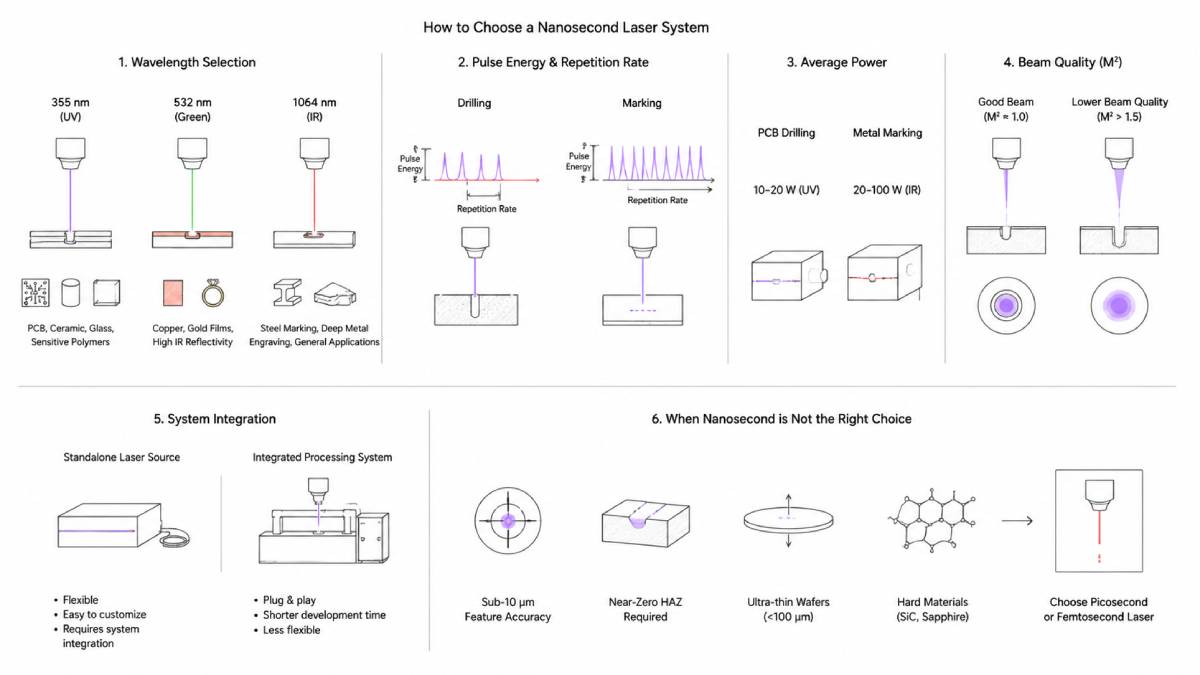
Wavelength selection:
355 nm (UV) — best for PCB, ceramic, glass, and sensitive polymers; minimizes HAZ relative to IR/green
532 nm (green) — preferred for copper, gold films, and coatings with high IR reflectivity
1064 nm (IR) — highest power efficiency; suitable for steel marking, deep metal engraving, and less thermally sensitive applications
Pulse energy and repetition rate: For drilling applications, pulse energy determines penetration depth per pulse; repetition rate determines throughput. Applications requiring deep or clean holes benefit from higher pulse energy at moderate repetition rates. Marking applications prioritize high repetition rate for line speed compatibility.
Average power: Scale average power to the required throughput. PCB drilling stations typically require 10–20 W UV, while metal marking systems range from 20 W to 100 W IR depending on mark area and cycle time.
Beam quality (M²): Tighter M² values (closer to 1.0) produce smaller focused spots and finer feature capability. UV nanosecond lasers with M² < 1.3 are preferred for high-density PCB via drilling.
System integration: Evaluate whether a standalone laser source or a fully integrated processing system (including motion stage, galvo scanner, vision, and software) is required. Integrated systems reduce engineering time but limit flexibility; modular configurations allow adaptation to future process changes.
When nanosecond is not the right choice: If your application requires sub-10-µm feature accuracy, near-zero HAZ on thermally sensitive materials, processing of ultra-thin wafers (<100 µm), or cutting of hard substrates like SiC or sapphire — a picosecond or femtosecond system should be evaluated instead.
Conclusion
Nanosecond laser systems remain the backbone of industrial laser processing precisely because they deliver a combination of capability, reliability, and cost efficiency that no other laser category can match at high production volumes. For manufacturers seeking to optimize throughput on PCB drilling, ceramic cutting, diamond processing, or high-speed marking operations, a well-specified nanosecond laser system represents the most direct path to production ROI.
Chanxan Laser supplies industrial nanosecond laser processing systems for PCB, ceramic, metal, and packaging applications, with configurations optimized for production-scale throughput and process stability.
Frequently Asked Questions
What is a nanosecond laser and how does it work?
A nanosecond laser emits optical pulses with durations between 1 and 100 nanoseconds (10⁻⁹ seconds). During each pulse, the laser delivers a high-energy burst that heats, melts, and vaporizes the target material. Because the pulse duration is relatively long compared to ultrafast alternatives, some thermal energy diffuses into surrounding material, creating a heat-affected zone (HAZ). Common configurations include Nd:YAG (1064 nm), UV (355 nm), green (532 nm), and CO₂ nanosecond sources, each optimized for different material types.
What wavelength nanosecond laser is best for PCB drilling?
UV nanosecond lasers at 355 nm are the standard choice for PCB drilling. The UV wavelength minimizes HAZ relative to IR or green sources and produces clean cuts through FR4, high-frequency laminates, and multi-layer copper stacks. For high-density PCB via drilling, UV nanosecond systems with M² below 1.3 are preferred to achieve the smallest focused spot and finest feature capability.
How does a nanosecond laser compare to a picosecond laser?
Nanosecond lasers produce a larger heat-affected zone (HAZ) than picosecond lasers because their longer pulse duration allows more thermal diffusion into surrounding material. Picosecond systems offer substantially better edge quality, minimal HAZ, and are suited to thermally sensitive materials, ultra-thin wafers, and fine features below 10 µm. However, nanosecond lasers typically cost 30–60% less than equivalent picosecond systems and deliver higher average power for production-speed throughput — making them the better choice where moderate thermal effects are acceptable.
What is the typical ROI payback period for a nanosecond laser on a PCB line?
A UV nanosecond drilling system on a PCB line typically achieves payback in 12–24 months, depending on utilization rate and the mechanical process it replaces. ROI drivers include elimination of drill bit consumables, improved first-pass yield by reducing edge chipping and delamination, high throughput at lower capital cost than ultrafast alternatives, and line flexibility that reduces changeover time between job formats.
Can nanosecond lasers process SiC or sapphire wafers?
Nanosecond lasers are generally not the preferred choice for SiC or sapphire wafer dicing and slicing. These hard substrates require near-zero HAZ and extremely precise material interaction to avoid cracking and subsurface damage. Picosecond and femtosecond lasers are strongly preferred for SiC and sapphire processing. Nanosecond lasers are better suited to materials like PCB laminates, alumina ceramics, copper, and packaging films where moderate thermal effects are acceptable.
What industries rely most heavily on nanosecond laser systems?
The single largest application sector is electronics and PCB manufacturing, including automotive PCB, high-frequency communication boards, mini LED carriers, and IC substrates. Other major sectors include power electronics and ceramic substrates (DBC/AMB drilling), EV and automotive components (battery tab cutting, copper busbar drilling), packaging and consumer goods (fly marking on production lines), tool and die manufacturing (permanent marking of cutting tools), and diamond tool manufacturing (cutting CVD diamond blanks and PCD inserts).
When should I evaluate a picosecond or femtosecond laser instead of a nanosecond system?
A picosecond or femtosecond system should be evaluated if your application requires sub-10-µm feature accuracy, near-zero HAZ on thermally sensitive materials, processing of ultra-thin wafers below 100 µm, or cutting of hard substrates like SiC or sapphire. If your priority is throughput, broad material compatibility, proven reliability, and cost efficiency on applications with moderate thermal tolerance — nanosecond is the appropriate platform.