
Key Words: Silicon Wafer Dicing PCB Depaneling Glass Cutting
Home > News > Industry News
【Description】:
Using an industrial ultraviolet (UV) picosecond laser micro-machining system, the minimum achievable kerf width in Flexible Printed Circuits (FPCs) is down to 10 to 12 microns (μm). This hyper-narrow cut is achieved because ultra-short picosecond pulses ($10^{-12}$ seconds) complete energy delivery faster than the material's electr
TL;DR (Too Long; Didn't Read)
In modern microelectronics manufacturing, minimizing slot spacing and maximizing circuit density are critical. Using an industrial ultraviolet (UV) picosecond laser micro-machining system, the minimum achievable kerf width in Flexible Printed Circuits (FPCs) is down to 10 to 12 microns (μm). This hyper-narrow cut is achieved because ultra-short picosecond pulses ($10^{-12}$ seconds) complete energy delivery faster than the material's electron-phonon thermalization time. This results in pure 'cold ablation' that directly ionizes polyimide (PI) and copper lamination with zero liquid splashing, shrinking the Heat Affected Zone (HAZ) to under 5μm and allowing trace-to-edge clearances to drop to unprecedented micro-levels.
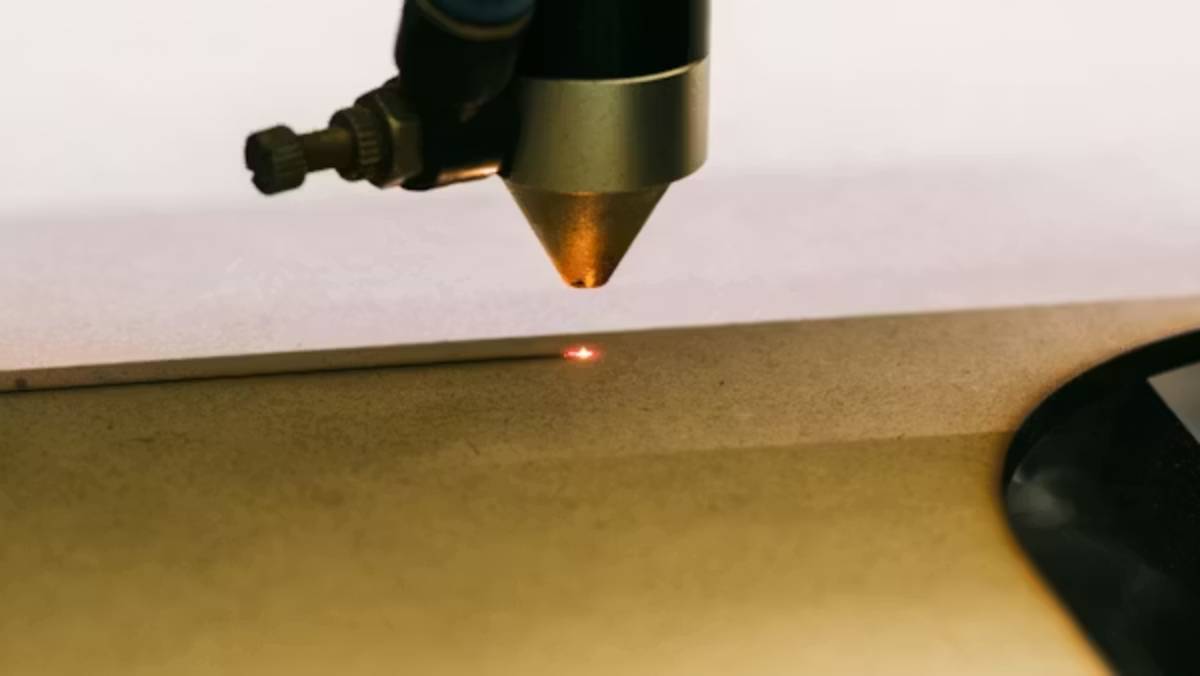
Traditional nanosecond lasers leave a cutting width of 25–40μm because their relatively long pulse dwell time allows thermal energy to travel sideways, melting adjacent plastics. A picosecond laser operates in the realm of ultra-short timing. The pulse width is so narrow (typically 10–15 picoseconds) that the target polyimide or adhesive layer transitions instantly from a solid phase to a plasma state (sublimation). Because the thermal diffusion distance is practically zero, the kerf width is strictly limited to the actual focused spot size of the laser optical train.
According to the laws of diffraction optics, the minimum focused spot diameter ($d$) is determined by the formula: d = (1.22 × λ) / NA, where λ is the wavelength and NA is the numerical aperture of the lens. By utilizing an Ultraviolet (UV) picosecond laser source at 355nm instead of Infrared (1064nm), the physical beam focus limit is cut by two-thirds. Combined with a high-performance telecentric F-theta scan lens featuring a high Numerical Aperture, Chanxan Laser systems compress the physical beam spot size to under 8–10μm, laying the hardware foundation for a 10μm kerf.
Achieving a 10μm cut requires a precise beam trajectory. Rather than dragging a single heavy blast that widens the ditch, digital galvanometer scanners program a tight, multi-pass spiral or concentric path with a microscopic overlap pitch (typically 1–3μm). By setting ultra-fast tracking speeds up to 4000 mm/s and high pulse repetition rates (200–500 kHz), the laser cuts deep, straight vertical sidewalls without tapering or widening the entrance slit.
The following performance chart defines the micro-processing limits of various laser systems on a standard 0.12mm ultra-thin single-sided PI FPC substrate:
| Laser Technology Category | Minimum Spot Size | Achievable Kerf Width | Heat Affected Zone (HAZ) | Cross-Section Quality / Burrs | Minimum Trace-to-Edge Gap |
|---|---|---|---|---|---|
| UV Nanosecond Laser (355nm) | ~ 20 μm | 25 μm - 35 μm | 15 μm - 25 μm | Minor melt lip / Micro-burrs | ≥ 100 μm |
| Green Picosecond Laser (532nm) | ~ 15 μm | 18 μm - 22 μm | < 8 μm | Clean, slight discoloration | ≥ 50 μm |
| Chanxan UV Picosecond Laser (355nm) | < 8 μm | 10 μm - 12 μm | < 3 μm | Perfectly vertical, Zero burrs | ≥ 15 μm (Ultra-dense) |
Q: Does a narrower 10μm kerf width reduce the daily throughput of our FPC factory?
A: No. Because a picosecond laser spot concentrates a massive peak power density (GW/cm²), the energy efficiency threshold for material removal is much lower than nanosecond lasers. While it requires multiple passes, it scans at an extreme speed of 4000 mm/s, keeping the overall cycle time equivalent to or faster than nanosecond machines while doubling the density yield per sheet.
Q: What thickness limits apply if we want to maintain the absolute minimum 10μm kerf?
A: To secure a perfectly clean 10μm cut with vertical sidewalls, the FPC or flexible coverlay laminate thickness should ideally be under 0.15mm (150μm). As thickness increases, the laser beam naturally scatters inside the deep trench, causing the aspect ratio to widen the upper kerf entrance slightly to 15–18μm.
Q: Will a 10μm picosecond cut leave any metallic conductive residue on multi-layer FPCs?
A: Absolutely not. Nanosecond lasers melt copper layers, causing microscopic liquid metal splatters along the PI edge which lowers isolation. The UV picosecond laser cold-vaporizes copper instantly alongside the polyimide. Cross-sectional SEM imaging proves that the matrix remains completely clean with no metallic migration or plating effect.
Profile: Senior Hardware Layout Engineer & Production Director at an Advanced HDI PCB Corporation.
The Challenge: The engineering team was developing a next-generation 5G smartphone camera millimeter-wave antenna module. Due to extreme space limits, the circuit layout required an ultra-dense trace pitch with a trace-to-edge separation clearance of just 25μm. Their existing nanosecond UV laser systems had a minimum kerf profile of 30μm and a 20μm HAZ, which completely burned through the shielding traces near the cut line, creating an catastrophic 32% scrap rate during reliability qualification.
The Solution: The corporation upgraded its cleanroom singulation cell to Chanxan Laser's High-NA UV Picosecond Laser Micro-Machining Workstation, featuring a 15W short-pulse UV source and digital closed-loop linear encoders.
The Outcome: Chanxan's ultra-short picosecond pulse matrix successfully shrank the stable production cutting width to exactly 11μm, with the edge heat damage reduced to near zero (<3μm). This guaranteed absolute dielectric protection for the outer copper tracks. Production singulation failure rates dropped from 32% to a steady 0.15%, saving thousands of dollars in high-end raw multi-layer laminates per batch and clearing strict high-frequency signal attenuation tests.
Disclaimer: To protect intellectual property and honor customer Non-Disclosure Agreements (NDAs), company names and specific background details in this scenario have been fictionalized or anonymized. However, all technical parameters, processing data, and yield performance metrics remain fully verified by Chanxan Laser's technical applications laboratory.
| Free solution
Previous: Laser Coverlay Cutting vs Mechanical Die Punching: Cost-Effectiveness Comparison
Next: How to Prevent Charring and Carbonization When Cutting FPC with Carbon Dioxide Lasers?