
Key Words: Silicon Wafer Dicing PCB Depaneling Glass Cutting
Home > News > Industry News
【Description】:
A comprehensive comparison between 3-axis and 5-axis laser cutting machines, detailing their freedom of movement, primary applications, programming complexity.
When evaluating laser cutting solutions for complex manufacturing tasks, one of the most fundamental decisions is whether to invest in a 3-axis or a 5-axis machine. While both technologies use a high-power laser beam to cut materials, their capabilities, applications, and cost structures are vastly different. Understanding this distinction is critical to ensuring you select the right equipment for your production needs.
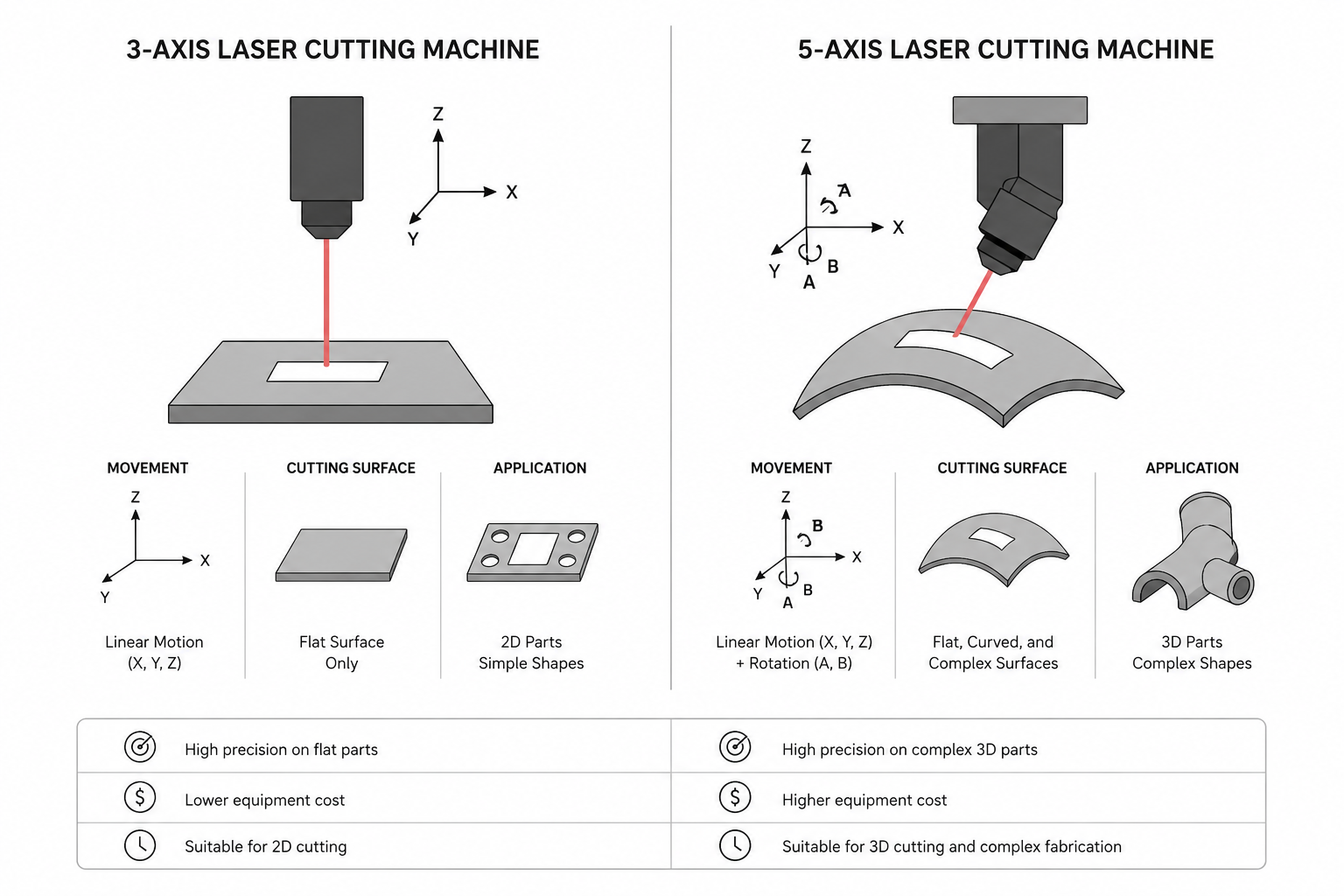
To understand the difference, we must first define what we mean by "axes" in the context of laser cutting.
A standard 3-axis laser cutting machine operates along three linear axes:
X-Axis: Left to right movement.
Y-Axis: Front to back movement.
Z-Axis: Up and down movement.
This configuration is the industry standard for 2D flat sheet cutting. The cutting head maintains a fixed vertical orientation (perpendicular to the material surface) as it moves across the flat sheet. The Z-axis is used primarily to adjust the focal position for different material thicknesses or to perform simple pierces, but it does not tilt or rotate the cutting head during the cutting process.
A 5-axis laser cutting machine builds upon the three linear axes by adding two rotational axes. This is often referred to as 5-axis linkage or simultaneous 5-axis machining. The two additional axes are typically:
A-Axis: Rotation around the X-axis (tilting the head forward and backward).
C-Axis: Rotation around the Z-axis (swiveling the head left and right).
With these two additional degrees of freedom, the cutting head can tilt and rotate to approach the workpiece from virtually any angle. Critically, in a true 5-axis machine, all five axes can move simultaneously during the cutting process, allowing the laser beam to follow complex 3D contours in a single, continuous operation.
The fundamental difference is that 3-axis cutting is primarily a 2D process, while 5-axis cutting is a true 3D process. This single distinction creates a cascade of differences in capability, application, and cost.
| Feature | 3-Axis Laser Cutting | 5-Axis Laser Cutting |
|---|---|---|
| Motion Type | Linear (X, Y, Z) | Linear + Rotary (X, Y, Z, A, C) |
| Cutting Head Orientation | Fixed (perpendicular to table) | Variable (can tilt and rotate) |
| Primary Application | 2D flat sheet cutting | 3D complex contour cutting |
| Workpiece Geometry | Flat sheets, simple formed parts | Fully 3D parts (e.g., hot formed steel, plastic enclosures) |
| Beam Perpendicularity | Always perpendicular to the table | Maintained perpendicular to the workpiece surface |
| Programming Complexity | Relatively simple (2D CAD) | Complex (3D CAM, offline simulation) |
| Fixturing Requirements | Generally simple (flat table) | More complex (3D positioning fixtures) |
Capabilities:
3-axis laser cutters are exceptionally fast and accurate for processing flat materials. They can cut intricate 2D profiles, holes, and slots with high speed and precision. The fixed head orientation is ideal for piercing and cutting sheet metal, plastics, and wood.
Limitations:
The fixed head orientation is the primary limitation. If a 3-axis cutter attempts to process a pre-formed 3D part (like an automotive door panel or a helmet shell), the laser beam will hit the surface at an oblique angle on any curved or sloped section. This results in:
Angled Cut Faces: The cut edge will not be square.
Inconsistent Kerf Width: The width of the cut will vary.
Inability to Access Features: The beam may not be able to reach certain undercuts or deep recesses.
Risk of Collision: The fixed nozzle may collide with the part geometry.
Typical Applications:
Cutting flat metal sheets (steel, aluminum, stainless steel) for brackets, enclosures, and frames.
Processing flat plastic sheets for signs and displays.
Cutting flat wood panels for furniture.
Capabilities:
The ability to orient the cutting head dynamically unlocks the processing of true 3D parts. The machine can keep the beam perfectly perpendicular to the surface of a complex curved part, ensuring a clean, square cut every time. The additional axes also allow the head to be tilted to access and cut features that would be impossible with a fixed head.
Limitations:
The increased capability comes with increased complexity.
Higher Initial Investment: 5-axis machines are significantly more expensive due to their complex mechanical design and advanced control systems.
Complex Programming: Creating toolpaths for 5 axes requires specialized CAM software and skilled programmers, though some systems (like DMP Teaching) simplify this.
Higher Maintenance: The more complex motion system has more components that require maintenance and calibration.
Typical Applications:
Automotive: Trimming and piercing hot formed structural parts (B-pillars, door beams), cutting automotive interior plastic components.
Aerospace: Trimming and drilling composite components, processing formed sheet metal parts.
Consumer Goods: Cutting helmet shells, shoe heels, 3D plastic enclosures.
Medical: Processing complex implant components and device housings.
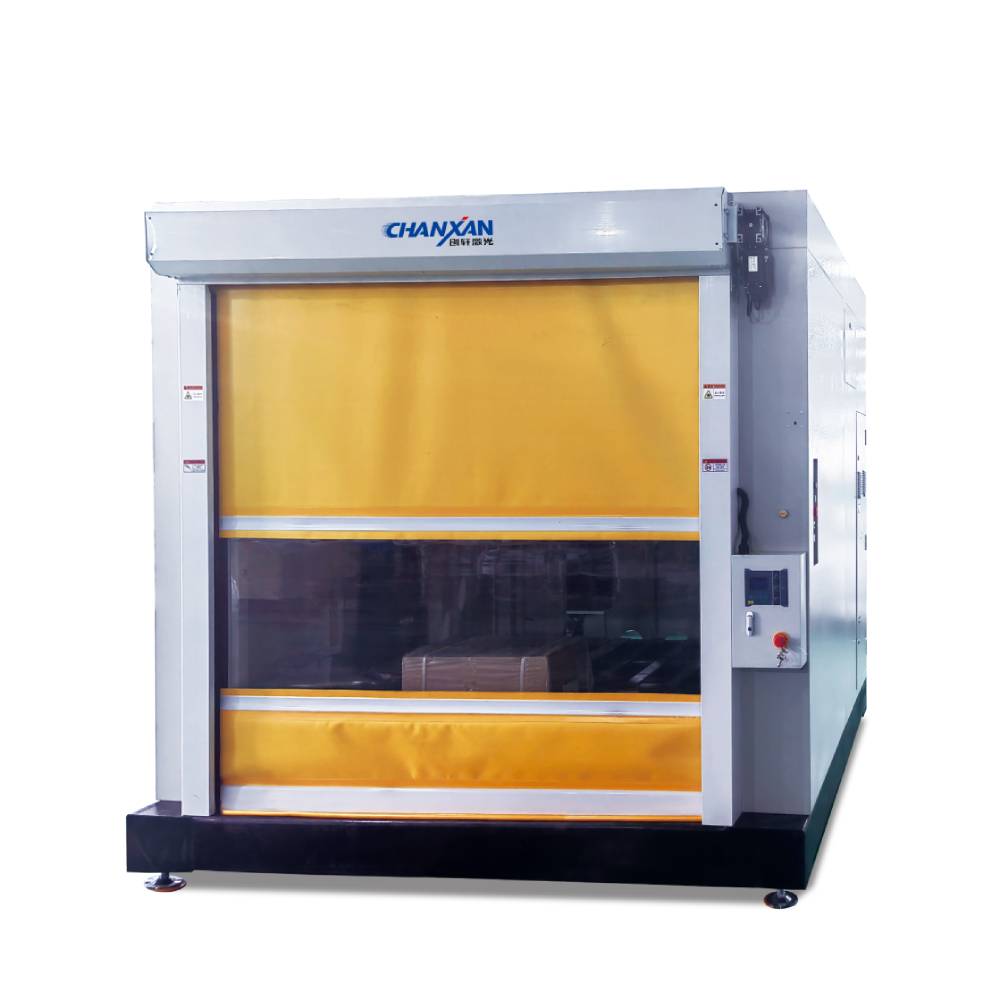
Chanxan's 3D Five-Axis Laser Cutting Machine makes the transition from 3-axis to 5-axis cutting more accessible. By simplifying the programming process through the DMP system and offering a flexible, application-focused machine, they allow manufacturers to adopt advanced 3D laser cutting technology without the steep learning curve or exorbitant costs typically associated with such systems.
| Chanxan 5-Axis Feature | How It Solves the 3-Axis Limitation |
|---|---|
| True Five-Axis Linkage | Unlike 3-axis machines, this system can tilt and swivel the cutting head in real-time to follow complex 3D contours, maintaining perfect beam perpendicularity and a clean cut on curved surfaces. |
| DMP Teaching System | Addresses the complexity issue head-on. Instead of requiring advanced CAM programming, operators can teach the machine the desired path by physically guiding the head. The system records the trajectory and generates the program, making complex 5-axis programming simple and easy to learn. |
| Cost-Effective Fixturing | The non-contact nature of laser cutting, combined with the 5-axis flexibility, means that simple and reusable positioning fixtures are sufficient. This is a significant cost-saving compared to the complex and expensive fixtures sometimes needed for 3-axis processing of 3D parts. |
| Versatile Laser Options | Available with CO₂ or fiber laser sources, the machine can be configured to cut a wide range of materials—from plastics and composites (as highlighted in the earlier article) to metals and advanced alloys. |
| Proven Automotive & Industrial Application | The machine is specifically designed for applications like automotive interior trimming, helmet shell perforation, and processing 3D plastic components, demonstrating its capability in demanding, high-mix production environments. |
Talk with our technical experts to find the perfect 3D Five-Axis solution tailored for your production lines.
Contact Us to Get a Free Quote| Free solution
Previous: 3D Five‑Axis Laser Cutting for Helmet Manufacturing
Next: 3D 5-Axis Laser Cutting for Automotive Hot Formed Parts