
Key Words: Silicon Wafer Dicing PCB Depaneling Glass Cutting
Home > News > Industry News
【Description】:
Compare UV and ultrafast laser cold ablation vs mechanical die-cutting for Polyimide PI film and FPC coverlay processing. Achieve zero-burr and zero-delamination.
TL;DR: Too Long; Didn't Read
Polyimide PI films are indispensable in Flexible Printed Circuit FPC manufacturing due to their exceptional thermal stability and dielectric strength. However, their high heat resistance combined with a tendency toward localized thermal warping poses a major challenge for legacy machining tools. To achieve zero-burr, zero-delamination micro-cuts and flawless coverlay window profiling, advanced FPC laser processing utilizing Ultraviolet UV or ultrafast laser systems is mandatory. By shifting the cutting mechanism from mechanical shearing or thermal melting to photolytic cold ablation, Chanxan Laser workstations deliver high-precision micro-cutting without compromising the fragile copper-polyimide adhesive interfaces—directly reducing scrap rate, rework labor, and warranty exposure on high-density FPC programs.
Polyimide (PI) is celebrated in the electronics sector for surviving extreme solder reflow temperatures. Yet, this exact material advantage turns into a processing bottleneck. When subjected to standard long-pulse infrared or CO2 lasers, the high energy required to break down the resilient PI matrix creates severe heat accumulation.
Because PI films are exceptionally thin—often ranging from 12.5μm to 50μm—this intense heat triggers localized thermal deformation, dimensional warping, and carbonized, yellowed cut edges that destroy the board's aesthetic and dielectric reliability.
For procurement and process engineering teams, this bottleneck shows up downstream as a cost line item: every panel scrapped for edge carbonization or warping is a panel that still consumed copper, adhesive, and labor hours before failing inspection. On high-density, high-mix FPC lines, defect-driven rework is consistently one of the largest avoidable yield-loss categories—which is exactly why the cutting method matters as much as the material spec itself.
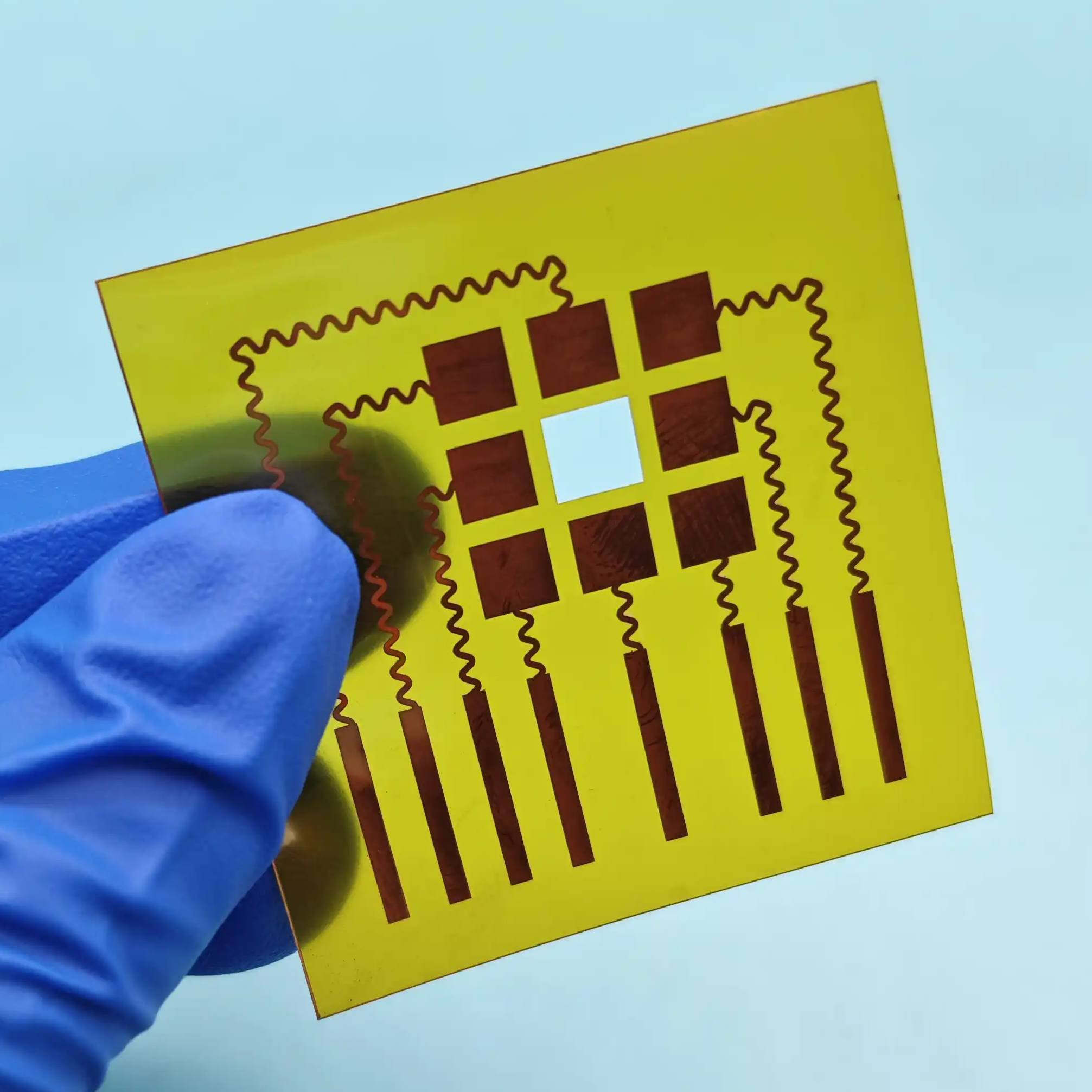
Historically, mechanical die-cutting and routing were used for PI and FPC singulation. However, as circuit traces shrink and component density surges, mechanical blades introduce devastating physical defects:
Interlayer Delamination: The mechanical shear stress pulled by a physical die breaks the sensitive adhesive bonds bonding the copper trace to the polyimide base film.
Heavy Edge Burrs: As die tools experience inevitable micro-wear, they drag the ductile PI film instead of shearing it cleanly, creating prominent microscopic burrs.
Micro-Cracks and Fractures: Rigid stress profiles left by blades act as stress-concentration points, leading to trace failure during dynamic bending cycles.
Polyimide flex circuits aren't a single market—they're the backbone material across several industries with very different failure tolerances. Understanding where PI laser cutting matters most helps clarify whether it's a nice to have or a must have for a given production line:
5G and RF Communication Modules: PI-based flex antenna feeds and RF shielding cutouts require burr-free edges and tight dielectric tolerance—even a few microns of mechanical distortion can detune signal performance.
Wearable and Foldable Display Flex Circuits: Dynamic bending cycles make micro-cracks from die-cutting a long-term reliability risk; laser-cut edges without stress-concentration points hold up far better under repeated flexing.
Medical Device Flexible Sensors and UDI Marking: Biocompatibility and traceability requirements including UDI marking demand contamination-free, repeatable processing with no loose particulate from mechanical shearing.
Aerospace and Defense Flexible Interconnects: Low-volume, high-reliability programs can't tolerate the tooling drift that comes with die wear over a production run.
Automotive HDI Flex-Rigid Circuits: High-Density Interconnect HDI flex-rigid boards push feature sizes below what mechanical die rules can reliably hold, particularly around vibration-prone connector zones.
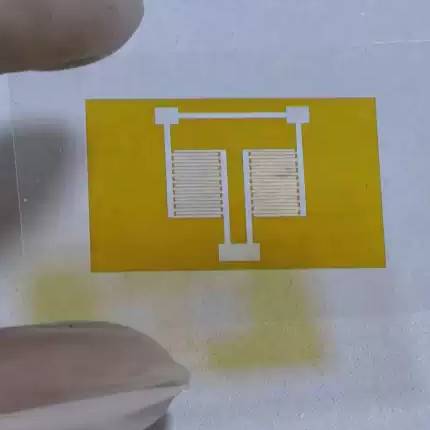
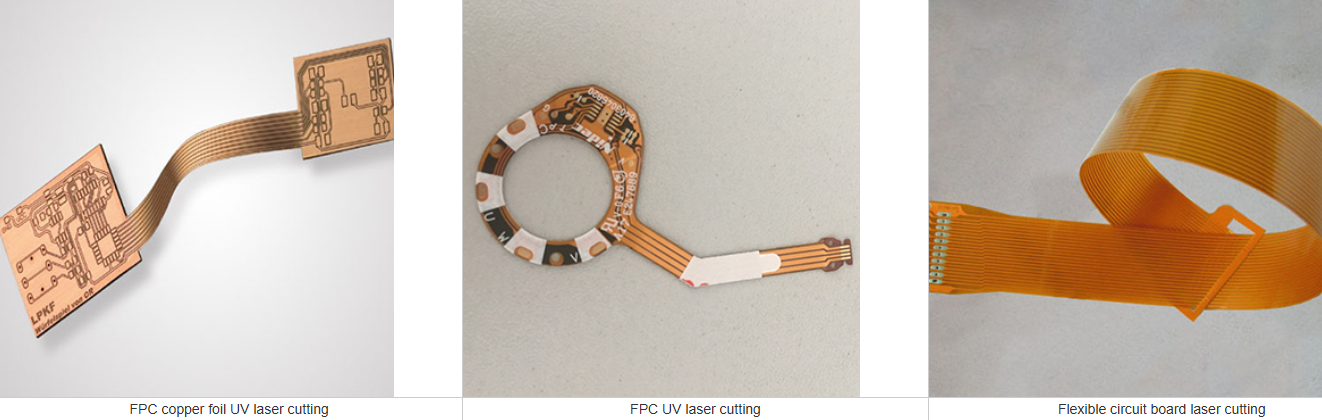
Migrating to UV laser cutting and ultrafast laser processing eliminates mechanical stresses entirely. Operating at a 355nm wavelength, Chanxan's UV laser photons carry enough energetic force to directly break the carbon-nitrogen and carbon-oxygen molecular bonds within the polyimide chemical chain.
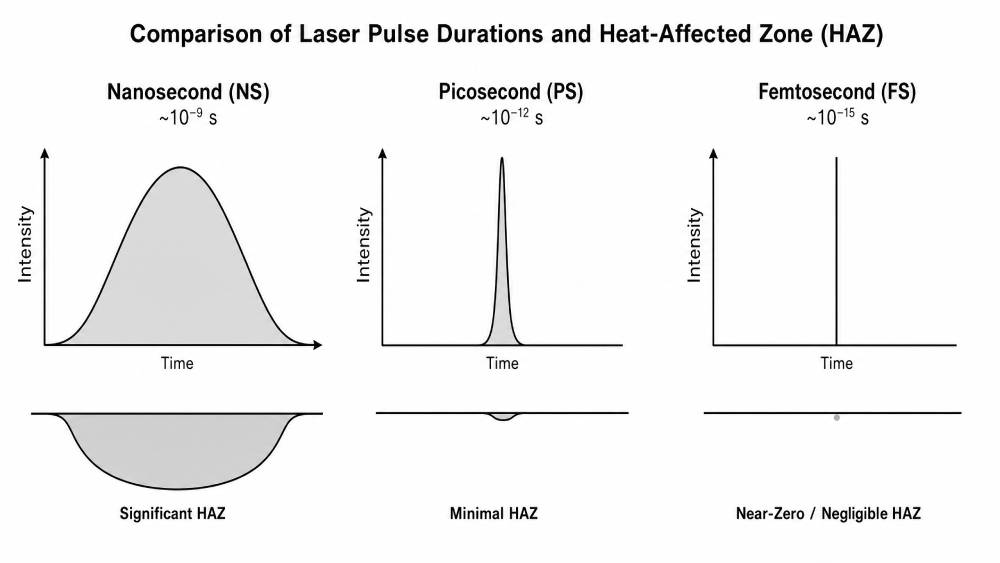
This process, known as photolytic cold ablation, transitions the polyimide film cutting from a melting process to an instantaneous gaseous sublimation. The material transitions from solid to vapor in picoseconds, shrinking the Heat Affected Zone HAZ to a negligible fraction and ensuring pristine, uncharred sidewalls.
Not every PI cutting task needs the same laser tier, and matching the right system to the job is part of getting the economics right:
Nanosecond UV: The workhorse for standard outline cutting and most coverlay opening work—it covers the majority of PI processing needs at the most cost-effective throughput.
Picosecond UV/Ultrafast: Systems pull HAZ down further for tight-pitch features, fine slots, and applications where even minor discoloration at the edge is a defect.
Femtosecond Ultrafast: Reserved for the most demanding cases: multi-layer rigid-flex stacks, copper-adjacent micro-features, or programs where zero measurable thermal input is a hard customer requirement.
This tiering matters for buyers evaluating equipment cost against actual process need—it's rarely a question of best laser in the abstract, but which tier matches the tightest defect tolerance in your product mix.
Beyond final panel singulation, FPC laser processing is highly critical for Coverlay window opening fabrication. The coverlay layer—consisting of a PI film coated with an acrylic or epoxy adhesive—must be selectively patterned to expose specific copper pads for surface mount component soldering.
Chanxan High-Precision Laser Platforms feature advanced pulse control software that allows operators to calibrate the ablation depth perfectly. The laser selectively ablates and carves through the tough polyimide coverlay and adhesive matrix, stopping cleanly on top of the underlying microscopic copper trace without scratching or scuffing the conductive metal pad.
| Quality Attributes | Mechanical Die Stamping | Chanxan High-Precision UV/Ultrafast Laser |
|---|---|---|
| Edge Burr Profile | Frequent over 30 μm raised burrs; requires mechanical brushing | Zero Burr Perfect flat coplanarity |
| Interlayer Defect Rate | High risk of localized copper-PI edge delamination | No Delamination Stress-free photolytic cut |
| Minimum Feature / Slot Size | Limited by die machining rules over 100 μm | High-Precision Micro-Cutting less than 20 μm kerf |
| Carbonization and Charring | None but high mechanical deformation | Negligible to Zero Pristine yellow-translucent edge |
| Tooling Re-calibration Cost | High Blades wear out rapidly on tough polyimide webs | Zero Software-driven digital CAD processing |
| Production Throughput at Scale | Drops over tool life as die wear increases reject rate | Stable cycle-to-cycle; no mechanical degradation curve |
| 3-Year Total Cost of Ownership | Recurring die/tooling replacement and brushing/deburring labor | Lower marginal cost per panel once amortized; no consumable tooling |
To secure a competitive advantage in high-density flexible printed circuit FPC production lines, Chanxan Laser offers its premier modular workstation configured for advanced micro-machining:
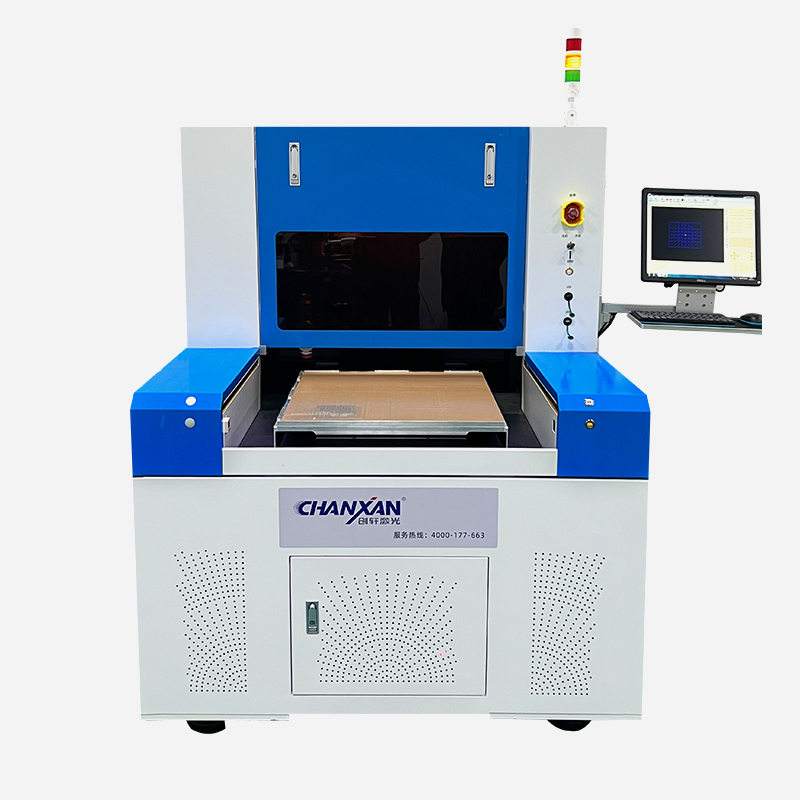
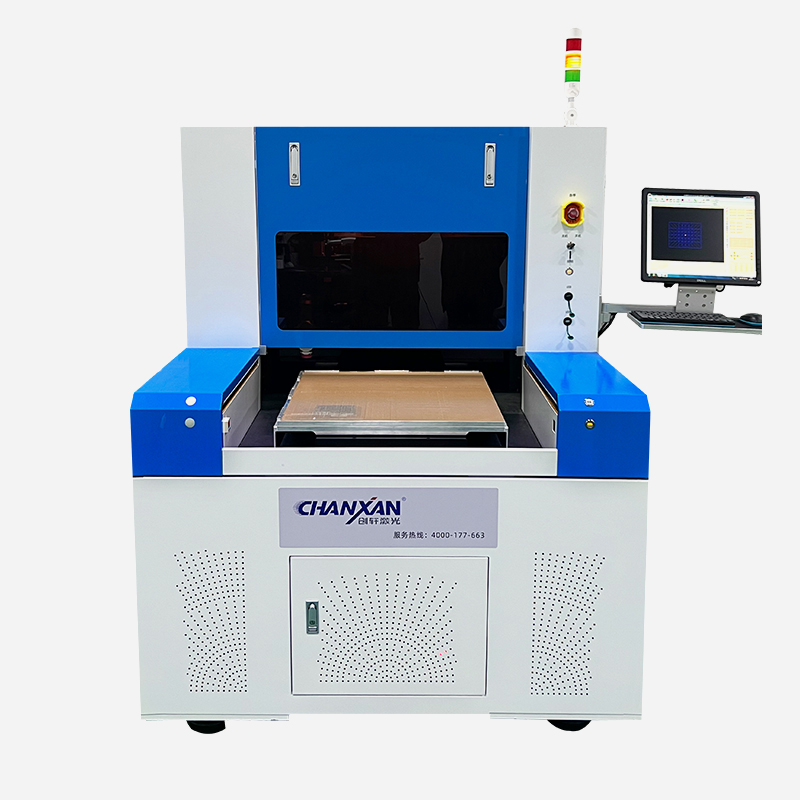
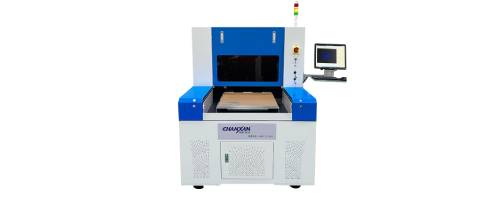
Chanxan Micro-FPC Laser Processing Center: Engineered specifically for high-speed PI laser cutting and coverlay skiving. This platform can be equipped with either premium nanosecond UV or ultrafast picosecond laser engines based on your target throughput and carbonization constraints.
Coaxial CCD Auto-Registration Suite: Integrated smart cameras dynamically recognize etched fiducials on the FPC panel, instantly correcting for material shrinkage or stretching across multi-layer lamination processes.
Dynamic Galvanometer Scanner Control: Slashes processing cycle times by steering micro-focused spots down to 15 microns along complex curved profiles without mechanical positioning lag.
Together, these three subsystems are what separate a laser that can demo a clean sample cut from a platform that holds that quality consistently across a full production shift—which is the gap that actually determines ROI on an FPC line.
Q: What is the minimum PI film thickness that can be laser cut without damage?
A: UV and ultrafast laser systems routinely process PI films as thin as 12.5μm without burning through or distorting the substrate, since the cold ablation mechanism doesn't rely on bulk heating the way mechanical or CO2-based processes do.
Q: Does UV laser cutting cause yellowing or discoloration on polyimide edges?
A: Properly tuned UV laser parameters keep the Heat Affected Zone negligible, leaving a pristine, yellow-translucent edge rather than the dark carbonized edge typical of CO2 or long-pulse infrared processing.
Q: What's the difference between nanosecond and picosecond UV lasers for PI processing?
A: Nanosecond UV systems handle the majority of standard outline and coverlay cutting cost-effectively, while picosecond systems further reduce HAZ for tight-pitch features or applications where even minimal discoloration is unacceptable.
Q: Can laser cutting fully replace mechanical die-cutting for high-volume FPC production?
A: In most modern FPC programs, yes—laser systems match or exceed die-cutting throughput once tooling wear and recalibration downtime are factored in, while also removing burr and delamination defects that die-cutting can't fully eliminate.
Q: How does PI laser coverlay opening avoid damaging the copper pad underneath?
A: Calibrated pulse control software allows the laser to ablate through the polyimide and adhesive layers and stop cleanly at the copper interface, since copper's reflectivity and ablation threshold differ enough from PI to allow precise depth control.
Q: Can an existing FPC production line be retrofitted with a Chanxan laser system, or does it require a full line replacement?
A: Chanxan's modular Micro-FPC Laser Processing Center is designed to integrate into existing production flows rather than require a full line rebuild—a configuration consultation can confirm fit for a specific factory layout.
If edge burr, delamination, or tooling downtime are showing up in your PI or coverlay yield data, the fastest way to evaluate a laser-based alternative is with real material rather than a spec sheet:
Request a free PI/coverlay sample test cut on your own panel design.
Schedule a technical consultation with a Chanxan applications engineer to review your current defect data.
Request a custom equipment quote configured for your throughput and feature-size requirements.
Send your Polyimide (PI) or Coverlay materials and CAD drawings to Chanxan Laser's lab for a free sample test cut and custom ROI evaluation.
Get a Free Sample Test & QuotationDisclaimer: To protect intellectual property and honor customer Non-Disclosure Agreements (NDAs), specific corporate background details in this industry scenario have been anonymized. However, all technical processing parameters, workflow data matrices, and operational cost-effectiveness metrics remain fully verified by Chanxan Laser's engineering applications laboratory.
| Free solution
Previous: PET Film Laser Cutting for Flexible Electronics | CO2 Laser Cutting PET & Mylar
Next: Precision Laser Cutting & Micromachining for Flexible Films