
Key Words: Silicon Wafer Dicing PCB Depaneling Glass Cutting
Home > News > Industry News
【Description】:
An in-depth analysis of the physics, material challenges, thermal dynamics, and failure modes involved in micron-level glass cutting.
Glass is one of the most versatile and widely used materials in modern manufacturing—from smartphone displays and optical lenses to medical devices and semiconductor packaging. Yet despite its ubiquity, glass remains one of the most difficult materials to machine with precision. When the requirement is micron‑level accuracy—cutting with tolerances measured in micrometres, edge roughness below half a micrometre, and zero defects—the challenge becomes truly formidable.
But what exactly makes micron‑level glass cutting so difficult? The answer lies in the fundamental physics and material properties of glass itself. Glass is hard, brittle, transparent, and thermally sensitive—a combination that defeats most conventional cutting methods and severely limits the effectiveness of many laser technologies.
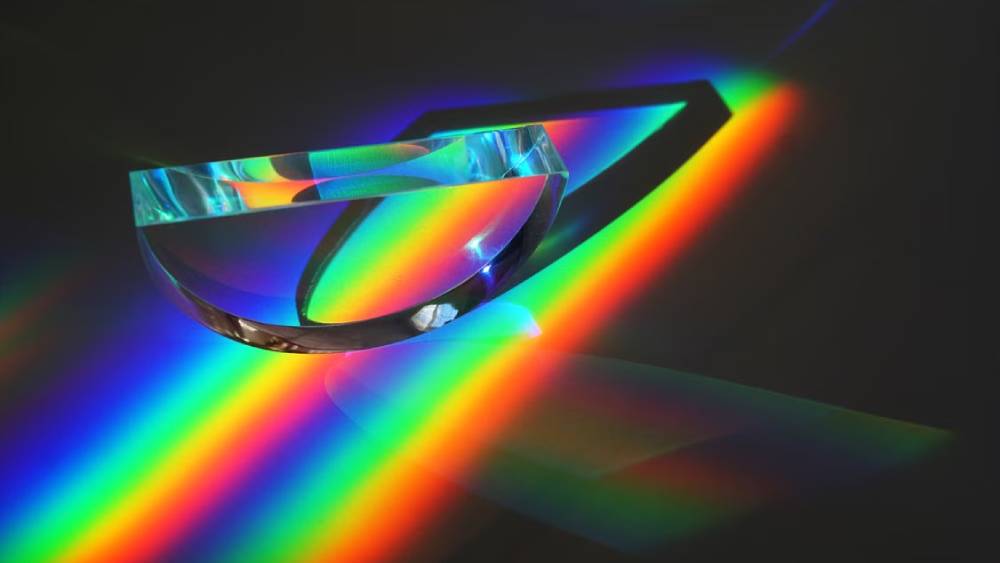
Glass is a material of contradictions. It is hard yet brittle, strong yet fragile, transparent yet demanding of precision. These contradictions create a unique set of processing challenges.
Glass is hard—typically 5 to 7 on the Mohs scale. This hardness makes it resistant to scratching, but it also means that cutting requires significant energy. Unlike metals, which deform plastically before fracturing, glass is brittle. It has no plastic deformation region. When the stress exceeds its fracture limit, it breaks catastrophically—without warning.
The implication for cutting: Any mechanical force applied to glass creates stress concentrations at the cutting edge. These stress concentrations propagate as cracks, leading to chipping, edge defects, and sometimes complete fracture. This makes mechanical cutting of glass inherently problematic for precision applications.
Glass is transparent to most visible and infrared wavelengths. This property is essential for optical applications, but it creates a fundamental problem for laser cutting. A laser beam must be absorbed by the material to remove it. If the beam passes through without being absorbed, no cutting occurs.
The implication for cutting: CO₂ lasers at 10.6 µm are absorbed by glass, but they generate significant heat. Infrared fibre lasers at 1064 nm pass through glass without absorption—they cannot cut glass at all. Even UV lasers at 355 nm, which are absorbed more effectively, still require high peak power to achieve efficient material removal.
Glass has low thermal conductivity—typically less than 1.5 W/m·K, compared to over 400 W/m·K for copper. This means that heat does not spread quickly through the material.
The implication for cutting: When heat is applied to glass, it remains localised. This is beneficial in some respects—it confines the heat-affected zone—but it also means that thermal stresses build up rapidly. If the thermal gradient is too steep, the glass cracks. This is the principle behind thermal shock, and it is one of the primary failure modes in thermal glass cutting.
For chemically strengthened glasses—such as aluminosilicate glass used in smartphone cover glass—there is an additional challenge. The strengthening process creates a compressive surface layer that gives the glass its impact resistance. However, this compressive layer also makes the glass more difficult to cut. Any processing that introduces heat, stress, or subsurface damage can disrupt the stress balance and cause the glass to shatter.
The implication for cutting: Cutting strengthened glass requires a process that does not introduce heat or mechanical stress—a requirement that only cold ablation with UV picosecond lasers can satisfy reliably.
Micron‑level glass cutting is susceptible to three primary failure modes, each caused by different mechanisms:
Mechanical cutting methods—diamond sawing, scribing, or scoring—apply force to the glass surface. This force creates stress concentrations at the cutting edge. Because glass is brittle, these stress concentrations propagate as cracks. The result is chipping at the cut edge and subsurface cracks that extend beyond the visible surface.
Why chipping is critical: Even microscopic chips—too small to be seen with the naked eye—significantly reduce the strength of the glass. A chip is a stress raiser. Under bending or folding stress, a chip becomes the initiation point for a crack that propagates across the glass, causing complete fracture.
Subsurface damage: Mechanical methods often create subsurface cracks that are not visible on the surface. These hidden defects reduce the effective strength of the glass by 50% or more, even though the surface appears intact.
Thermal cutting methods—CO₂ lasers, infrared lasers, and even some UV nanosecond lasers—apply heat to the glass surface. The heat melts or vaporises the material, but it also diffuses into the surrounding area.
The heat‑affected zone (HAZ): The HAZ is the region of material that is thermally altered but not removed. In this region, the glass structure has been changed—it may be weakened, stressed, or otherwise degraded. For optical applications, even a HAZ of a few micrometres can degrade performance.
Thermal stress: When heat is applied to glass, it expands. The surrounding cold glass resists this expansion, creating stress. If the stress exceeds the glass's fracture limit, cracking occurs. For chemically strengthened glass, thermal stress disrupts the compressive surface layer, causing shattering.
When glass is cut—whether mechanically or thermally—debris is generated. This debris can be in the form of particles, dust, or molten glass droplets.
The impact of particles: In applications such as OLED display manufacturing, even particles smaller than 1 micrometre can cause pixel defects. In microfluidics, particles can block channels. In optical applications, particles can scatter light. Particle control is essential, yet challenging, in glass cutting.
Why particles are difficult to manage: Mechanical methods generate large amounts of debris through abrasion. Thermal methods generate re‑condensed particles from the melt. Even laser ablation generates fine particles that must be evacuated effectively.
The transparency of glass to most laser wavelengths creates a fundamental problem for laser cutting. The laser wavelength must match the absorption properties of the glass, or no cutting occurs.
CO₂ lasers (10.6 µm) are absorbed by glass, but the absorption is thermal. Heat is generated at the surface and diffuses into the material. The heat‑affected zone is typically 50–100 micrometres or more, and thermal stress often causes micro‑cracks. CO₂ lasers are effective for scoring thick glass but are unsuitable for high‑precision cutting where edge quality is critical.
IR fibre lasers (1064 nm) pass through glass with almost no absorption. Cutting is ineffective—the beam does not interact with the material.
UV lasers (355 nm) have higher photon energy and are absorbed more effectively by glass. The absorption is more efficient, and the shorter wavelength enables a tighter focus and higher precision. However, UV nanosecond lasers still have a thermal component. The pulse duration is long enough (10–50 nanoseconds) for heat to diffuse, creating a measurable HAZ.
UV picosecond lasers are fundamentally different. The pulse duration is less than 10 picoseconds—shorter than the thermal diffusion time. Heat does not have time to spread. The material is removed by cold ablation, with virtually no thermal impact on the surrounding glass.
The transition from nanosecond to picosecond pulse duration is not a gradual improvement—it is a quantum leap in capability. Nanosecond lasers still rely on thermal mechanisms. Picosecond lasers create a fundamentally different interaction, enabling cold ablation with zero micro‑cracks and minimal HAZ.
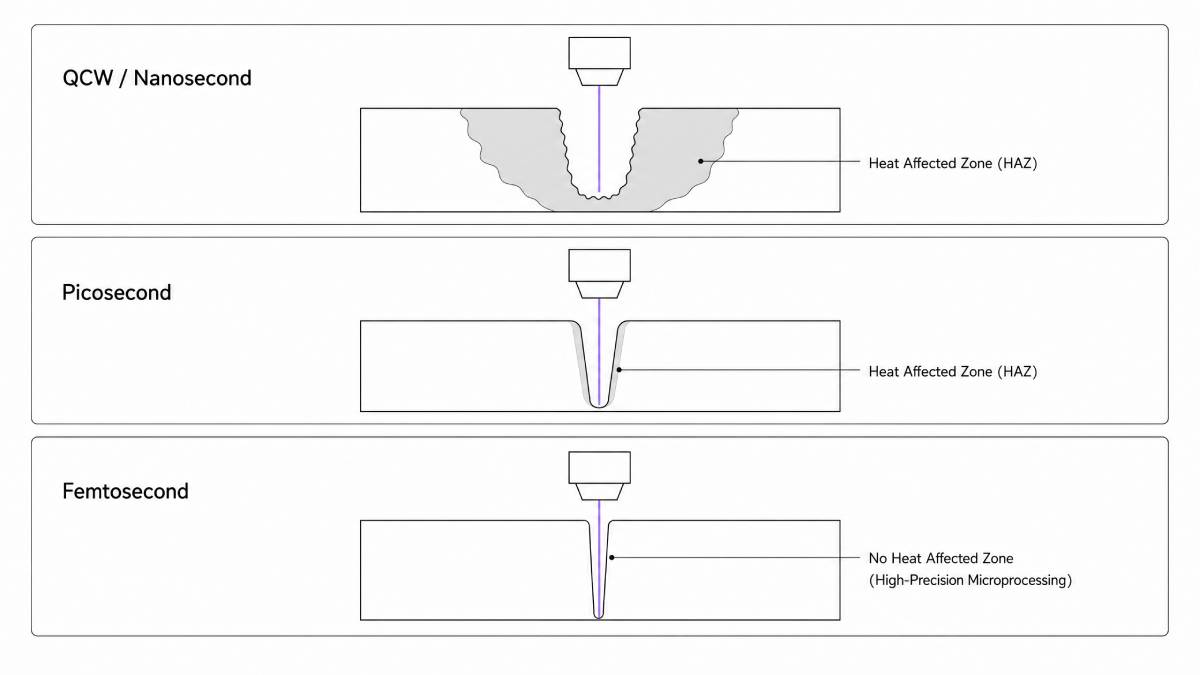
The term “cold ablation” is sometimes used loosely to describe various laser processes, but true cold ablation requires pulse durations shorter than the thermal diffusion time of the material. For glass, this means picosecond or femtosecond pulses. UV nanosecond lasers may be described as “cold” relative to CO₂ lasers, but they still generate measurable heat. Only picosecond and femtosecond lasers achieve truly thermal‑free material removal—a fact that is critical for applications requiring the highest edge quality.
When cutting glass with a focused laser beam, the cut is rarely perfectly vertical. The beam has a depth of focus—a region where the spot size is at its minimum. Above and below this region, the beam diverges, creating a tapered cut.
The implication for precision: Taper is problematic for many applications. In TGV (through‑glass via) drilling, taper affects the aspect ratio and the ability to fill vias with metal. In optical applications, taper can affect assembly tolerances and optical performance.
Managing taper: Reducing taper requires techniques such as beam shaping (using Bessel beams to extend the depth of focus), multi‑pass cutting, or dynamic focus adjustment. However, these techniques add complexity and can reduce throughput.
The trade‑off: Achieving zero taper requires careful process optimisation. The ideal combination of parameters—pulse energy, focus position, number of passes—depends on the specific glass material and thickness.
Even when a cut appears perfect—smooth edges, no visible chipping, no cracks—the glass may still be weaker than expected. The reason is that invisible defects are often present.
Subsurface damage: Mechanical cutting methods create cracks that extend below the visible surface. These cracks are not visible under optical microscopy—they require cross‑sectioning and scanning electron microscopy to detect.
Residual stress: Laser processes that generate heat create residual stress in the glass. The stress may not be high enough to cause immediate fracture, but it is present. Over time, or under load, this stress can cause failure.
The consequence: A glass component may meet all visual inspection criteria and still fail in service. This is the “silent killer” of glass reliability—defects that are present but invisible.
The solution: Eliminating subsurface damage requires processes that do not introduce heat or mechanical stress. UV picosecond laser cutting, with its cold ablation mechanism, is unique in delivering edges with no subsurface damage and no residual stress.
UV picosecond laser technology addresses each of the challenges identified above:
| Challenge | How UV Ps Solves It |
|---|---|
| Brittleness | Non‑contact processing—no mechanical force, no chipping |
| Thermal sensitivity | Cold ablation—no heat‑affected zone, no thermal stress |
| Transparency | UV wavelength is absorbed; nonlinear absorption enables efficient material removal |
| Particle generation | Clean process—debris is evacuated, not deposited |
| Taper | Multi‑pass cutting and advanced beam shaping minimise taper |
| Subsurface damage | No mechanical or thermal input—no hidden defects |
Micron‑level glass cutting is difficult because glass is fundamentally incompatible with traditional cutting methods. Its hardness makes mechanical cutting imprecise; its transparency defeats most lasers; its brittleness makes it susceptible to chipping and cracking; and its thermal sensitivity makes heat‑based processes problematic.
Chanxan Laser provides the UV ps laser systems that deliver micron‑level glass cutting across display, semiconductor, and optical applications. With cold ablation technology, high precision, and global service support, Chanxan is the trusted partner for manufacturers requiring the highest quality glass processing.
| Free solution
Previous: How to Achieve Micron-Level Precision in Glass Laser Cutting- A Practical Guide
Next: Micron‑Level Glass Cutting: Technologies, Precision and Applications