
Key Words: Silicon Wafer Dicing PCB Depaneling Glass Cutting
Home > News > Industry News
【Description】:
Discover how ultrafast laser micro-perforation technology resolves interfacial impedance, suppresses dendrite growth, and enhances ionic transport in solid-state battery separators.
As solid-state battery (SSB) architectures transition from laboratory proof-of-concept to pilot-line scaling, interfacial impedance remains the principal bottleneck limiting rate capability and operational lifespan. While solid-state electrolytes (SSEs) offer exceptional safety and thermal stability, their solid-solid interface with active electrodes introduces significant charge-transfer resistance.
Laser micro-perforation has emerged as a crucial structural engineering process. By delivering sub-micron precision without mechanical stress or thermal collateral damage, industrial ultrafast lasers transform solid-state separators from passive physical barriers into active, micro-engineered transport networks.
Conventional liquid lithium-ion battery separators rely on wet/dry stretching processes that yield randomized, tortuous pore structures. In solid-state and hybrid systems, such random porosity leads to localized current bottlenecks and non-uniform lithium-ion flux.
Laser precision allows battery engineers to replace random networks with deterministic micro-channel arrays:
Controllable Aspect Ratios: Ultrafast lasers can drill micro-vias with controlled taper angles, adjusting hole diameters from 500 nm up to 20 µm depending on the viscosity of localized trace gel/liquid electrolytes or solid composite matrices.
Tailored Tortuosity (τ ≈ 1): By creating straight-through vertical micro-channels perpendicular to the electrode surface, laser micro-perforation minimizes the effective path length (τ), directly boosting ionic conductivity (σeff).
Spatial Density Customization: Processing algorithms adjust hole pitch and pattern density across the membrane surface to match the specific current density profile of adjacent patterned electrodes.
The physical transformation enabled by laser micro-perforation alters interface dynamics across several key domains:
In un-patterned solid separators, microscopic surface roughness creates localized electric field spikes. These hot spots trigger preferential lithium nucleation, initiating dendritic growth that penetrates brittle ceramic membranes (e.g., LLZO, LATP) or soft polymer matrices (e.g., PEO). Laser-perforated micro-arrays distribute the electric field homogeneously across the entire active area. By equalizing ionic flux, the formation of localized lithium plating is suppressed, promoting smooth, planar lithium deposition.
In semi-solid or trace-electrolyte solid-state designs, getting liquid/gel additives to uniformly infiltrate high-density ceramic or polymer matrices is notoriously difficult. Laser-engineered micro-cavities act as capillary channels, driving rapid, uniform wetting through capillary pressure (Pc = 2γ cosθ / r). This reduces initial formation time and eliminates dry spots that cause premature capacity fade.
Solid-state battery anodes (especially silicon-graphite composites or pure lithium metal) undergo extreme volumetric expansion and contraction during charge-discharge cycles. Arrayed micro-perforations provide localized expansion reservoirs within the separator membrane, absorbing mechanical stress and preventing catastrophic interfacial delamination or micro-cracking.
Achieving sub-micron accuracy on delicate, heat-sensitive battery separators requires strict avoidance of the Heat-Affected Zone (HAZ). Traditional nanosecond lasers induce thermal melting, edge burrs, and material degradation.
Ultrafast laser platforms (picosecond and femtosecond) transform the material through non-thermal cold ablation:
| Parameter | Thermal Processing (Nanosecond) | Ultrafast Precision (Picosecond/Femtosecond) |
|---|---|---|
| Pulse Duration | > 1 ns | < 10 ps (down to < 300 fs) |
| Ablation Mechanism | Photothermal (Melting & Vaporization) | Photochemical / Multiphoton Cold Ablation |
| Edge Quality | Elevated melt lips, charring, micro-cracks | Clean micro-apertures, zero melt beads |
| Structural Integrity | High thermal stress, membrane shrinkage | Original mechanical strength & dielectric insulation preserved |
To translate laser micro-perforation from lab-scale innovation to production line speeds, equipment manufacturers integrate advanced laser beam delivery technologies:
Polygon Scanner Systems: High-speed rotating polygon mirrors achieve surface scanning velocities exceeding 100 m/s, enabling millions of micro-holes per second across moving webs.
Focus & Web Stabilization: Continuous optical distance measurement ensures that ultra-thin separator foils remain perfectly within the Rayleigh range (depth of focus) during high-throughput Roll-to-Roll (R2R) handling.
In-Line Quality Assurance: Coaxial vision systems combined with high-speed CCD inspection monitor hole diameter, array pitch, and edge burr morphology in real time.
Laser micro-perforation represents a paradigm shift in solid-state battery separator design. By moving from non-uniform, random porosity to micro-engineered channel arrays, laser precision directly resolves interfacial impedance, homogenizes lithium-ion transport, and mitigates dendrite growth. As battery manufacturing advances toward higher energy densities and ultra-fast charging capabilities, laser micro-machining stands as a critical enablement technology for commercializing next-generation energy storage.
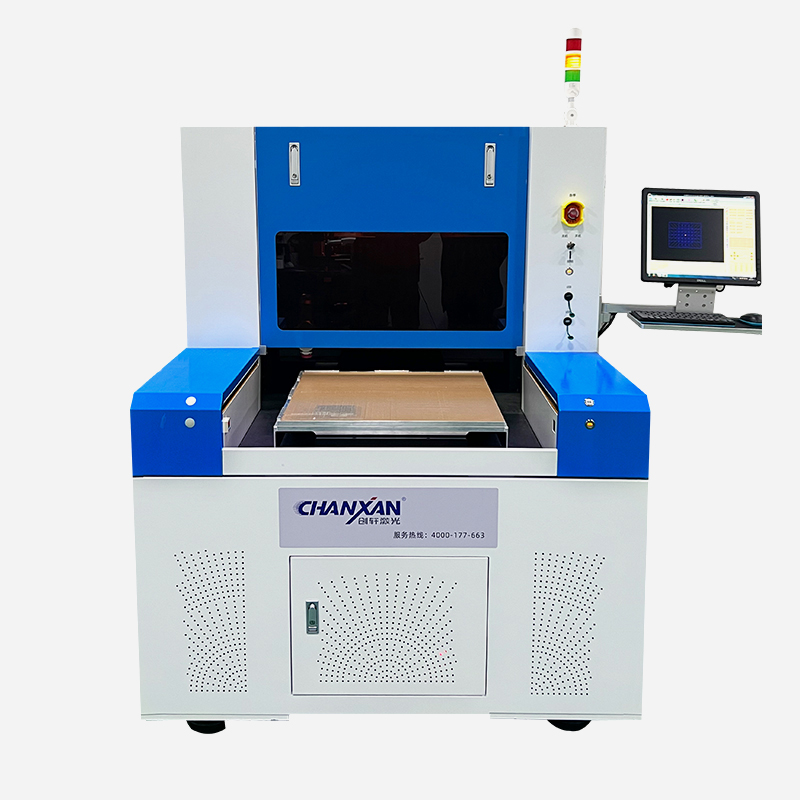
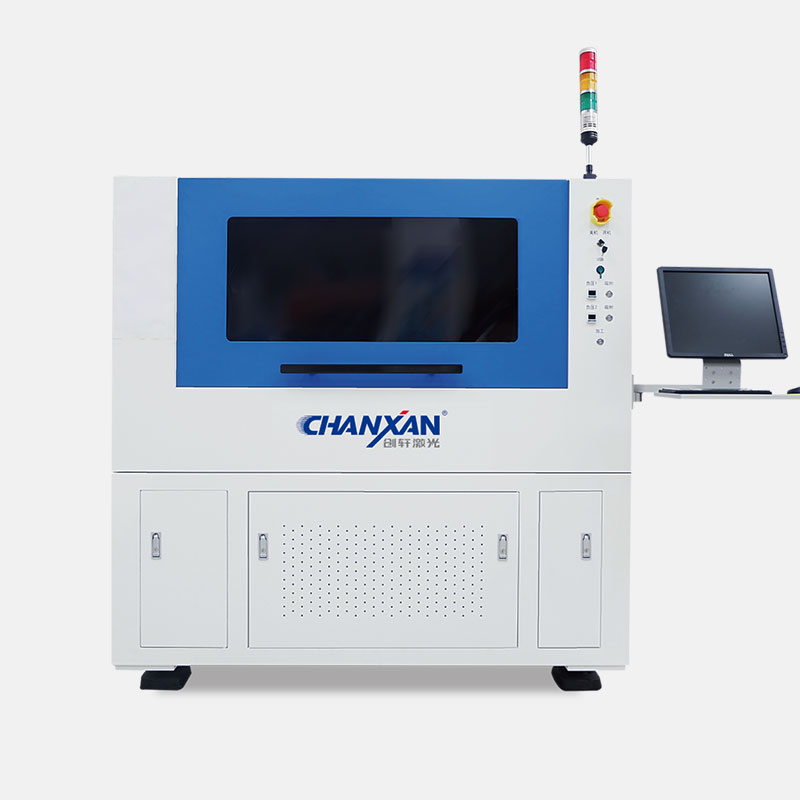
Chanxan Laser delivers cutting-edge industrial ultrafast laser solutions tailored specifically for solid-state battery separators. Utilizing advanced picosecond and femtosecond lasers with UV (355 nm) and Green (532 nm) wavelengths, Chanxan's micro-machining systems achieve ultra-clean cold ablation on sensitive ceramic (LLZO, LATP) and flexible polymer composite membranes. Integrated with dynamic focus tracking, high-speed Roll-to-Roll (R2R) web handling, and automated vision inspection, Chanxan Laser empowers gigafactories to scale high-precision separator micro-perforation with zero heat-affected zone (HAZ), maximum yield, and superior electrochemical performance.
| Free solution
Previous: Laser Micro-Perforation for Solid-State Battery Separator
Next: Laser Micro-Perforation in Solid-State Battery Separators | Next-Gen Energy Storage