
Key Words: Silicon Wafer Dicing PCB Depaneling Glass Cutting
Home > News > Industry News
【Description】:
This guide breaks down the mechanics, pros, and cons of FPC laser cutting vs punching to help you determine the best flexible PCB processing methods for your production line.
The explosive growth of modern electronics has placed immense pressure on manufacturers to design smaller, lighter, and more complex devices. At the heart of this evolution is the FPC (flexible printed circuit). However, working with highly sensitive flexible circuit board materials requires specialized manufacturing techniques. Manufacturers usually find themselves at a crossroads: laser cutting vs die cutting for FPC. Choosing the wrong approach can lead to structural damage, low yields, and skyrocketing overhead costs. This guide breaks down the mechanics, pros, and cons of FPC laser cutting vs punching to help you determine the best flexible PCB processing methods for your production line.
Traditional die cutting machine for FPC setups rely on physical force. A custom steel rule die or male/female punch die physically stamps the material to create the desired shape. It is a contact-based, mechanical shearing process that has been the industry standard for high-volume, low-complexity manufacturing for decades.
In contrast, an FPC laser cutting machine utilizes a highly focused, computer-controlled laser beam to vaporize material along a pre-programmed path. This PCB laser cutting process is entirely software-driven and contact-free. Modern systems leverage UV laser FPC cutting or picosecond laser flexible PCB processing to achieve high-accuracy PCB laser ablation without touching the delicate circuitry.
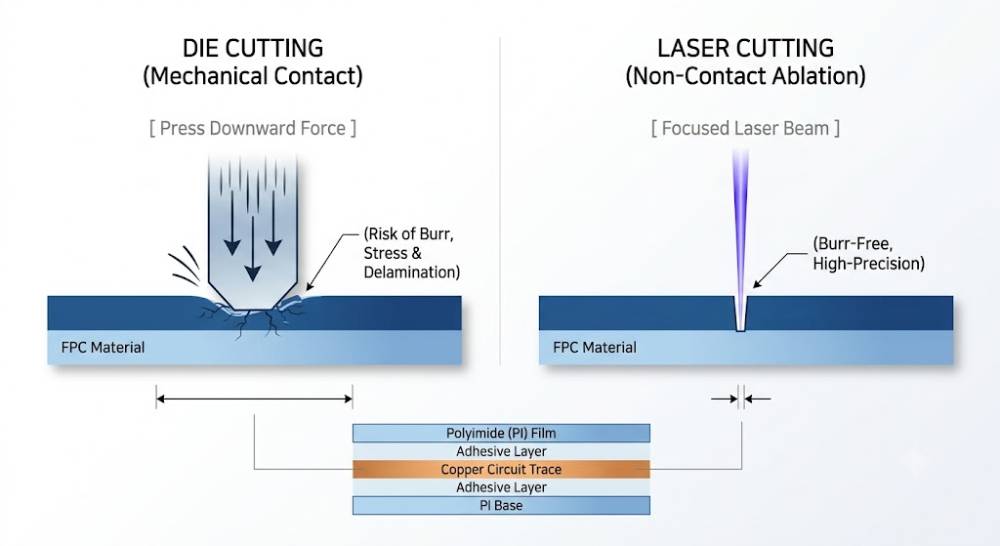
The fundamental difference between the two processes lies in contact and flexibility.
Die cutting is a mechanical process. Once a tooling die is manufactured, it defines a fixed production path. This makes it efficient for large-scale production of identical parts, but it limits design changes and introduces wear-related quality variation over time.
Laser cutting, on the other hand, is software-driven. A flexible PCB laser cutting system can switch between designs instantly without tooling changes. This allows manufacturers to respond quickly to design iterations, prototyping needs, and high-mix production requirements.
From a quality perspective, die cutting often leads to edge burr formation due to blade wear and material stress. In contrast, laser processing delivers a burr free flexible PCB cutting edge and eliminates the need for secondary deburring processes.
| Feature | Mechanical Die Cutting | FPC Laser Cutting Machine |
| Contact Type | Physical Contact (Shearing force) | Non-Contact (Thermal/Ablation) |
| Tooling Cost | High (Requires custom dies for every design) | Zero (Software-driven digital paths) |
| Edge Quality | High risk of die cutting burr problem | Guarantees burr free FPC cutting |
| Precision | Limited by physical blade thickness ($\pm 100\,\mu\text{m}$) | High precision flexible PCB cutting ($\pm 20\,\mu\text{m}$ or better) |
| Design Flexibility | Poor (Modifications require rebuilding dies) | Excellent (Instant adjustments via CAD/CAM) |
| Production Volume | Best for massive, unchanging mass production | Ideal for prototypes, high-mix, & high-precision |
The delicate stack-up of polyimide, adhesives, and copper creates unique failure mechanisms during manufacturing. Let's explore how both methods tackle these structural challenges:
Because mechanical tools press downward with tons of force, they frequently pinch and pull at the edges of the circuit board. This physical stress can easily induce separation between the layers. Using a PCB laser depaneling machine ensures you avoid delamination in FPC because there is no mechanical load pulling the bonded films apart.
Over time, mechanical dies wear down, resulting in the notorious die cutting burr problem. Fractured copper burs can pierce insulation layers and trigger short circuits. Switching to a laser cutting system for FPC delivers a completely burr free flexible PCB cutting edge, eliminating manual post-processing deburring steps.
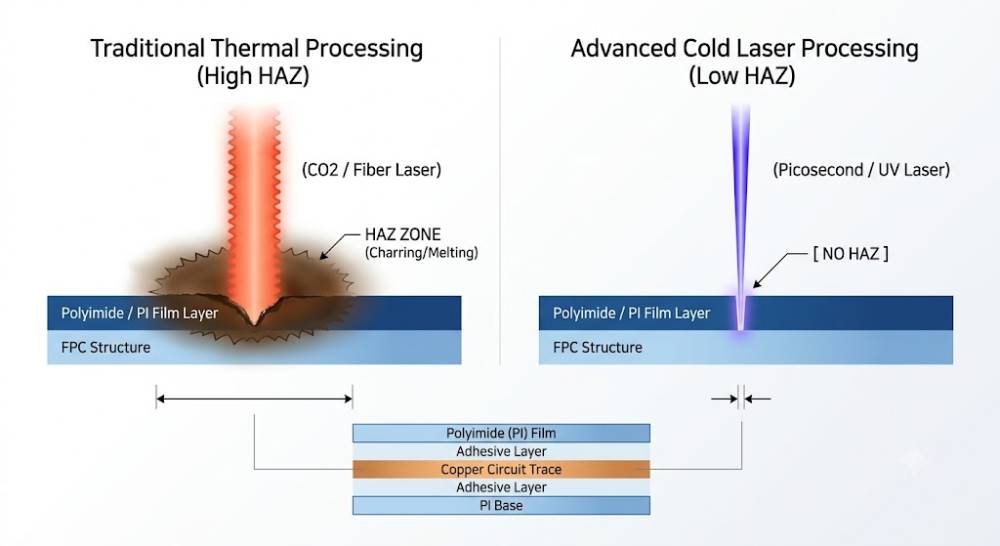
A common critique of older laser technology was thermal damage. However, modern systems utilize UV laser FPC cutting and advanced cold processing laser technology. By migrating from infrared wavelengths to ultra-short pulse lengths—such as picosecond laser flexible PCB processing—the pulse duration is so fast that the material transitions instantly from solid to gas. This achieves low HAZ laser cutting, allowing you to safely reduce HAZ in PCB cutting without charring adjacent traces.
One of the most important limitations of mechanical die cutting is geometric constraint. Sharp internal corners, micro-scale cutouts, and highly dense routing patterns are difficult or impossible to achieve due to physical tool limitations.
In contrast, PI film laser cutting enables virtually unlimited design freedom. Because the process is non-contact, the laser beam can execute extremely tight radii and complex internal geometries without mechanical resistance. This makes it ideal for modern flexible electronics, where space efficiency and circuit density continue to increase.
In real production environments, the choice between laser cutting vs die cutting for FPC is often determined by application requirements rather than technology preference.
Industries such as automotive electronics, medical devices, and wearable systems typically require high reliability and precise edge quality. These sectors benefit more from FPC laser cutting machine solutions, especially when dealing with evolving product designs and strict quality standards.
On the other hand, mechanical die cutting remains suitable for mature, high-volume products with stable designs and cost-sensitive production models.
Choose Die Cutting if you are manufacturing millions of identical, low-complexity flexible circuits, your designs are completely finalized, and edge precision is not a limiting factor for your application.
Choose an FPC Laser Cutting Machine if you need to improve yield in FPC production, run high-mix or evolving designs, process ultra-thin sensitive layers, or require flawless, high-density edge contours.
Chanxan Laser provides advanced FPC laser cutting solutions designed for high-performance flexible electronics manufacturing. Our systems are optimized for PI film laser cutting, copper trace precision processing, and burr free flexible PCB cutting in demanding industrial environments.
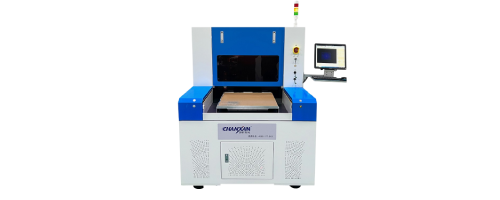
For manufacturers requiring higher precision and process stability, the Chanxan FPC UV picosecond laser cutting machine delivers superior performance in flexible PCB processing. By combining UV laser and ultrafast picosecond pulse technology, the system enables ultra-low HAZ processing while maintaining excellent edge quality and production consistency.
Whether your application involves flexible PCB laser cutting, FPC depaneling, or high-density PI film micro-processing, Chanxan Laser provides a stable and scalable solution for modern electronics manufacturing, helping improve yield, reduce defects, and support next-generation flexible circuit production.
| Free solution
Previous: UV Laser vs CO2 Laser for Film Laser Cutting: Precision, HAZ, and Process Comparison
Next: Heat-Affected Zone (HAZ) Control in Flexible PCB Laser Cutting