
Key Words: Silicon Wafer Dicing PCB Depaneling Glass Cutting
Home > News > Industry News
【Description】:
Learn what causes layer separation and delamination during polyimide laser cutting. Prevent flexible PCB defects with Chanxan's picosecond solutions.
TL;DR Too Long; Didn't Read
Polyimide (PI) is the preferred substrate for high-performance flexible printed circuits because of its excellent thermal stability, electrical insulation, and mechanical flexibility. However, delamination remains one of the most critical quality issues during polyimide laser cutting. Instead of occurring within the polyimide itself, delamination usually develops between laminated layers such as the PI film, adhesive layer, coverlay, and copper foil. Excessive thermal stress or improper process control can weaken the interfacial bond, leading to layer separation, reduced reliability, and lower manufacturing yield. By using optimized process parameters and ultrafast picosecond laser cutting, manufacturers can significantly reduce the risk of delamination while maintaining clean, precise cuts.
Polyimide has become the standard substrate for high-performance flex PCB manufacturing. Compared with PET (Polyethylene Terephthalate) film, PI offers much better thermal resistance and dimensional stability, making it suitable for demanding electronic applications.
Common polyimide processing applications include:
Flexible printed circuits (FPC)
Rigid-flex PCBs
FPC coverlay films
Flexible sensors
Wearable electronics
Medical electronic devices
Most flexible circuits are not made from a single PI film. Instead, they consist of multiple laminated layers that must remain firmly bonded throughout the manufacturing process.
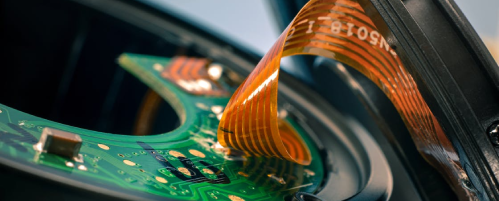
A typical flexible circuit contains several functional layers:
PI substrate
Copper foil
Adhesive layer
Coverlay
Surface protective coatings
Each material has different mechanical and thermal properties. During polyimide laser cutting, these layers respond differently to laser energy. If the stress at the interfaces becomes too high, the bond between adjacent materials may begin to fail. This is known as laser delamination.
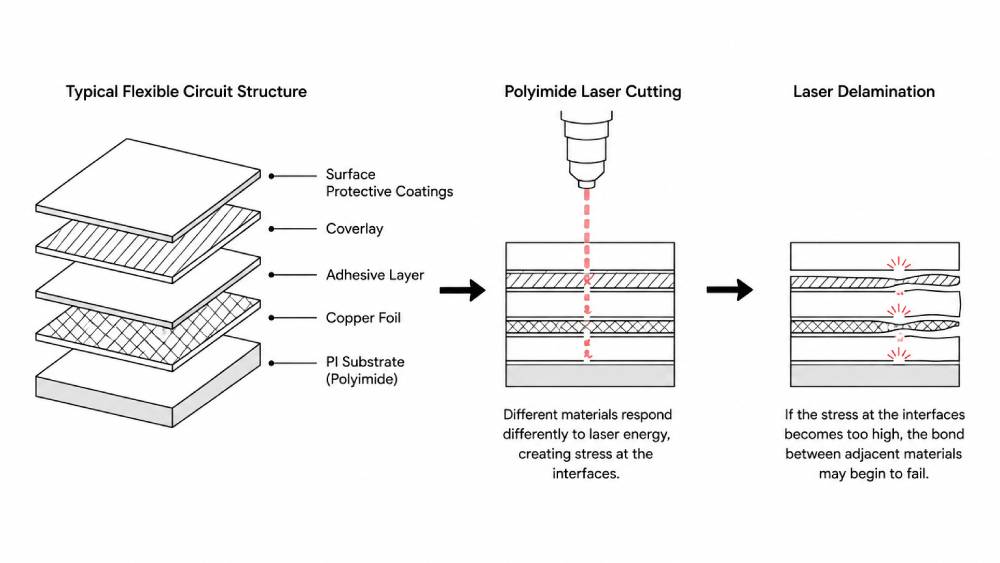
Delamination refers to the separation of bonded layers inside a laminated flexible circuit.
Unlike burrs or edge roughness, delamination is often hidden beneath the surface. It may not be immediately visible after cutting but can lead to failures during assembly or long-term operation.
Typical forms include:
Coverlay delamination
Adhesive layer separation
Copper foil lifting
PI substrate separation
Localized layer peeling
Once delamination occurs, the mechanical integrity of the circuit is permanently reduced.
Every material expands differently when heated. PI film, copper foil, adhesives, and coverlay all have different coefficients of thermal expansion. As laser energy is applied, these materials expand at different rates, creating stress at the bonding interfaces. If the stress exceeds the adhesive strength, layer separation begins.
The adhesive layer connects multiple functional layers inside the flexible circuit. Poor lamination quality, insufficient bonding pressure, or aging adhesives reduce bonding strength before laser processing even begins. During cutting, these weakened interfaces become the first locations where delamination develops.
Modern flexible circuits often contain multiple copper layers, coverlays, reinforcement films, or shielding materials. As the stack becomes more complex, internal stresses become less uniform. This increases the likelihood of localized laser delamination, especially around corners, slots, and narrow bridge structures.
Laser processing must remove material without overstressing the laminated structure. Poorly optimized settings may increase the risk of interface failure, including: excessive pulse energy, slow cutting speed, repeated heating in small areas, or incorrect focus position. Careful process optimization helps maintain stable bonding between layers.
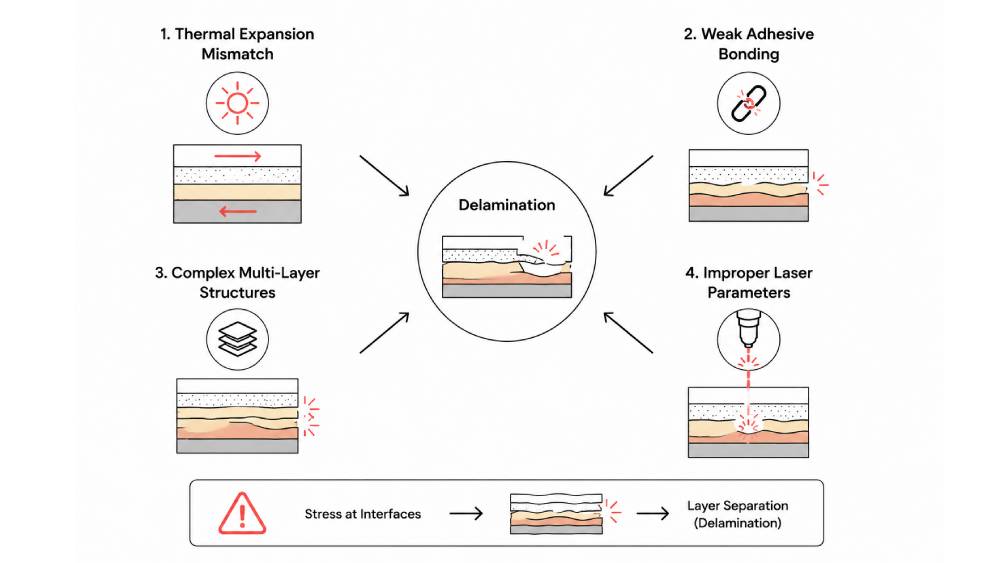
Reducing delamination requires attention to both material quality and laser process control. Recommended practices include:
Recommended practices:
✔ Use high-quality laminated PI materials.
✔ Ensure strong adhesive bonding before cutting.
✔ Optimize laser power and cutting speed.
✔ Minimize repeated exposure in narrow areas.
✔ Maintain accurate focus throughout the cutting process.
Most importantly, choose a laser source that minimizes stress within the laminated structure.
Picosecond lasers remove material using ultrashort pulses that deliver energy over an extremely short time. Because the interaction time is much shorter than conventional laser systems, surrounding laminated layers experience significantly less mechanical and thermal stress.
This provides several advantages for polyimide laser cutting:
Lower risk of coverlay delamination
Better bonding integrity between layers
Cleaner multilayer edges
Improved dimensional accuracy
Higher manufacturing yield
For high-density flexible circuits, picosecond laser processing has become an increasingly popular solution for achieving reliable precision cutting while protecting delicate laminated structures.
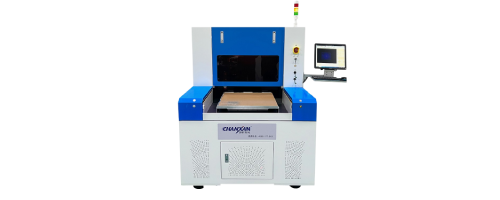
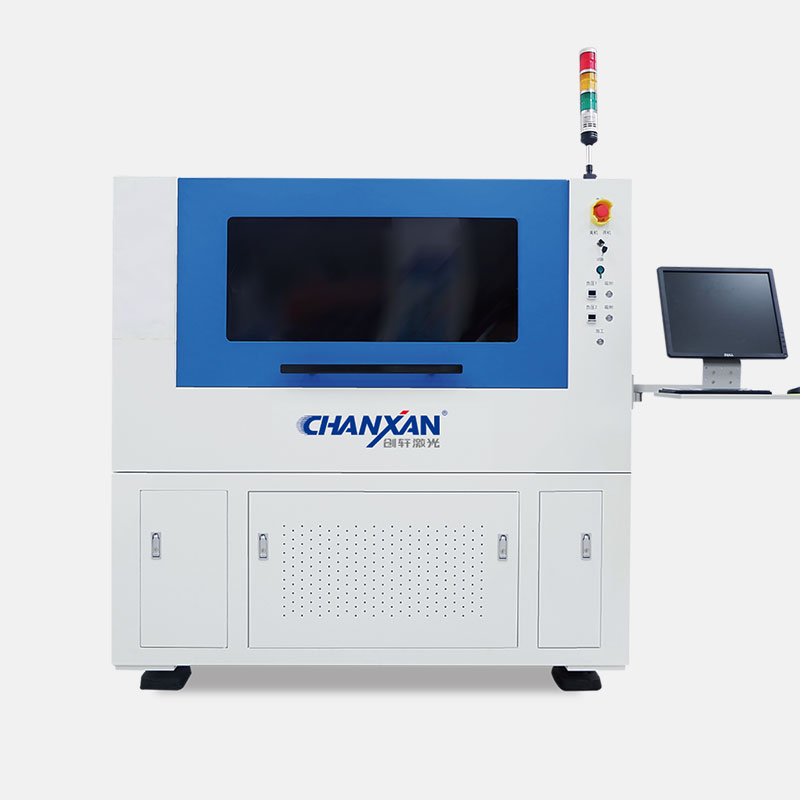
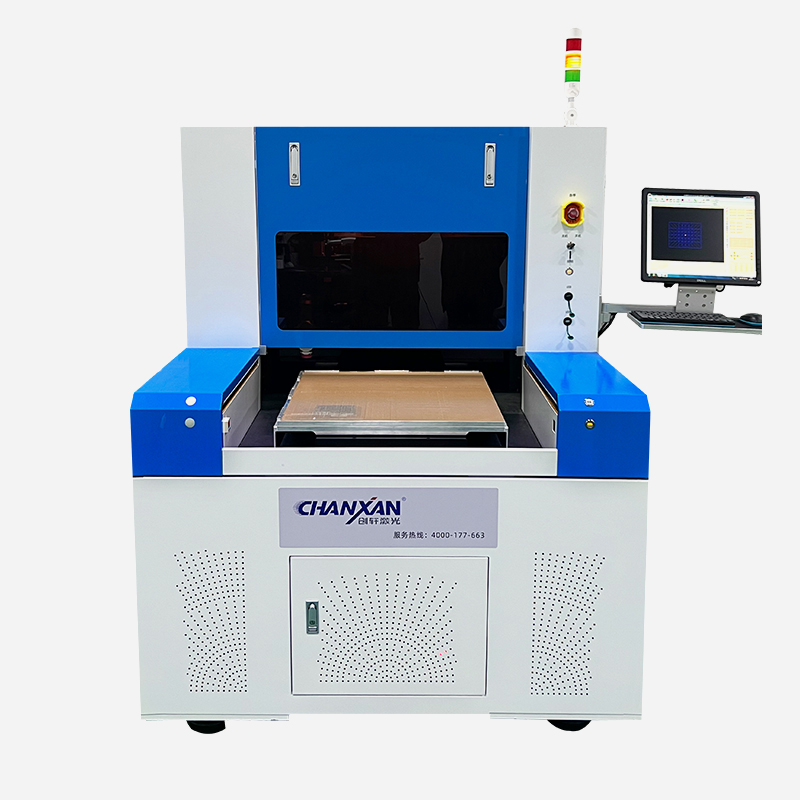
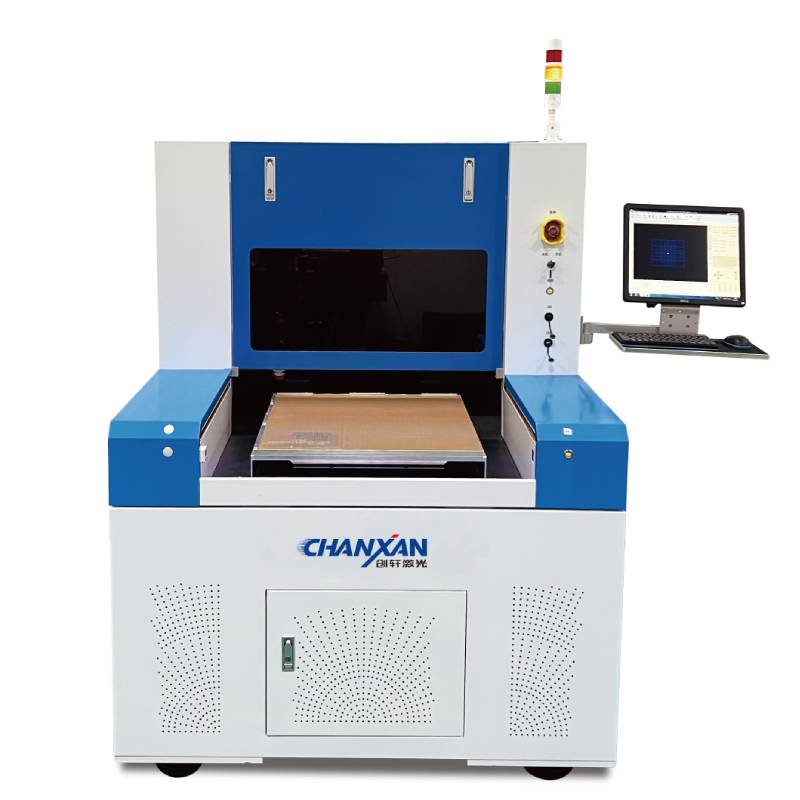
Chanxan provides high-precision polyimide laser cutting machines for advanced flexible electronics manufacturing. Our Picosecond Laser System is engineered for precision processing of:
Polyimide (PI) film
Flexible printed circuits (FPC)
Rigid-flex PCBs
Coverlay films
Adhesive layers
Copper-clad flexible laminates
With micron-level positioning, high-speed motion control, and stable beam delivery, Chanxan systems produce clean profiles while minimizing the risk of layer separation and maintaining excellent cutting consistency across complex flexible circuit designs. Whether producing prototype FPCs or high-volume flexible electronics, Chanxan helps manufacturers improve yield, reduce defects, and achieve reliable polyimide processing for demanding industrial applications.
Related reading:
Heat-Affected Zone (HAZ) Control in Flexible PCB Laser Cutting
Thermal Deformation in PET Film Laser Cutting: How to Control It
Carbonization in Polymer Laser Processing: Causes and Fixes
Burr Formation in Flexible PCB Laser Cutting: Causes and Solutions
| Free solution
Previous: Thermal Deformation in PET Film Laser Cutting: How to Control It
Next: Burr Formation in Flexible PCB Laser Cutting: Causes and Solutions