
Key Words: Silicon Wafer Dicing PCB Depaneling Glass Cutting
Home > News > Industry News
【Description】:
Learn about minimizing the Heat-Affected Zone (HAZ) in flexible PCB laser cutting. Explore how Chanxan ultrafast systems suppress thermal diffusion for precision FPCs.
TL;DR Too Long; Didn't Read
In flexible PCB laser cutting, Heat-Affected Zone (HAZ) refers to the region around the laser cut where material properties are altered due to thermal diffusion. Although no direct burning or mechanical damage occurs in this area, excessive heat input can still degrade FPC edge quality, reduce dimensional stability, and affect circuit reliability. Controlling HAZ requires managing laser energy, pulse width, scanning behavior, and selecting the appropriate laser type such as nanosecond or picosecond systems.
Heat-Affected Zone (HAZ) is the area surrounding the laser interaction point where the material does not get fully removed but experiences thermal influence.
In FPC laser cutting, HAZ typically appears in:
PI flexible circuits
Copper trace edges
Adhesive layers
Coverlay interfaces
Multi-layer FPC stack-up structures
Although the material remains physically intact, its internal structure may change due to thermal diffusion.
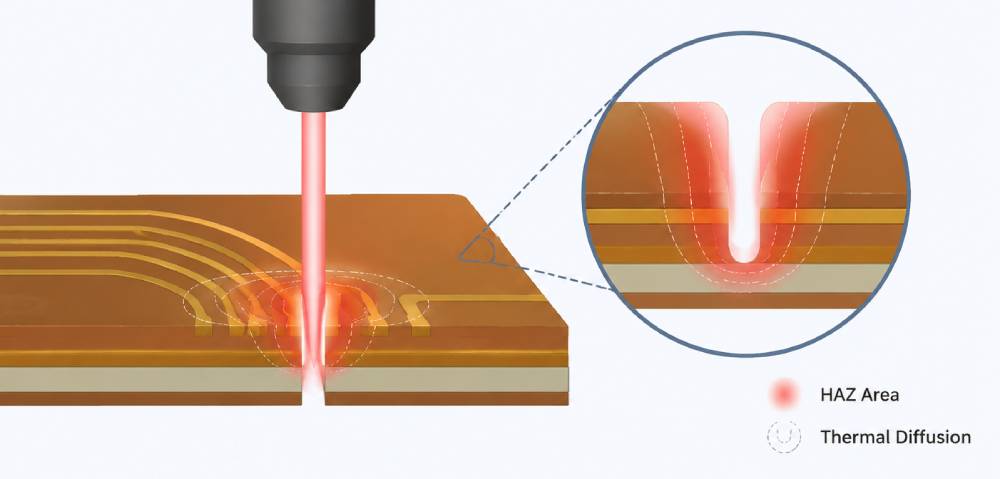
HAZ is formed through a chain of thermal interactions during laser processing. When laser energy is applied to a flexible PCB, the energy is absorbed at the surface and begins to spread outward into surrounding materials. This process is known as thermal diffusion.
Different layers in the FPC stack-up react differently. PI substrates, copper traces, and adhesive layers each have unique thermal conductivity and absorption characteristics. As a result, heat does not distribute evenly, and a surrounding affected zone naturally forms.
This thermal interaction directly influences final FPC edge quality, especially in fine-pitch or high-density designs.
Higher laser energy increases heat penetration into surrounding materials. If energy is not properly controlled, thermal diffusion expands beyond the intended cut zone, enlarging the HAZ and reducing edge precision.
Pulse duration plays a critical role in HAZ control. Longer pulses, such as those used in nanosecond lasers, allow more time for heat to spread into adjacent materials. This increases thermal diffusion and enlarges the affected zone. In contrast, shorter pulse systems reduce the interaction time, limiting heat transfer and improving thermal confinement during FPC laser cutting.
If the scanning speed is too slow or overlap is too high, heat accumulates in the same region. This repeated exposure increases the size of the heat-affected zone and reduces edge consistency. Stable scanning dynamics are essential to maintain predictable laser heat affected zone behavior.
Different layers in flexible PCBs respond differently to heat:
The PI substrate distributes heat slowly but steadily
Copper traces conduct heat rapidly along edges
Adhesive layers are more sensitive to thermal buildup
Coverlay interfaces can amplify local stress effects
These differences create uneven thermal distribution, which contributes to HAZ variability across the FPC stack-up.

The choice of laser type has a direct impact on heat-affected zone size.
Nanosecond Laser Processing
Nanosecond lasers operate with relatively long pulse durations. This increases thermal interaction time between laser energy and material, leading to greater heat diffusion. As a result, the HAZ is typically wider, especially in sensitive flexible PCB laser cutting applications.
Picosecond Laser Processing
Picosecond lasers deliver energy in ultra-short pulses, significantly reducing the time available for heat to spread. This leads to tighter energy confinement, lower thermal diffusion, and a much smaller heat-affected zone. It is widely used in high-precision FPC laser cutting applications where edge quality and dimensional accuracy are critical.
Effective HAZ control requires balancing multiple process parameters rather than adjusting a single factor. In practical manufacturing, manufacturers typically achieve better results by:
Reducing excessive laser energy input
Increasing scanning speed to limit heat accumulation
Using shorter pulse laser systems when possible
Maintaining stable and uniform scanning paths
Matching laser parameters to material stack properties
When these factors are properly optimized, the laser heat affected zone can be significantly minimized, improving both edge precision and overall process reliability.
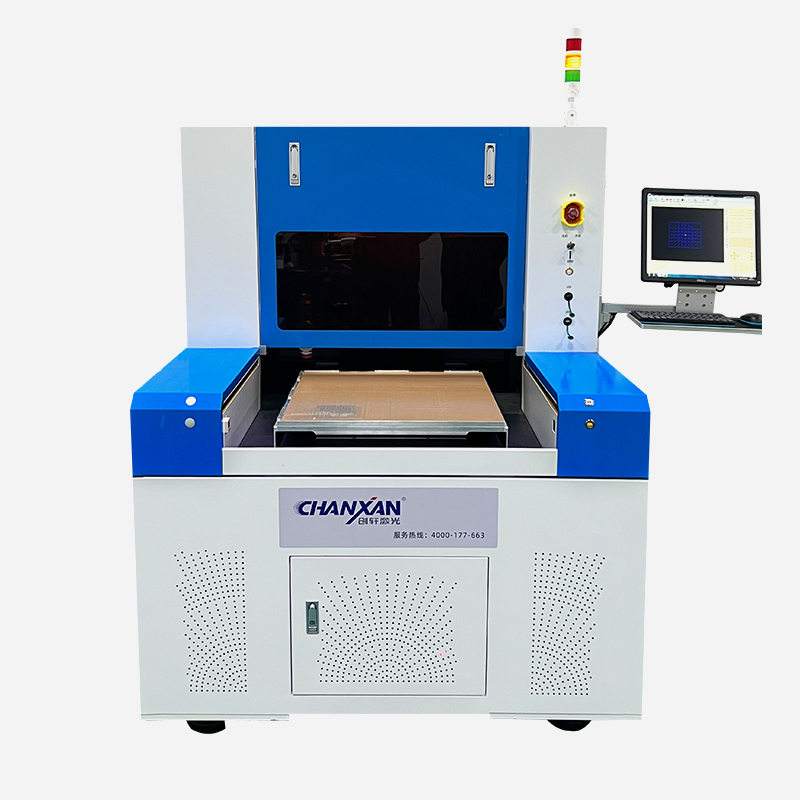
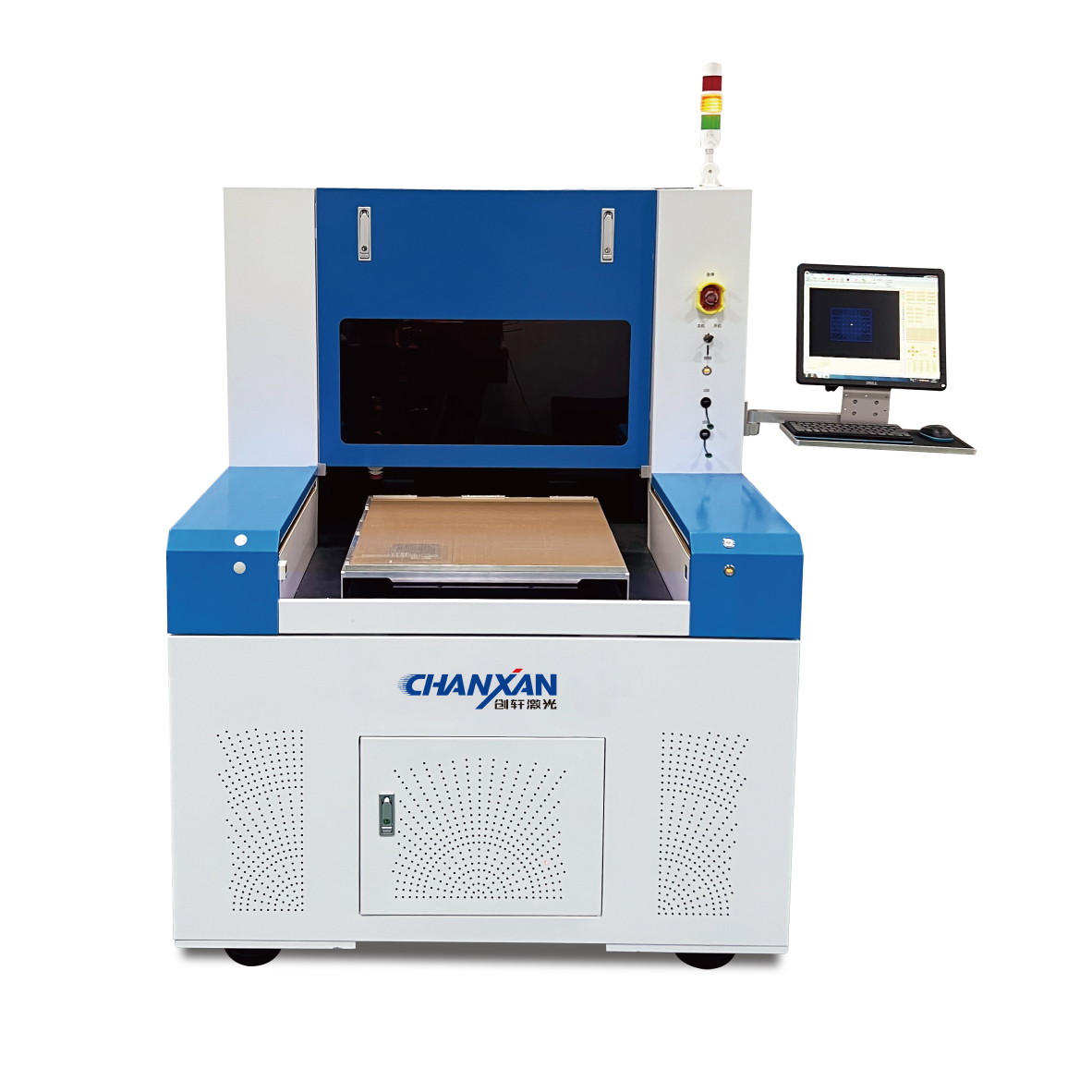
Chanxan ultrafast laser systems are engineered for precision-driven flexible PCB laser cutting, where tight control of the Heat-Affected Zone (HAZ) directly determines final product reliability and yield.
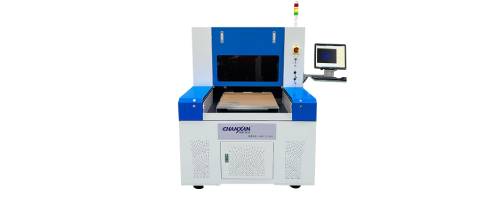
Built on a high-stability industrial platform, the system delivers 1 um positioning accuracy and 1 um repeatability, ensuring consistent micron-level energy placement across complex FPC geometries. Combined with a <30 um overall machining accuracy, the platform maintains geometric integrity even in high-density interconnect structures.
In advanced FPC laser cutting applications, the system precisely controls laser energy input, pulse width, and thermal diffusion behavior, significantly reducing unwanted heat propagation during processing. The optimized optical and motion architecture limits the HAZ to <20 um, ensuring stable processing results even on multi-layer structures such as PI substrates, copper traces, adhesive layers, and coverlay interfaces.
The integration of ultrashort pulse laser technology (picosecond-level cold processing) minimizes thermal accumulation at the source, while the high-speed motion system (up to 3000 mm/s processing speed) further reduces localized heat buildup during continuous scanning. This combination ensures that thermal impact remains tightly confined to the ablation zone.
✔ Positioning & Repeatability: 1 um high-precision motion tracking.
✔ Strict HAZ Boundary Control: Confined within 20 um to protect FPC trace margins.
✔ Overall Accuracy: <30 um flawless micro-geometric structural yield.
✔ High-Speed Thermal Suppression: Dynamic scanning up to 3000 mm/s prevents energy accumulation.
As a result, manufacturers achieve consistently improved FPC edge quality, higher dimensional stability, and superior process repeatability in mass production environments. The Chanxan ultrafast platform is particularly suited for high-precision applications such as fine-pitch flexible circuits, RF interconnects, wearable electronics, and multi-layer FPC stack-up processing, where thermal control defines final performance.
Related reading:
Carbonization in Polymer Laser Processing: Causes and Prevention
Thermal Deformation in PET Film Laser Cutting: How to Control It
Delamination in Polyimide Laser Cutting: Root Causes and Prevention
Burr Formation in Flexible PCB Laser Cutting: Causes and Solutions
| Free solution
Previous: Laser Cutting vs Die Cutting for FPC Cutting: Which Is Right for Your Production?
Next: Carbonization in Polymer Laser Processing: Causes and Prevention