
Key Words: Silicon Wafer Dicing PCB Depaneling Glass Cutting
Home > News > Industry News
【Description】:
Technical guide on roll-to-sheet picosecond laser processing for thin film manufacturing, covering ultrafast UV cold ablation, automated web tension control, dynamic singularization
In modern microelectronics, flexible photovoltaics, and display manufacturing, high-throughput processing of flexible functional thin films represents a major manufacturing bottleneck. Traditional batch processing methods—such as sheet-to-sheet handling—often suffer from low yield rates, high material handling overhead, and contamination risks. As functional film stacks become thinner and more thermally sensitive, integrating high-speed web handling with cold ultrafast laser ablation is essential for modern mass production lines. Roll-to-sheet picosecond laser processing for thin film manufacturing provides an automated, non-contact manufacturing route that optimizes both optical precision and continuous production efficiency.
The roll-to-sheet picosecond laser workflow seamlessly converts continuous web substrates into high-precision, singularized components through four synchronized stages:
Dynamic Tension Compensation: Flexible substrates (e.g., PI, PET, COP, ITO films) are unreeled under active closed-loop tension control to prevent stretching, dynamic wrinkling, or lateral drift.
Web Edge Guide (EPC): Ultrasonic or optical sensors continuously track web alignment to maintain sub-millimeter tracking accuracy prior to entering the laser working zone.
Ultrashort Pulse Mechanism: Operating at pulse widths between 1 and 10 picoseconds, laser photon energy is absorbed by the target material before lattice thermalization occurs. This prevents heat buildup, constraining the Heat-Affected Zone (HAZ) to ≤ 5 μm.
Wavelength Selection: Depending on optical absorption spectra, 355 nm UV picosecond lasers are typically deployed for polymer films (PI/PET) and transparent conductive oxides (ITO/AZO), while 1064 nm IR or 532 nm Green lasers handle metallic layers and thick foils.
Dynamic Perimeter Cutting: High-speed galvo scanners execute complex perimeter contours or micro-perforations synchronized with step-and-repeat or continuous motion platforms.
Automatic Sheet Stacking: Processed thin films are cleanly severed from the web roll, picked up via automated vacuum grippers or air-assist chutes, and neatly stacked into magazine trays for downstream assembly.
| Industry Sector | Film Substrate & Stack | Picosecond Processing Task | Manufacturing Edge |
|---|---|---|---|
| Flexible Electronics & FPC | Polyimide (PI) coverlays, FCCL, PET optical films | Roll-to-sheet coverlay window opening, perimeter profiling | No carbonization, zero adhesive squeeze-out, edge burr < 3 μm. |
| Perovskite & Flexible PV | ITO/FTO transparent conductive glass/films, perovskite layers | Selective P1, P2, P3 monolithic interconnect scribing | Sub-10 nm ablation depth repeatability; preserves flexible substrate integrity. |
| Li-ion & Solid-State Batteries | Ceramic-coated separators, coated current collectors (Cu/Al foils) | High-speed roll-to-sheet separator slitting, tab shape slitting | Eliminates mechanical blade wear; prevents short-circuit burrs. |
| Medical & Bio-Sensors | Microfluidic diagnostic films, biocompatible polymer laminates | Micro-channel scribing, hole drilling, precision sheet cutting | Clean-room compatible; zero thermal degradation of biological coatings. |
To achieve high yield and stable operation in continuous production environments, integrated roll-to-sheet picosecond processing equipment relies on several core engineering innovations:
On-the-Fly (Fly-Cutting) Synchronization: Advanced motion controllers interface galvo scanner deflection encoders with line-scan web speed sensors, allowing the picosecond laser beam to execute precise patterns while the substrate is continuously moving without stopping.
Coaxial Vision Alignment & Mark Tracking: High-speed CCD cameras detect printed fiducials or roll register marks on the fly, dynamically updating laser beam coordinates to compensate for material shrinkage, thermal stretching, or pitch variation.
Vacuum Bed Flattening & Exhaust Systems: Porous ceramic or multi-zone vacuum suction beds hold thin flexible films perfectly flat during laser exposure, while localized particulate extraction prevents sub-micron debris redeposition.
Addressing the stringent demands of mass production, Chanxan Laser provides industrial-grade ultrafast laser micromachining systems specifically customized for automated roll-to-sheet thin film manufacturing.
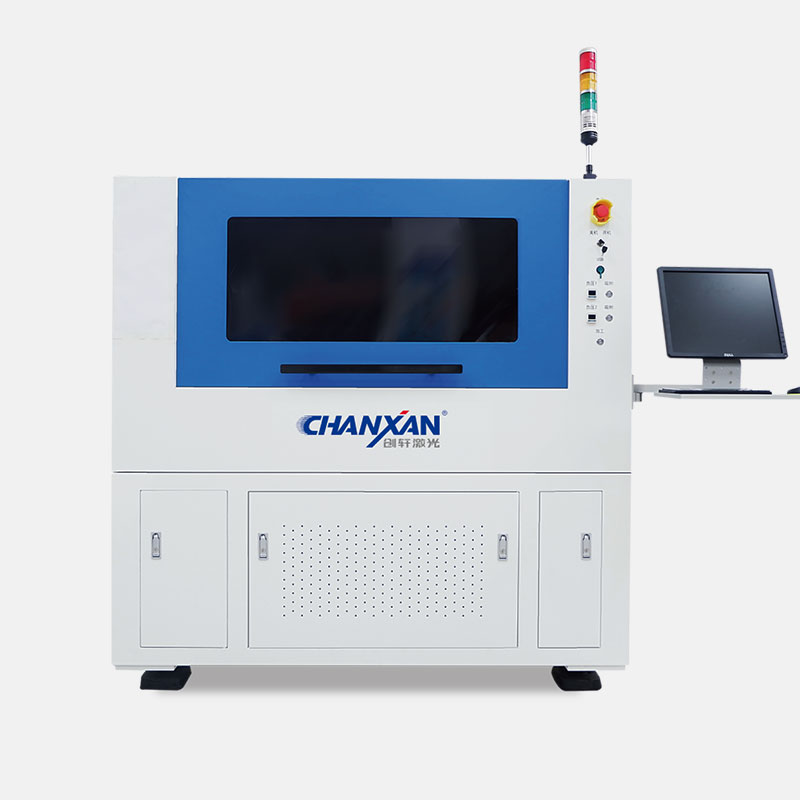
High-Power Picosecond UV Laser Integration: Equipped with industrial UV (355 nm) picosecond laser engines delivering high single-pulse energy and repetition rates up to 2 MHz. Ensures cold ablation without thermal damage or burrs on delicate PI, PET, and optical substrates.
Precision Web Unwinding & Dynamic Tensioning: Features tension feedback controllers and automatic edge-alignment systems, accommodating web widths up to 650 mm while maintaining web tension stability within ± 1 N.
Sub-Micron Vision & On-the-Fly Processing: High-magnification coaxial vision systems dynamically track register marks, enabling continuous high-speed cutting and precision drilling with overall placement accuracy ≤ ± 8 μm.
Automated Sheet Singularization & Stacking: Fully integrated vacuum pickup or air-floating drop systems automatically sort, stack, and transport cut sheets, dramatically reducing manual handling contamination.
As manufacturing paradigms move toward flexible, light, and thin functional materials, roll-to-sheet picosecond laser processing stands at the forefront of advanced production automation. By combining ultrafast non-thermal laser ablation with continuous web automation, industrial manufacturers can achieve exceptional edge quality, higher throughput, and reduced operational costs across flexible electronics, semiconductor packaging, and green energy applications.
| Free solution
Previous: High-Precision Polyimide Film Laser Cutting: The Ultimate Processing Solution for FPC Manufacturing
Next: Precision Laser Processing of Thin Films: Technologies, Applications, and Equipment Solutions