
Key Words: Silicon Wafer Dicing PCB Depaneling Glass Cutting
Home > News > Company News
【Description】:
Evaluating selective laser ablation of 4-ply PET/Aluminium composite film using the Chanxan CW-6050Z 355nm nanosecond UV laser system, delivering a 12-fold processing speed increase over picosecond solutions.
When a Chinese manufacturer of flexible electrothermal elements set out to replace their chemical etching line with a dry, mask‑free process, they faced a deceptively simple requirement: remove the top insulating PET layer from a four‑ply composite film, precisely exposing the aluminium foil beneath, without damaging that foil—and do it fast enough for roll‑to‑roll production.
The material was a composite film with a clear hierarchy: PET (insulating topcoat), aluminium foil (the functional heating layer), PE adhesive, and PET backing. Their target was to create heating circuit patterns by opening windows along predefined traces—essentially converting the film into a flexible heating element for electric vehicle battery packs and smart home thermostats.
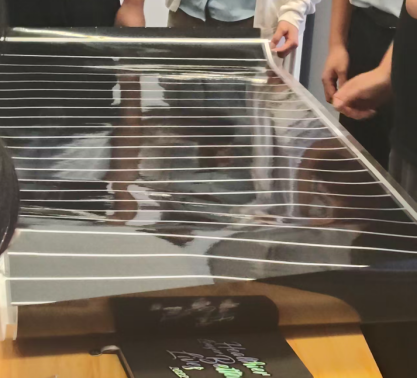
The top PET layer had to be completely vaporised with zero residue.
The aluminium surface had to remain pristine with no melting, oxidation, or pinholes.
The heat‑affected zone (HAZ) had to stay below 100 µm to prevent short circuits between adjacent traces spaced just 0.5 mm apart.
Neither traditional method was acceptable for a production line targeting >95% yield and sub‑minute cycle times per heating unit. That’s when the project team turned to advanced laser processing—and quickly realised that not all lasers are created equal for multilayer film laser processing.
Polymer films like PET absorb strongly in the ultraviolet spectrum. A 355 nm laser doesn’t melt the material; it breaks molecular bonds via photochemical decomposition, effectively chipping away the layer with minimal heat diffusion. Infrared wavelengths (1064 nm or 9.3 µm CO₂) would have produced molten edges and a heat‑affected zone wider than 200 µm—ruling them out immediately. So the choice narrowed to UV laser film processing, but the pulse‑width decision proved far more interesting.
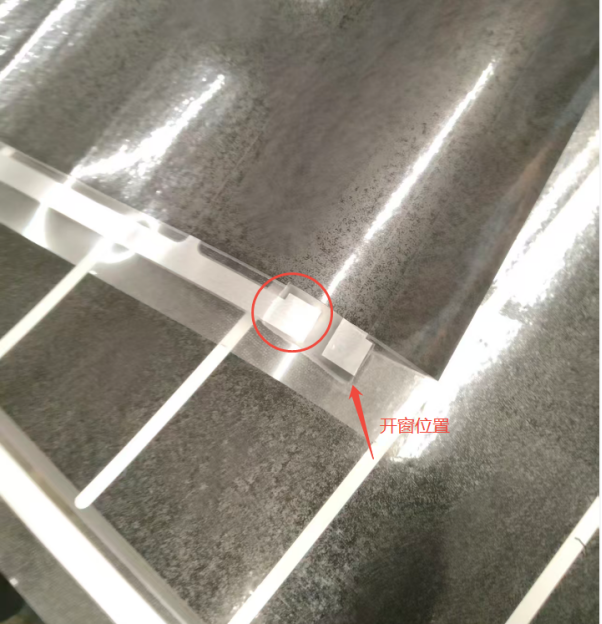
The client initially considered a picosecond UV laser, attracted by its ultra‑low thermal impact. However, a side‑by‑side trial revealed a dramatic trade‑off. Picosecond sources deliver high peak power but very low single‑pulse energy—typically less than 50 µJ. To uniformly ablate a 50 µm PET layer, the scanner must trace dense hatch lines with tiny overlap, forcing the galvanometer to make thousands of extra jumps. For a typical heating window of 20 × 20 mm, the picosecond system took nearly two minutes.
In contrast, the nanosecond UV laser (355 nm, 15 W average power, 200 kHz repetition rate, ~12 ns pulse width) offered >200 µJ per pulse. With a 35 µm spot and 25 µm hatch spacing, it cleared the same window in just 10 seconds—a 12‑fold improvement in throughput.
| Parameter | Picosecond UV Laser | Chanxan Nanosecond UV Laser |
|---|---|---|
| Single Pulse Energy | <50 µJ | >200 µJ (Tuned to 75 µJ) |
| Processing Time (20×20mm) | ~120 seconds | 10 seconds (12× Faster) |
| Heat-Affected Zone (HAZ) | 10–20 µm | ≤20 µm (Spec 100 µm) |
| Cost & ROI Efficiency | High capital expenditure | High ROI / Production Ready |
Yes, the nanosecond laser produces a slightly wider heat‑affected zone (60‑80 µm un-optimized versus 10‑20 µm), but the client’s subsequent lamination process covers the aluminium surface, making minor edge oxidation differences irrelevant. Given that cost per watt is also significantly lower for nanosecond sources, the decision was clear: nanosecond UV was the pragmatic, production‑ready winner.
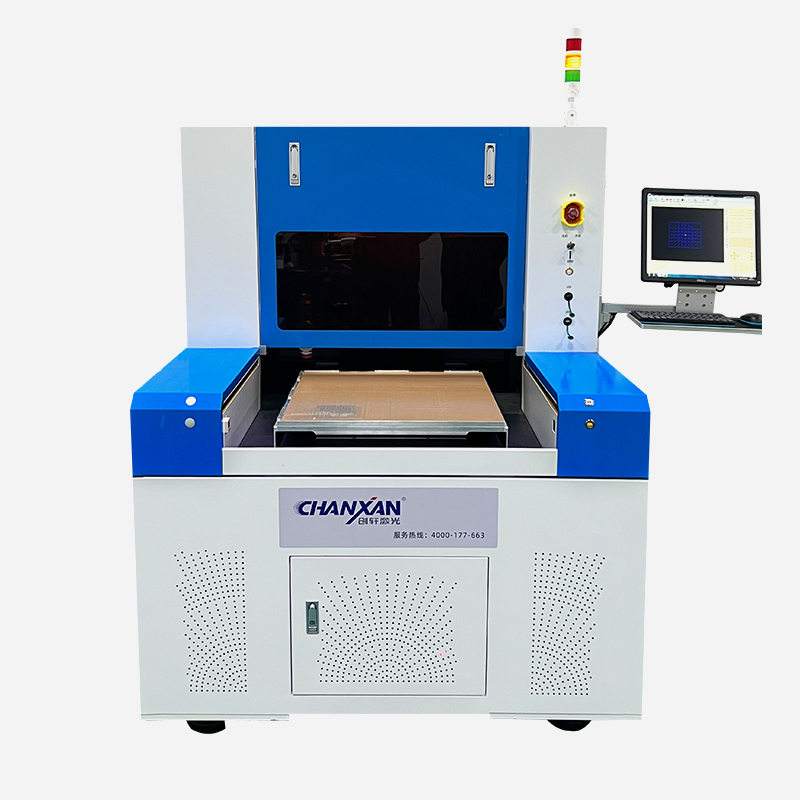
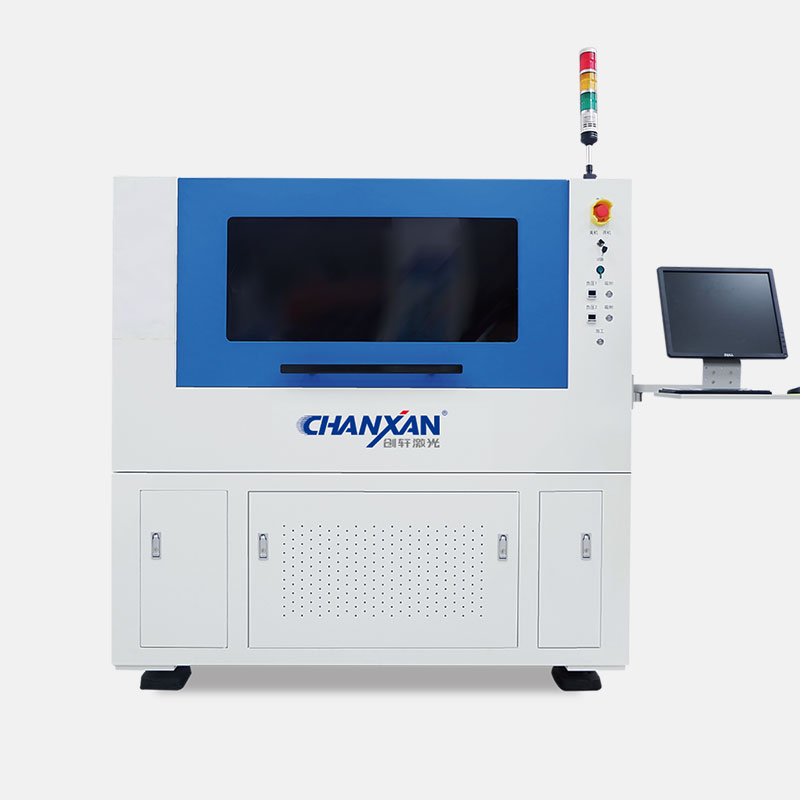
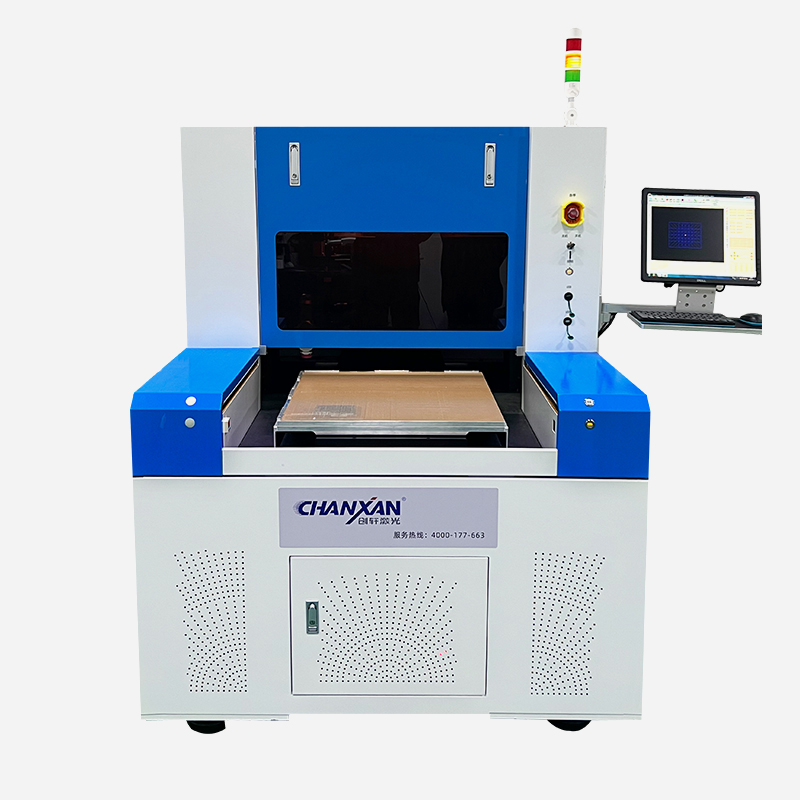
At the core of this roll-to-roll production line is the Chanxan CW-6050Z nanosecond laser micromachining system. For this specific application, we equipped it with a 355 nm ultraviolet (UV) laser source (15 W average power)—a wavelength chosen specifically to match the high photon absorption of the 50 µm PET layer, enabling clean photochemical decomposition rather than thermal melting.
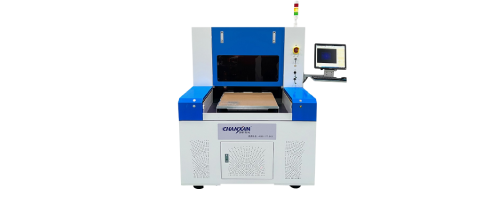
The closed-loop control is seamlessly integrated with Chanxan’s proprietary software, which accepts standard CAD formats (DXF, DWG, AI, PLT, BMP, and LAS).
After ablation, the system’s optional automation interfaces allow this entire process—from unwinding to inspection to rewinding—to run continuously with minimal operator intervention. Finally, the qualified rolls are laminated with a protective cover film and rewound, ready for electrode attachment. The entire cycle per typical heating window (20 × 20 mm) takes just 10 seconds.
This project is a compelling example of how composite film laser processing can be tailored to real‑world production constraints. The key was not chasing the highest‑spec laser, but matching the selective laser ablation parameters to the specific material stack—PET over aluminium—and accepting a slightly larger HAZ in exchange for a 12‑fold speed gain.
Today, the same solution is being evaluated for flexible circuit coverlay opening and OLED thin‑film encapsulation patterning. But for now, it has already delivered one clear victory: transforming a tricky multilayer film into a high‑yield, high‑speed heating element production line—without a single drop of chemical etchant.
From flexible electronics and precision glass processing to complex multilayer film ablation, Chanxan Laser designs custom laser equipment tailored to your exact material, yield, and throughput targets. Send us your samples for process verification and proof-of-concept testing!
| Free solution
Previous: Troubleshooting X/Y Axis Motion Faults in Laser Machines: A Practical Guide
Next: LaserCAD Machine-Software Communication Failure: Complete Troubleshooting Guide